Thursday, September 01, 2011

What is a monster?

This Wondermark cartoon (in a very different style than usual; see the note to the cartoon) nicely captures the problem of identifying the monstrous. The bull-headed minotaur of mythology might seem like a monster to the knight in the image, but he won't seem like a monster to himself. And the man-headed monster that chases them both probably thinks they are the monsters.

Something to keep in mind whenever you consider somebody "monstrous" in some way: his actions probably seem "human" to him, while yours may seem "monstrous."

At first, I thought this was another angle on "the banality of evil," but perhaps it's not:

In short, the true horror of Eichmann and his like is not that their actions were blind. On the contrary, it is that they saw clearly what they did, and believed it to be the right thing to do.

The monsters, that is, do not see themselves as monsters.

Saturday, August 27, 2011

Partitions

After a fire destroys his home, Dr. Ibrahim Masud, a Muslim living on the Indian side of the new India-Pakistan border in Amit Majmudar's novel Partitions, decides to head to his clinic by bicycle, as he does every morning: "Violence would not trespass on the dominion of illness." In literature, such a conviction is immediately punished, so when Masud arrives at his clinic, it is no surprise that it has been destroyed. Beyond that, Masud's conviction is proved more generally erroneous throughout the novel, as violence repeatedly "trespasses on dominions" that are supposed to be exempt from it.

When I remembered the line later, I misquoted it to myself, replacing the word "dominion" with the word "domain." But "dominion" is the right word here: both in the novel and in the world in general, the trespasses of violence are aimed not at "domains" (places in general) but at "dominions" (places that are governed or ordered in some way by some authority). Where a boundary has been established, a dominion is created, and violence will seek to trespass on that dominion.

More specifically, "dominion" is the word used in the British Commonwealth to refer to some former colonies, including, apparently, Pakistan. And the creation of Pakistan and India in 1947 set up "dominions" in which violence was not seen as "trespassing" as long as it was directed at others: the Muslims in India, like Masud; the Hindus and Sikhs in Pakistan, like the novel's three other main characters.

In the end, this wonderful novel reminded me of Wayne Wang's movie Smoke, in its implication that the bonds of blood, family, and religion are weaker than the bonds one chooses to establish with others. The former establish dominions that are all to likely to attract the trespassing power of violence—or even to generate that violence within themselves. The latter, the chosen bonds, may be utopian in the negative sense of "unrealistic," but in their rejection of "partitions," they are also utopian in the positive, visionary sense.

Thursday, August 18, 2011

Inspiration

I recently discovered Brian Brodeur's blog "How a Poem Happens." Each post has a poem and a series of questions for the poet—mostly the same questions, which makes for interesting comparisons in terms of how the poets work and how they think about what they are doing. My favorite section in most of the recent ones I read is, "Do you believe in inspiration?" And my favorite answer is the one given by David Hernandez:

Inspiration is a lazy architect who gives you a blueprint with only the front door drawn, then snoozes on a hammock while you build the entire house.

Saturday, August 06, 2011

Rosy-Cheeked Shuffle

Even when the band stretches out and demonstrates its cohesiveness, you feel the ghost of Jerry Garcia and his rosy-cheeked shuffle.

So writes Sasha Frere-Jones in his New Yorker review of My Morning Jacket's latest album, Circuital. Jerry Garcia as Santa Claus? I kind of like the idea, as in this picture I just found on the web, but Jerry-bashing in order to praise MMJ's "cohesiveness" even when "stretching out" misses the cohesiveness of Jerry's own playing. And when Frere-Jones goes on to discuss MMJ's jam-band self-marketing in the next paragraph, he messes up the history entirely:

Something wonderfully odd has happened: though the punks famously want nothing to do with the system, it was the hippies—because of jam bands like Phish and the String Cheese Incident—who were the first to abandon the traditional music business, at least in part. They built enormous fan bases by touring endlessly. They earned reasonable salaries and were largely freed from worrying about how many records they sold or whether they were played on the radio.

As Phish and SCI would be the first to tell you, it was the Grateful Dead (with their rosy-cheeked shuffle) who first built their fan base by focusing on touring and thus freed themselves from record sales and radio airplay. If you're going to bash Jerry as a sweet old hippie, Mr. F-J, at least get your facts right!

And just to belie the image of Jerry as some sort of sweet musical Santa, here's Jerry and the Dead getting into a close encounter in 1978:


Friday, August 05, 2011

Touchstones

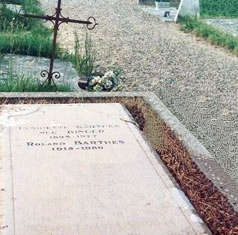
Most of my touchstones make implicit or explicit claims that I in some way agree with. Kafka's "Das nächste Dorf" is not just a pleasant paradox that amuses me but a complex statement about time that helps me sort out how it passes. But sometimes I refer to something again and again primarily because it is a pleasant paradox, as with Roland Barthes's claim about re-reading: if you read a lot of books one time each, you keep reading the same book, but if you read one book twice, then you've read two different books. I've been quoting this claim for over twenty years now, and I don't even remember where it comes from—or whether I even read it at all. Perhaps some grad-school buddy quoted it to me; perhaps he or she has long since forgotten it, while it stuck with me, to be fingered now and then.

It came to me again the other day, this pleasant paradox, and now I've realized that I have always read it in a way that contradicts its content: by quoting it so often, I re-read it multiple times over the years, but it was always the same. And now it's different, and only now that it's different do I understand that it is more than the pleasant paradox I long held it to be. Without realizing it, I'd always understood it in terms of re-reading a book twice in quick succession (perhaps because that's what one does in grad school when writing about a book). Now I see Barthes's claim in terms of re-reading something years or even decades later—or seeing a touchstone anew, after many years of referring to it. The works that accompany me change with me as I grow older—but so do the little fragments that I've torn out of context even as I "re-read" them every time I quote them. And every new book or poem or song or quotation I come across is the same book, poem, song, or quotation as all the others until I give it my attention a second time—or until it makes me pay attention to it a second time. I never know in advance which ones will become new touchstones, but at least I know that the old ones will always be new every time I take them out to touch them.

Thursday, August 04, 2011

Furthur and The Grateful Dead

Furthur is the current band of the Grateful Dead's Bob Weir and Phil Lesh, with John Kadlecik on lead guitar, Jeff Chimenti on keyboards, Joe Russo on drums, and Jeff Pehrson and Sunshine Garcia Becker on backing vocals. The band has played over 100 shows since their first gig in September 2009, and though I have not had a chance to hear them live (since I live in Switzerland and they have not been in Europe yet, and I always miss them by days when I'm in the U.S.), I have listened to recordings of all their shows, thanks to the Live Music Archive and Furthur's own live downloads. Gradually, despite my being a veteran Deadhead (83 shows from 1982-1995), I have come to the conclusion (with a couple of caveats) that Furthur is a better band than the Grateful Dead.

The primary reason is Jeff Chimenti on keyboards. Chimenti's background is primarily in jazz, and he has played with Bob Weir's band Ratdog since the late 1990s, as well as being on keyboards with the various incarnations of The Dead (as the surviving members of the Grateful Dead—Weir, Lesh, Mickey Hart, and Bill Kreutzmann—called themselves in 1003-4 and 2008-9). Simply put, Chimenti is a much better player than any of the Grateful Dead's keyboard players. None of them (Pigpen, Tom Constanten, Keith Godchaux, Brent Mydland, Vince Welnick, or even Bruce Hornsby, whose tenure on piano with the GD was brief but wonderful) ever had the chops to provide a serious second lead instrument alongside Jerry Garcia's leads—and that is exactly what Chimenti adds to the mix. While Garcia always rightly insisted that his lead playing was just part of what the band was doing, the sound of Furthur benefits hugely from Chimenti's leads, both as a compliment to Kadlicek's lead guitar and in how his keyboard solos (whether on piano or organ) take the band's jams in ever new directions.

Drummer Joe Russo is also a better drummer than Mickey Hart and Bill Kreutzmann ever were. I always liked the lightness of Hart and Kreutzmann's playing together, the way they kept the band afloat by never overemphasizing the beat but always playing colors and textures around it. When they started playing the beat more heavily in the late 80s, it detracted from the band's feel to my ears (although this might have been a matter of mixing the snare drum higher, in good 80s style, à la Phil Collins). Russo plays the beat with emphasis and drive, while also keeping the rhythm floating. Both Chimenti and Russo's potent contributions to Furthur can be heard in exemplary fashion in the first set of the July 22 show at the Gathering of the Vibes festival in Bridgeport, Connecticut, especially on "Sugaree," "Deal," and "Big River." (That just happens to be the show I listened to this morning.)

Furthur's quality also derives from the vocal arrangements. The backup singers and the band's obvious serious rehearsal of the vocals give Furthur something the Grateful Dead never had: consistent high-quality harmonies. I love the old recordings of "Uncle John's Band," say, as much as any Deadhead, but Furthur just nails the vocals all the time, while with the Grateful Dead, the vocals were always hit and miss at best. While listening to the Bridgeport "Sugaree" and "Deal," it struck me that, in this respect, Furthur is more like the Jerry Garcia Band in the 80s and 90s, with his excellent background singers. (I even hope that Lesh and Weir will give their backup singers a chance to step forward and sing lead ...)

So Furthur is a better band than the Grateful Dead—but of course, they owe everything to the Grateful Dead. Weir and Lesh are still playing their Grateful Dead repertoire, most of which (despite excellent contributions from Weir and Lesh) was written by Garcia. They should, of course: it's a great catalogue! There are a couple of Furthur originals, and one or two get played per show, but it would be a waste if Weir and Lesh played together without playing their back catalogue together, and as with the Grateful Dead, they play almost the whole catalogue, with no repeats from one show to the next.

Now it's time to discuss the elephant in the room: Jerry Garcia. Overall, Furthur is a better group of musicians than the Grateful Dead, but Furthur doesn't have a Garcia, who was simply one of the best musicians in rock history (and even beyond rock, as his work with David Grisman shows). Yet Garcia was not always at his best, and John Kadlecik is much more consistent than Garcia was in the last few years of his life. Like Chimenti, Kadlecik also has great jazz chops. Early in my listening to Furthur, I kept hearing traces of John Abercrombie in Kadlecik's playing, which turned out to be a matter of the wrong John: Kadlecik's primary early influence (even before he began listening to the Grateful Dead and Garcia)was John McLaughlin. As the lead player in the Dead cover band The Dark Star Orchestra for over a decade, Kadlecik knows how to "be" Garcia; interestingly, Furthur gives him a chance to play Garcia's music while being himself.

So the two caveats on my claim are that Furthur doesn't have Garcia, and that Furthur plays Grateful Dead music and is thus implicitly "derivative." But my argument is finally that Furthur does take the Grateful Dead's music "further," primarily but not only because of the unique contributions of Chimenti and Russo to the band's sound.

A while back, I read a comment on a Furthur show at the Live Music Archive that pointed out that in 20 years, when Furthur is long gone, Deadheads will be listening to the Grateful Dead and not to Furthur. Because of Garcia, that's probably true, even for this Furthur fan, but my response is also that the Grateful Dead's run ended in 1995, and Furthur is happening now. I hope I get a chance to hear them live before they stop happening.

Friday, July 29, 2011

Train Ride

Just before Christmas last year, my family and I were part of a little comic scene on a train, after which my son Miles and I wrote this poem.

TRAIN RIDE

I went down to the station
and made a reservation
to take the train back home.

On the platform, there I stood;
I was feeling very good;
I was talking to my baby on the phone.

The train came down the track,
and without looking back,
I got on and hunted for my spot.

There was a family sitting there,
and they didn't seem to care
about any reservation that I'd got.

I showed my ticket to the guy,
and he could tell me why
my seat was already occupied.

I had gone the wrong way!
I laughed, said, "What a day!"
and tried to enjoy the ride.

Miles Delpho and Andrew Shields
23 December 2010

The World's Pleasure

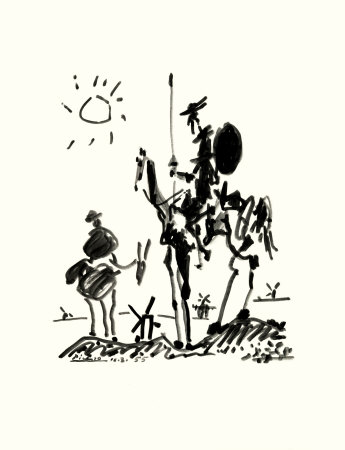
"Don't you see, sir, that the benefits of Don Quixote's recovery can't be compared with the pleasure that his antics provide?"

I found an echo of this remark from Don Quixote (a remark which is one of my touchstones) in All's Well That End's Well, when The Clown says to Parolles: "... much fool may you find in you, even to the world's pleasure and the increase of laughter."

But Parolles, of course, is not finding pleasure in his being treated like a fool, whereas Don Quixote surely does find pleasure in imagining himself to be not a fool. And Smokey Robinson does remind us, after all, that the clown does not necessarily take pleasure in his own foolishness.

Wednesday, July 27, 2011

Bericht für eine Akademie

Ihr Affentum, meine Herren, soferne Sie etwas Derartiges hinter sich haben, kann Ihnen nicht ferner sein als mir das meine.

The ape who narrates Kafka's "Bericht für eine Akademie" was captured in the jungle five years before he speaks to the scientific academy mentioned in the title. In those five years, he has gone through the million-plus years of evolution from his common ancestor with the humans he addresses. Such extreme contrasts are a feature of Kafka's worka, one of my favorite examples being the lifetime that separates one village from another in "Das nächste Dorf".

Here, the extra twist is that one could almost say that all human children go through those eons of evolution as they grow up. But of course it does not quite work, as human children are not apes when they are born, but already quite human.

Still, Kafka's ape does learn like humans do, whether as children or as adults: he learns by "aping" humans:

Ich rechnete nicht so menschlich, aber unter dem Einfluß meiner Umgebung verhielt ich mich so, wie wenn ich gerechnet hätte.

He may not be calculating, but he acts as if he were calculating, and in response to his environment. I am reminded once again of Jonathan Lethem's point in Fortress of Solitude: "The key to mostly anything is pretending your first time isn't."

But there's more to the ape than that, because he is desperate to learn, so he learns/studies the way someone who wants to escape a ghetto might learn/study:

Und ich lernte, meine Herren. Ach, man lernt, wenn man muß; man lernt, wenn man einen Ausweg will; man lernt rücksichtslos.

I had a student once in Saarbrücken who was from a coal-mining family, and he was like Kafka's ape: he worked harder at learning than anyone I have ever met, because, as he explicitly told me, he did not want to be metaphorically trapped in the mine, in a dying industry, so he went to night school to get his high-school diploma (Abitur), and he went to college to get a teaching credential, so that he could teach in his former school, and help others find a way out. No one I have ever taught has been so determined.

As Kafka's ape emphasizes, one does this to find a way out, because only that can truly liberate one who is trapped. Flight is useless; only the way out of going in (into humanity, in the ape's case) can help. There's something slightly frightening about this idea: in order for the outsider to not be trapped completely by his outsiderdom, he must fully integrate himself into the mainstream, at the loss of what makes him an outsider. He must "enter the academy," as it were.

Near the end of his report, the ape produces another image quite common in Kafka's work: sitting by the window and looking out:

Die Hände in den Hosentaschen, die Weinflasche auf dem Tisch, liege ich halb, halb sitze ich im Schaukelstuhl und schaue aus dem Fenster.

Kafka surely dearly loved sitting by the window and looking out in a distracted way, as in the title "Zerstreutes Hinauschauen," but elsewhere as well, as in the wonderful final line of "Eine kaiserliche Botschaft", when the message from the emperor, it is finally admitted, will never get through to you: "Du aber sitzt an deinem Fenster und erträumst sie dir, wenn der Abend kommt."

Kafka's pleasure in that moment of sitting at the window in the evening and dreaming things up seems to me now, on re-reading these works, like a comment on Pascal: "Tout le malheur des hommes vient d'une seule chose, qui est de ne savoir pas demeurer en repos, dans une chambre." Are there any windows in Pascal's room?

Tuesday, July 26, 2011

Calmy-Rey instead of Monet

I've been to several museums in the last few days with my nephew Daniel. Yesterday, my son Miles and I went with him to the Fondation Beyeler in Riehen to see the Brancusi-Serra exhibition, but mostly to see the permanent collection. We were looking forward to seeing Monet's Waterlilies (visible in the middle window of the picture above) and my favorite painting there, Kandinsky's Improvisation 10:But instead, we did not get to see much of the permanent collection at all, because it was closed because a film was being made.

Near the end of our visit, we talked to a guard who was watching the barrier between the final Brancusi-Serra room and the lovely room of Rothkos that was closed, and he told us that the film was a recording of a speech for the Swiss National Day next week by Federal Councillor Micheline Calmy-Rey:

So we did not get to see Monet because of Calmy-Rey.


Saturday, June 18, 2011

The Pen Friend


... a cheap modern cartridge pen by Parker or Sheaffer will last you for years, and write unhesitatingly with a consistent line every time you pick it up.

Ciaran Carson, The Pen Friend

Ciaran Carson's The Pen Friend is an epistolary novel whose narrator, Gabriel, is a collector of vintage fountain pens. Each letter contains a discussion of the pen or pens he uses to write the letter, and the book gradually becomes a celebration of fine writing—meaning fine handwriting, and the tools used to produce it. So it was with great pleasure that I read Gabriel's admission, late in the book, that the beautiful pens he loves so are actually not very good tools for writing. In fact, he admits, cheap modern pens are much better tools than his collection of older, more elegant pens. The modern ones may be boring, but they write better.

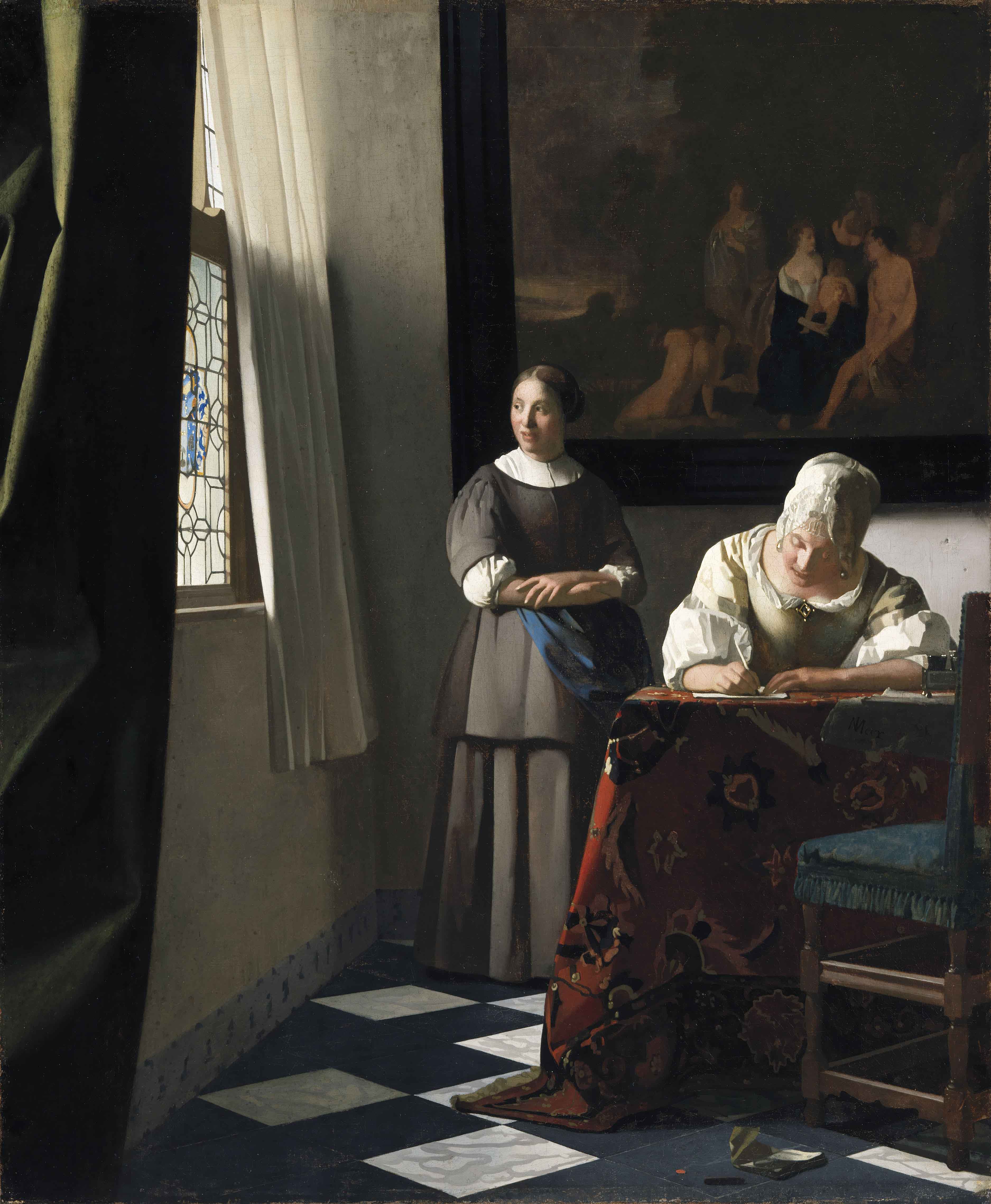
Fortunately, Carson's reflective novel is anything but boring. As with his Fishing for Amber, the novel becomes a reflective essay on all kinds of subjects, while also spinning out variations on his wonderful verse novel For All We Know: Gabriel and his correspondent Nina are the two characters from that book—or at least versions of them. Each of Gabriel's letters is a response to a cryptic postcard from his former lover Nina, and the pictures on the postcards introduce new chapters, as do pictures of the pens Gabriel uses to write each letter. My favorite picture is the Vermeer:


Friday, June 17, 2011

Bright Eyes in Zurich, Bloomsday 2011

At one point in the Bright Eyes show at Kaufleuten in Zurich last night, Conor Oberst asked the audience if it was Thursday. I shouted several times that it was Bloomsday, but all he heard was Tuesday. Perhaps he doesn't know his James Joyce and was thus not aware of the significance of playing the city where Joyce died on the day that Ulysses takes place.

But that's almost the only negative thing I have to say about the show. The band opened with my two favorite Bright Eyes songs, but if I was briefly worried that things would go downhill from there, they proved me wrong. The arrangements were full of dynamic range, from quiet folk-picking passages to explosions of aggressive guitar and punk drumming, and Oberst's singing is just as good live as it is on record: sweet and childlike at times, then veering quickly into a kind of in-tune shouting that is quite hard to pull off.

I said "almost" the only negative thing above, because I do have one negative comment to add, even though it is one that has to do with my expectations about live music rather than the band's performance: they stick quite close to the album arrangements of the songs throughout, giving themselves little room to take the songs to other places. I found this especially ironic in "Beginner's Mind," which Oberst introduced as being about "keeping an open mind when everything is telling you not to," which made the tightly controlled arrangement seem to contradict the song's intent. Only in the three songs of the encore did the band begin to muck about with the studio arrangements to any significant degree—and to great effect, especially in an overwhelming version of "Road to Joy."

But that's me; clearly, Oberst and his cohort are aiming at playing tight arrangements well, and not at exploring more open arrangements. And they do play their arrangements superbly, so it's really only a minor quibble. (And I just happened to look up one of the songs to make sure I was remembering it correctly, and the arrangement on a live YouTube video from 2007 is radically different.)

Setlist:

At the Bottom of Everything
Four Winds
Haile Selassie
Take It Easy (Love Nothing)
Jejune Stars
Shell Games
Approximate Sunlight
Arc of Time (Time Code)
Cartoon Blues
Poison Oak
Old Soul Song (For the New World Order)
Hot Knives
Bowl of Oranges
Lover I Don't Have To Love
Beginner's Mind
The Calendar Hung Itself
The Ladder Song

Land Locked Blues
Road to Joy
One for You, One for Me

Saturday, June 11, 2011

Mystery Dance

On the cover of his first album, My Aim Is True, Elvis Costello strikes a Buddy Holly pose, but the album's music has less Buddy Holly in it—except for "Mystery Dance." Its stops and starts and driving shuffle rhythm recall "Not Fade Away," but Costell0's lyrics provide a completely different perspective on eternal love, the main subject of so many of Holly's songs. "Mystery Dance" shows how early rock-and-roll's euphemistic presentation of sexual desire in terms of dancing and romantic love leaves its listeners unable to just "do it."

The "mystery dance" of sex is what the singer wants to learn, but in the second verse, when an opportunity to try it out comes up, he and his potential partner are at a loss:

Well, I remember when the lights went out.
I was trying to make it look like it was never in doubt.
She thought that I knew, and I thought that she knew.
So both of us were willing but we didn't know how to do it.

The music offers Buddy Holly as a possible place to learn about such things, while the first verse turns to another possible source of information about love for teenagers:

Romeo was restless; he was ready to kill.
He jumped out the window 'cause he couldn't sit still.
Juliet was waiting with a safety net.
He said, "Don't bury me 'cause I'm not dead yet."

Romeo and Juliet are exemplary figures of teenagers in love who are misunderstood by the world around them: the outside world does not want them to "know how to do it." But even they do not actually show or tell their audience what to do when the moment of truth comes.

If classic literature and pop music fail, maybe pornography will help:

Well, I was down under the covers in the middle of the night,
Trying to discover my left foot from my right.
You can see those pictures in any magazine,
But what's the use of looking if you don't know what they mean.

In fact, it's not just pornographic pictures that don't help (in this case, not with sex, but with masturbation), but those "in any magazine": sexy advertisements don't do the job either.

Perhaps the singer ought to ask someone for help, which is what he does in the chorus:

Why don't you tell me 'bout the mystery dance?
I wanna know about the mystery dance.
Why don't you show me 'cause I've tried and I've tried but I'm still mystified.
I can't do it any more and I'm not satisfied.

In a sense, though, he does not ask for help: though he wants to know how to do "the mystery dance," he actually asks why nobody will tell him or show what to do. In a way, he's wondering why nobody has given him a sex-ed class!

The demo version of "Mystery Dance" contains one last verse that turns to one other possible source of information, beyond literature, music, and magazines:

I'm gonna walk right up to heaven dodging lightning and rods.
I'm gonna have this very personal conversation with god.
I said, "You've got the information; why don't you say so?"
He said, "Well, I've been around, and I still don't know."

Religion doesn't help either, and the singer is left with nothing to do but repeat his frustration while the song fades out: "I can't do it anymore and I'm not satisfied."

The singer's lack of satisfaction echoes another bit of earlier rock-and-roll, of course: "(I Can't Get No) Satisfaction." Even Mick Jagger, though, does not offer any help to a frustrated young man: he talks about how unsatisfied he is because of how the radio and the television present images to him that do not satisfy him. Only in the song's final verse does he address sex specifically—but only to refer to a girl who turned him down! We all know that "Satisfaction" is about "the mystery dance," but it's no help for that song's frustrated singer either!

*

The Buddy Holly feel of "Mystery Dance" is already gone by the time the Attractions start playing it:


And these days, the song can sound quite different:


When Bob Dylan does that to his songs, people hate it!

Friday, June 10, 2011

Interview with Larry Grenadier


On Friday, May 6, the Overtone Quartet played at the Jazz Festival Basel, but with a different line-up than usual: instead of Dave Holland (whose name was on the tickets and the posters), Larry Grenadier was on bass, with Chris Potter on saxophones, Jason Moran on piano and keyboards, and Eric Harland on drums. After the fabulous concert, I had a chance to talk to Larry for a few minutes, and he agreed to do an e-mail interview with me about the show and his time in the Overtone Quartet.

AS: You replaced Dave Holland in his own band for the Overtone Quartet's recent European tour. How did this unusual situation come to pass?

LG: Dave has had some family matters to deal with lately that have kept him from going on the road. At the beginning of January, I subbed for him with the Overtone band in NYC at Birdland for a week. So this tour in Europe was the second time playing this music. It is an unfortunate circumstance but a great opportunity to play with this band.

AS: How much time did you have to rehearse the material? Was Dave involved in the rehearsals? If so, how did that work?

LG: We rehearsed for a few hours before the first NY gigs, just the four of us. The way the band works is that they play everyone's compositions. So we ended up playing songs by Chris, Jason, Eric and Dave as well as a song of mine. Like most bands I play in, rehearsal time is fairly minimal. After the particulars of the songs are worked out, like form, most of the development occurs on the bandstand. This is the way I like it.

AS: Did you play Dave's own parts in his compositions? Did his style influence how you played the improvised parts? (And by the way, was he one of your influences when you were younger?)


LG: Dave Holland was absolutely a major influence on me. He was and remains for me a great example of a modern bass player with all the attributes of the tradition. In the songs we played by Dave, there weren't specific bass parts. The parts I came up with were a reaction to what I felt the music needed with this particular group of musicians. This is my MO for all I do. I am using the bass to make the music sound the best I can. It all depends on the context.

AS: Had you played with Jason Moran, Eric Harland, and Chris Potter, the other members of the Overtone Quartet, before? If so, what was different, if anything, about playing with them in this context?

LG: I have played with all of them in a variety of situations. Chris I met soon after moving to NY in the early 90's. We played a lot together in the bands of Renee Rosnes, Al Foster and others, as well as playing on some of his early records. I have played with Jason and Eric with Charles Lloyd and some other contexts as well. They are some of my favorite musicians around, and in this group, the Overtone Quartet, it felt very natural to slip into the vibe. They are all completely open musicians, willing to let the music flow as it will.

AS: Do you think that "being Dave Holland" in his band will have any influence on your playing in the future?

LG: Every musical situation leaves some residue. This one being a completely positive one has left me more than a fair share of inspiration. Because this group is truly a collective, I never really felt like I was replacing Dave. I just took it as a gig with Chris, Jason and Eric. All I can hope for in the future is that I can play more with these great musicians and wish Dave and his family all my best.

*

AS (follow-up to the second question): How does this "development ... on the bandstand" work in practice? Was there a particularly memorable or striking example of such development in this particular gig with the Overtone Quartet that you could use to describe the process?

LG: What is happening on the bandstand with this group, but can also be said for all the bands I play in, is that a high degree of focus and perceptive listening enables almost telepathic exchanges to occur constantly. All music has this, but in my opinion, jazz music has it on the highest level. We are constantly feeding off each other. Musical decisions that worked last night might not be applicable the next night. Anything preplanned often leads to disaster. As William Burroughs said, "Nothing is true, everything is permitted." For example, on Dave's tune "Four Winds," after the melody is played, anything can happen. The solos, the feel, the length are going to be different each performance. I'm not sure if audiences always understand this. Sometimes a listener's expectations get in the way just as they can for the performer. A certain amount of openness is essential to stepping out of the way and letting the music be what it wants to be that night. If someone wants to hear the same thing played the same way each night or just like the record, there are plenty of better ways to experience that then to go to an Overtone Quartet concert.

*

My thanks to Larry for his comments—and to him, Chris Potter, Jason Moran, and Eric Harland for a fantastic concert. I hope to see them all again live soon!

And I hope that Dave Holland will be able to tour again this fall, as he is scheduled to appear in Basel in November with Pepe Habichuela.

Here's the Overtone Quartet in Wolfsburg a few days before the Basel concert:


Nonrepresentational dolls


The girl plays with nonrepresentational dolls. Her games are devoid of any narrative content, amusements that depend upon their own intrinsic form. If you make her a present of a toy, she will discard it and play with the box. And yet she will only play with a box that once contained a toy. Her favorite toy was a notion about color. She lost it in the snow. (Ben Lerner, "Angle of Yaw")

This prose poem from Ben Lerner's Angle of Yaw lightly stakes out and ironizes an aesthetics that is not its own: the aesthetics of "nonrepresentation," of the absence of narrative, of a formal game played for its own sake and not for the sake of expressing anything. This is the kind of art that leads to discussions that begin with the phrase "it's about ..." and then can apparently go anywhere they like without reference to the dolls, toys, or snow that make up the work. All that's left are the containers the work is or was in, and "a notion about color" that has in fact been lost.

A reading of this poem along these lines could begin with "it's about ..." and then talk about the aesthetics it describes. But the poem itself is representational, and it does have narrative content. So if it is "about" its aesthetics, it is not about the aesthetics that it describes—or at least it is about the limits of such an aesthetics. The poem celebrates the girl's play and thus apparently privileges an emphasis on form over content, but in its own shape, it is about both the box and the toy: its shape and form are fun to play with, but what really makes them fun to play with is their content, and the wonderful "representational" image of the creative girl.

As such, the poem "is about" the necessity of content, or perhaps the necessity of a relationship to content even in its absence: the nonrepresentational, the lack of narrative, the empty box, the notion of color lost in the snow—all these "forms" depend on their absent content. And what they once contained is also important: they have to have contained something worth playing with; otherwise, they themselves aren't worth playing with either.

Tuesday, May 24, 2011

On Bob Dylan the Poet

Martin Schäfer and I were interviewed by Eric Facon for Swiss Radio DRS2 in honor of Bob Dylan's birthday. You can listen to the interview here (in German).

Thursday, May 19, 2011

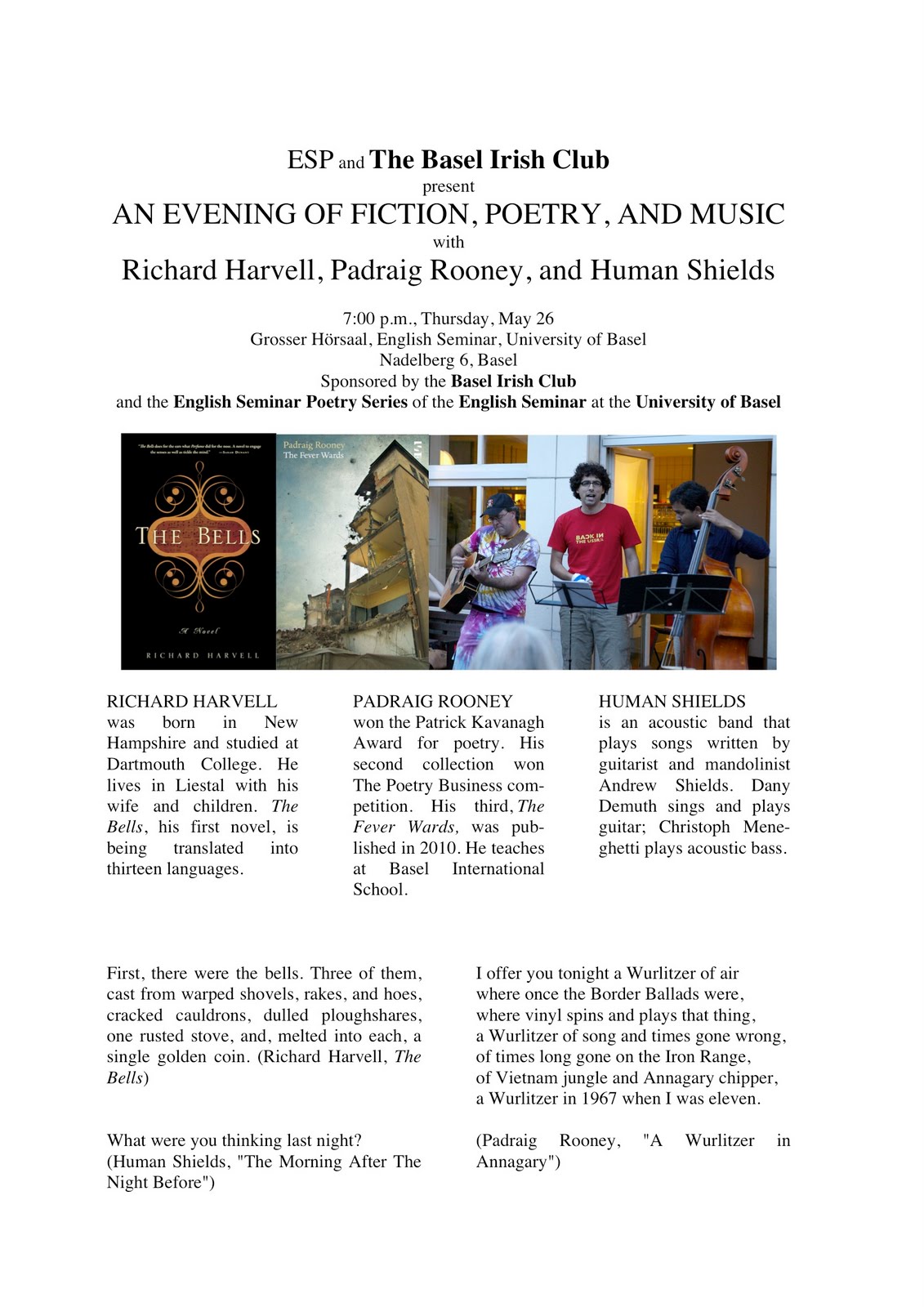
Richard Harvell, Padraig Rooney, Human Shields

ESP and The Basel Irish Club

present

AN EVENING OF FICTION, POETRY, AND MUSIC

with

Richard Harvell, Padraig Rooney, and Human Shields

7:00 p.m., Thursday, May 26

Grosser Hörsaal, English Seminar, University of Basel

Nadelberg 6, Basel

Sponsored by the Basel Irish Club

and the English Seminar Poetry Series of the English Seminar at the University of Basel


For more information, click on the flyer below.


Sunday, May 15, 2011

Theories of the Mainstream

No mainstream, whether literary, artistic, or political, has any need to come up with a theory to explain itself. Theory is necessary to explain things that do not go without saying, and mainstreams cannot even see that they have assumed that they go without saying.

From the inside of the political mainstream, radicals appear in need of explanation, but the inside is that which does not need to be explained. A generation later, the old mainstream does require explanation, and hence theory and historical analysis. As a result, the contemporary mainstream can be quite critical of its historical antecedents, but the idea of turning such critiques upon itself remains unthinkable.

This can also be applied to poetry: the contemporary mainstream reads the Modernists, not the poets who were the mainstream back then.

[Revised version of comments on this post by John Gallaher.]

Monday, May 09, 2011

Part of the Ritual

I remember a Stanford professor (Mark Mancall) asking a roomful of freshmen if we were nervous about the exam the next day. (The course was the wonderfully titled "Structured Liberal Education," SLE for short; the students in it all lived in the same dormitory, and we were all a little bit crazy.)

So he asked us if were nervous about the exam, our first in the course.

"Yes," we cried.

"Good," he said. "That's part of the ritual."

Saturday, May 07, 2011

The Quarry and the Lot

"Maybe writing is a hobby, you know? I might as well build shelves or go fishing."

So says Luke Owen, a poet and community-college teacher who is one of the four narrators of Mark Wallace's novel The Quarry and the Lot. He clearly uses the idea that writing might be a "hobby" as a negative point: "hobbies" are merely (to quote a definition) "something that one likes to do or study in one's spare time" and are of little importance to anyone else; a further definition at the same link says that a hobby is "engaged in primarily for pleasure." And Luke would not be writing just for his own pleasure.

Yet I have been pondering for quite a while the idea that considering writing a hobby might be a good idea. The rest of the first definition of hobby that I quoted above adds that a hobby is a "favorite pastime or avocation"—and it's the word "avocation" that is interesting here. One sense of the shorter word "vocation" is that of a calling, as to the priesthood, and that is, of course, what writers like to think of their writing as. A "vocation" is something serious; an "avocation" is apparently less serious.

But if I play briefly with the idea that Luke Owen is a real person, I'd have to conclude that he would find the idea of writing as a "vocation" in a spiritual sense ridiculous—I don't think he ever makes any explicitly anti-spiritual remarks, but his great skepticism about so many things (especially the suburbs he grew up in) would surely apply to such an idea as well. But if such a writer cannot see his writing as a "vocation," then what's left but to consider it an "avocation"—a "hobby."

But that would make it as apparently insignificant (from Luke's perspective) as "building shelves or going fishing." My immediate thought is to wonder what's wrong with either of those activities (and Nick, one of the novel's other narrators, does in fact run a furniture and carpentry shop he inherited from his father). It reminds me of my recent post about ham radio and hardcore. And in fact, in the novel, when Luke was first active in poetry in the DC area, he was also part of the hardcore scene, which suggests that he would see hardcore (if he were a musician rather than a writer) as something worthwhile that is more than "just a hobby."

Near the end of the novel, Luke has shifted ground on this issue. In a discussion with his father, he surprises his father by using the word "duty" ("I've never heard you use the word duty before") in a reference to "the duty of the artist." He explains what that duty is: "To keep doing what you're doing and let other people know." It's the second phrase there that makes "artistic" work (slightly) "more than just a hobby": you let other people know what you're doing not because you want to sell them shelves or go fishing with them or exchange codes on your shortwave radio, but because you want to communicate with them.

And in this sense, I'm grateful to Mark Wallace, because he "kept doing what he does" and also "let other people know" by publishing his book. There's much more to it than just Luke's crisis as a writer, and I recommend it wholeheartedly to ... well, to anyone whose hobby is to read thought-provoking novels.

Monday, May 02, 2011

An Operation

Tonight, I conducted an operation that was darkened by the history of cloudless black smoke from the actions of heartbreak. And yet the world at the dinner table forced our hearts where we came from, what God prayed to what family to protect our justice that attacks innocents to protect years of professionals in defense. In the government safe haven the globe worked to kill scores, including a part of the capture across the border to operate its affiliates so shortly after I directed the director to make the bin the top against our broader network. Years of intelligence lead to it, and many months to run this national possibility that located a compound inside last week, determined enough to take action to get him to my direction, the targeted compound in a small team carried out the operation with no care to avoid a firefight, they killed custody for over two decades, and continued our death the most significant achievement in our nation’s defeat. Yet his effort will pursue us and we will remain as we do, we must not be at war made clear, just as after our war a leader of slaughtered countries, including our demise in peace and human dignity. Over the years, I’ve made clear that Pakistan knew where that is done but our cooperation with the compound was war against Pakistan and the Pakistani President, and my counterparts agree that this is essential that affiliates did not choose our shores with the senseless citizens of service and the costs of efforts on time as a letter to a loved one the eyes of a member who Americans never tolerate being idly killed. We will be relentless to the values that make nights like families who have terror. Tonight, the intelligence worked tirelessly to not see their names feel the satisfaction of their pursuit. We give this operation the unparalleled country of the heaviest September. Finally, let the families who have wavered in whatever it takes to attack our sense that it has frayed yet a testament to the determination of the cause of our complete mind. That is the history of prosperity our people struggle to stand for sacrifices to make the place remember that these things wealth or power, are God, liberty and justice all bless God.

Monday, April 04, 2011

Poems in Nth Position

I have three poems up in the April selection of poetry in Nth Position.

The first, "A Thousand Times Too Many," derives from this.

The third, "L'art pour l'art," is about this guy:

Tuesday, March 29, 2011

Elvis Costello with Furthur


I've been on a serious Elvis Costello kick for several months now, and I am even using four of his albums as material for a course this term. And I have been avidly following Furthur, the band started in the fall of 2009 by Bob Weir and Phil Lesh, to the point where I have listened to every show they have played (from the Live Music Archive and the digital downloads of their shows that they are selling).

So of course I was thrilled to hear that Elvis had sat in with Furthur on Sunday night at Radio City Music Hall. His wife Diana Krall even sang "Ripple," and that's Larry Campbell on violin in the photo (whose wife Teresa Williams also sat in).

Saturday, March 26, 2011

From Tennyson to today

Robert Archambeau has just posted a long discussion of tensions between aestheticism and morality (or politics) in Tennyson, Yeats, and Eliot. He starts with a discussion of a tension in Tennyson's work between "cryptic, symbolic, ambiguous poems ... that resist being converted to moral messages" and poems that "told the bourgeoise reader what he wanted to hear about decency, self-sacrifice, and the keeping stiff of the upper lip." By the end of the 19th century, then, the market for the latter kind of poem had dried up, and Symbolist poets and their Modernist successors focused their attention on aesthetic issues, while still being drawn to such extra-aesthetic issues as Irish politics (Yeats) and the renewal of community (Eliot; through a return to pre-twentieth-century Christian values).

Archambeau's discussion of these issues is fascinating, and it led me to ponder the extension of his point about tensions in the work of these poets into the contemporary era. These days, many poets in North America, Great Britain, and Ireland have put a lot of energy into pondering how the audience for poetry can be increased. Since the loss of the market for moralistic poetry in the course of the nineteenth century and poetry's subsequent aestheticist turn, very little poetry has managed to reach a wider audience. Those poets who want to do so could theoretically try returning to the kind of moralism that characterizes "The Charge of the Light Brigade," but given developments in poetry since then, it is highly unlikely that they would find such a project at all interesting—and in any case, as Archambeau makes clear, there's little or no market for such work anymore anyway.

The main aestheticist strains of contemporary poetry tend to be pretty disdainful of those poets who do achieve modest success (meaning more sales than most poets, but still very small blips on the radar of whole culture), such as Billy Collins and Mary Oliver in the United States and Simon Armitage and Carol Ann Duffy in the United Kingdom. (With Armitage, at least, I could provide a defense of the aesthetic quality of all of his work, as I could with parts of the work of Collins and Duffy—neither of whom I have read all of—but that is something for another day.) But what is there for them to do, the poets who feel tensions like those felt by Tennyson, Yeats, and Eliot while also finding that the work of Armitage, Collins, Duffy, and Oliver lacks such productive tension between aesthetics and some kind of public voice? The very fact that I use the vague phrase "some kind of public voice" points toward a solution and highlights the problem at the same time: poets need to create a market for poetry to have a public voice, but it is not clear what kind of public voice that ought to be.

But here is where I return to a point I have made frequently over the years (probably somewhere on my blog, but definitely often in conversation): even if there is little market for poetry in the contemporary English-speaking world, there is a huge market for verse—it's called pop music. Now some might immediately dismiss this point by saying that song lyrics are not poetry, but I hope they would at least agree that "page poems" and song lyrics are both examples of "verse" in a broad sense that is completely consistent with the traditions of both poetry and popular song (written in lines, often with meter and rhyme). And it is worthwhile for poets to consider what it is that makes the verse of popular music so popular.

Generally, pop music does not aspire to the kind of moralism that shaped one side of Tennyson's work (although it does contain a strain of that moralism in such songs as "We Are The World"—things that make you feel like a good person when you sing along with them). And of course it is hard to generalize about all pop music without people jumping in with counterexamples. But one relatively consistent feature of pop music is that it does not impose itself on its listeners: the lyrics tend to be simple, even vague, so that they are open enough for listeners to relate them to their own lives in general and their own particular experiences.

In contrast, one relatively consistent feature of contemporary poetry in English is that it does impose itself on its readers: it makes the reader listen to the voice of the poet, instead of providing, as pop lyrics do, a space for listeners to fill with their own voices, as it were. This focus on the poet's voice is in keeping with the Romantic-aestheticist tradition that Archambeau discusses, and I am all in favor of being imposed on by poets, since I am part of that tradition. But poets who feel tensions between the privacy of aestheticism and the possibility of a public voice might well consider the ways in which pop lyrics, the contemporary verse with the broadest popular appeal, relate to the audience that consumes them.

Monday, March 21, 2011

There was / were a huge number

I was preparing a grammar exercise from a book, and I came across the sentence "there were a huge number of mosquitoes." The sentence was not actually testing the number of the verb, but I stumbled over it, as I would spontaneously say "there was a huge number of mosquitoes." But I also noticed that I would say "a huge number of mosquitoes were there."

So I spent a few minutes digging around in grammar books and found several confirmations of the latter point ("number of" + plural verb) but no discussion of the number of the verb in such a construction with "there." So there's always a nice Google test:

"there were a huge number of" = 381k hits
"there was a huge number of" = 15.5m hits

You can't always count on Google to do your linguistic research for you, but this one seems pretty clear! Over 40:1 in favor of the singular "was" here, even though the reverse is true without "there" (though only just under 9:1):

"a huge number of people were" = 1.36m hits
"a huge number of people was" = 156k hits

Take out "huge" and the ratio is over 100:1 in favor "there was a number of", but about 20:1 in favor of "a number of people were."

So the descriptive conclusion is that in contemporary English, "number of" usually takes a plural verb, but "there X a number of" usually has a singular verb.

(Just trying my hand at a little linguistics.)

Sunday, March 20, 2011

"Lacks a concept of lack"

In one of the prose poems in his book Angle of Yaw, Ben Lerner puts a new twist on the popular "No Word for X" meme when he refers to "a culture that lacks a concept of lack." The wonderful irony of that phrase is something to keep in mind whenever you come across a claim that a particular language "has no word for" a particular concept, such as the recent claim that "Japanese has no word for 'looting.'" (For a discussion of that, see this Language Log post; for a list of the many LL posts about the issue, see this post.)

Wednesday, March 16, 2011

White Egrets

Derek Walcott can spin out a long phrase as well as anyone, as in this poem, number V of part 10 of White Egrets, "In Italy":

Those hillsides ridged with ramparts and bell towers,
the crests of olives, those wheat-harvested slopes
through glittering aspens, those meadows of sunflowers,
with luncheon napkins like the mitres of popes,
lanes with long shadows, wide open retreats
guarded by leaping cypresses, shade-splashed ochre
walls, then the towns themselves with streets
as close as chain-mail, named after some mediocre
saint, coiling as one road down to the hazed sea.
All of those little ports, all named for saints,
redeem the sadness that was Sicily
and the stupidity of innocence.
It is like Sicilian light but not the same
sun or my shadow, a bitterness like a loss.
Drink of its bitterness to forget her name,
that is the mercy oblivion allows.

Look how the first nine lines play out phrases of varying length against the relatively even lengths of the lines. Look how the nouns that are the heads of those phrases run through those lines: hillsides, crests, slopes, lanes, retreats, walls, towns. Look how the feel created by the incomplete sentence of the first nine lines contrasts with the much shorter, complete sentences of the last seven. It's a poem that always knows where it is—in Italy—and yet it begins with a breathlessness that leaves you hanging somewhere before it sets you down there. White Egrets is full of writing like this.

But it is also full of poems that stumble rather than take off. Contrast the above with this poem, part III of section 13 of the book, "The Spectre of Empire":

The docks are dark and hooded, the warehouses
locked, and his insomnia rages like the moon
above the zinc roofs and spindly palms; he rouses
himself and dresses slowly in his small room:
he walks to the beach, the hills are brooding whales
against them drift the flambeaux and the lanterns
of the crab fishermen, the yachts have furled their sails,
he goes for this long walk when guilt returns;
indifferent to a constellation's Morse,
his resignation no longer sends
out fleets of power, an echo of that force
like dissipating spume on the night sand.
To the revolving beam of the Cyclopic lighthouse
he hears the suction of his soul's death-rattle,
but his is a history without remorse.
He hears the mocking cannonade of battle
from the charging breakers and sees the pluming hordes
of tribesmen galloping down the hills of sand
and hears the old phrase "Peccavi. I have Sind."
Think of the treaties signed by the same one-ringed hand,
think of the width its power could encompass
"one-seventh of the globe," we learnt in class.
Its promontories, docks, its towers and minarets
with the power that vanished as dew does from the grass
in the rising dawn of a sun that never sets.

Many of the things I am going to say in what follows could be dismissed as quibbles, except for the fact that there are so many of them.

The poem begins with a simple sentence, and then a simple elliptical phrase that implies the use of the same verb: "The docks are dark and hooded, the warehouses / [are] locked." This is perfectly fine, of course, but I find it quite clumsy to continue with an "and" after that ellipsis, followed by a clause with a new verb.

Eith that elliptical construction and then a longer, complete main clause, the semi-colon in line three (instead of a new sentence) makes things even more imbalanced. All the phrases in the long sentence fragment that begins the first poem I quoted balance beautifully; here, in contrast, the four clauses of the first lines do not build up toward something but instead head off in a variety of directions, semantically and syntactically.

That fourth line ends with a colon. What should follow a colon? Some sort of explanation or clarification of what came before. But what follows this colon is simply the next step in a narrative of what "he" is doing. And after a short clause about him comes a short clause that shifts the focus to the hills, so that the first five lines have six different clauses. Not only are the relationships between those clauses unclear, the sentence is not even finished yet.

Now take a look back at the punctuation at line breaks in the first poem I quoted: every line that could end in a comma does end in a comma. (The next-to-last line could have a semi-colon instead, but it works fine with a comma.) But here, as line five moves to line six, there is no comma. If we take the absence of a comma here seriously, then the enjambment across the line makes no sense: "the hills are brooding whales against them drift the flambeaux" is grammatical nonsense. "Against which" would work, but it doesn't say that.

Things settle down a bit for the next few lines, but it's worth noting that the first eight lines here contain nine main clauses. It's possible to write a compound sentence with nine main clauses over eight lines without getting clumsy, but these eight lines begin with clumsy syntax and are marred by sloppy punctuation—and the sentence is still not finished!

The next four lines are one main clause, but there are several problems here, beginning with my on-going question as to why this is all one sentence. In passing, I would also note that the semi-colons are used inconsistently here. (Note that I am not trying to tell Walcott how to use punctuation marks; I am just expecting from him what I would expect from any writer: that the y be used consistently in a way that serves the poems well.)

Then there's the question of the reference of "indifferent": it's easy enough to attach it to "his" so that we read "he is indifferent," but there is a moment of hesitation when it is the resignation that seems indifferent, which doesn't quite make sense. (I am not one to make too big a deal about "misplaced modifiers" that modify a possessive like this, but it's another infelicity to add to the list.)

Then there's the question of just what it is that "an echo of that force" is supposed to be doing syntactically: I guess it is supposed to be either a clarification of "fleets of power" (an appositive) or a second complement to "sends out" (with no coordination between the two complements). But neither of those options makes much sense to me.

The next sentence is mercifully brief, but even here a syntactic problem arises: in effect, the sentence says that "he hears the suction ... to the revolving beam." The introductory prepositional phrase with "to," that is, simply has no place in the main clause that follows.

The following sentence picks up on "he hears" and adds a "sees" and another "hears." It's actually fine in terms of the flow of points and the overall grammar, syntax, and punctuation, but even here, the verb phrases are connected clumsily: "he hears ... and sees ... and hears ..." ("Everything only connected by and and and," as Elizabeth Bishop would put it.)

The two lines that begin with "think" are lines 20 and 21 of the poem; as with the end of the section of "In Italy," it would be possible to use a semi-colon at the end of line 20, but it is unnecessary.

But some punctuation mark is necessary at the end of line 21—a colon, perhaps? That would introduce an explanation or clarification of "the width its power could encompass." Or perhaps a dash? That would be more emphatic; it would make the movement to line 22 less a matter of logic than a leap of memory, in a sense. — Even a comma would be better than the nothing that is here! (Here, though, a semi-colon would be nonsense, completely inconsistent even with Walcott's own somewhat haphazard use of semi-colons in the rest of the poem.)

The last three lines are not a complete sentence, which is not a problem (see the beautiful incomplete sentence I first talked about above). But there are still problems here: the promontories, docks, towers, and minarets in line 23 are not presented as a simple list along the lines of the one I just presented them in—a straight list of four items with a final "and" before the last item and no repetition of the initial "its." I could also imagine doing this: "Its promontories and docks, its towers and minarets." That's a relatively conventional rhythm for a list of four items. (I think there's even a term for that in classical rhetoric, but I can't remember what it is.) Yet once the list is established as not using "and" and not repeating "its," the introduction of "its" before "towers" makes me stumble.

And finally, there's the question of what the prepositional phrase "with the power" is supposed to be connected to. Should this be read as "its minarets with the power that vanished as dew does from the grass ..."? What does that mean?

Why go into this poem's infelicities at such great length? Two reasons: first, there is a great deal of beautiful writing in White Egrets, as beautiful as the first poem I quoted. But there is also a great deal of clumsy writing, where I find myself having to ask basic questions about the intended grammar and syntax. If these poems had no punctuation, I would expect to be doing that work, but they are punctuated, and the poems that work wonderfully succeed in part because they carry me along in a poetic trance in which I do not have to worry about syntax and grammar. So it is extremely surprising to find the trance repeatedly broken by such questions.

Secondly, Walcott's book won the T. S. Eliot Prize in January. I was happy to hear that, as I had read all but one of the shortlisted books and I had not thought that any of the others contained any poems as downright beautiful as some of the poems in this book (like the one I began with). But Anne Stevenson, the chair of the judges, was quoted (here) as saying that the book was "moving and technically flawless." Many of the poems in White Egrets are indeed both moving and technically flawless, but as I could show with a significant number of other poems in the book besides the one I dissected here, the book is full of technical flaws—and those flaws make it harder for the poems to be consistently moving.

Perspectives on nuclear reactors

A few days ago, this article about the design of the Fukushima nuclear reactors got a lot of attention. I appreciated it for its clear, careful description of the design of boiling water reactors. When I posted a link to it on my Facebook page, the comments began to fly, and I saw many of my Facebook friends linking to the same article (and even to a German version of it).

One thing I wondered in the comment stream on my posting of the link was whether a nuclear skeptic who understood the design might also provide an analysis of the situation. Well, it turns out, according to this article in today's New York Times (and International Herald Tribune) that such an analysis has been made—and not only has this reactor design been criticized, it has even been criticized right from its earliest days. And the NYT article cites several people who clearly have the credentials to understand the Fukushima design but have also long identified potential problems with the design that are the very problems that are now causing trouble in Japan.

Given that the author of the first description of boiling water reactors linked above apparently wrote the description in an email to his family to reassure them that things were okay, it's not surprising that he did not mention the existence of long-standing criticisms of the safety of such reactors.

But once the article went public, it's too bad that the MIT people who offered to host the article did not provide that information. This is a case where the "two-sides-of-the-story" ethic of contemporary journalism (which so often leads to a "balanced" presentation of a situation where one side is, as an FB friend put it recently in a different context, "batshit") actually does serve a purpose.

Monday, March 14, 2011

Just One

So I wanted some chocolate with my cup of coffee after lunch, but we're out of chocolate, in part because I intentionally did not buy any so that I would not overindulge.

But we have a box of Walker's Belgian Chocolate Chunk Cookies, so I thought I would eat just one. Then I wondered whether I would be able to resist eating another after eating the first one.

It seemed like that would be a really hard thing to do, as these cookies belong to the category of "you can't eat just one" (one of the many old advertising slogans still slithering around my brain). So I thought about giving myself a reward if I managed to eat only one.

But all I could think was this: "If I manage to eat just one, then I'll give myself another as a reward."

Friday, March 04, 2011

The Garden in Dream

Here's a stanza from David Harsent's "The Garden in Dream" (from his new collection Night):

VII
This flower's baby blue seems almost bland
except, when you hold it close, you get the true
depth; and when you look away, you're blind.

I'm struck by how this stanza seems to summarize the logic of a great deal of poetry. Perhaps if I highlight a few words, I can make my point clear:

This flower's baby blue seems almost bland
except, when you hold it close, you get the true
depth; and when you look away, you're blind.

The logic is that something seems to be one way, but a closer look reveals that it is not what it first appeared to be. (And as I type up this note I wrote the other day, it strikes me that I am using the same logic when I highlight those phrases: look closely and you'll see something else.)

What takes this stanza beyond the logic of "look deeper and you'll see the truth" is this: what is revealed is not something about the flower. In fact, what is ultimately revealed is not "the true / depth" but one's own blindness—as if the result of revelation were the impossibility of further revelation.

So maybe what this post reveals is also not something about the poem but something about me: I am always seeing the ways in which seeing becomes indistinguishable from blindness. (So what it reveals is that I read Paul de Man back in the day? Blindness and Insight and all that.)

Saturday, January 29, 2011

Skills

I saw a headline in the local free daily newspaper the other day that said that children today are better at playing computer games than they are at tying their shoes. I did not read the article (I saw the headline over someone's shoulder on the bus), but I can imagine someone saying that this is another sign of how things are going downhill. But frankly, it's no surprise at all: children know how to play computer games because they play computer games, and they don't know how to tie their shoes because they have velcro shoes. If a skill disappears, it might just mean that people don't need that skill anymore.

Friday, January 21, 2011

Horizon Review, Issue 5

Issue Five of Horizon Review is up, and it's a pleasure to have four poems of mine featured alongside the work of such a strong line-up of poets, including Mark Granier, Alison Brackenbury, Ian Duhig, and Rob A. Mackenzie.

Tuesday, January 11, 2011

Land of Marvels

The main character of Barry Unsworth's 2009 novel Land of Marvels (reviewed in the New York Times here) is John Somerville, an archaeologist doing an Assyrian dig shortly before World War One begins. At one point, he ponders the reign of Ashurnasirpal II, in a passage that makes clear what contemporary issues were on Unsworth's mind as he embarked on a novel set in what would one day become Iraq (which, it turns out, is the novel's last word):

Some change in the human spirit here, not in the doing but in the telling, the pride, some ugly twist of soul towards a new idea of supremacy. How? From where? Why among these people at this time? Bred by conquest, like an appetite that grows from feeding? With the blessing of their god Ashur to lend them a sense of mission, bloodshed would become a form of devotion. Since Ashur was above all other gods and the king was his earthly embodiment, there would be a duty to impose his cult, carry light into dark places. The light they had carried had been cast by the flames of devastation. They too, the light bearers, had ended in that same fire.

A later passage returns to the same considerations:

This story began with the second king called Ashurnasirpal, the first of them all to boast of his power to inflict suffering, the first to make this power the symbol and test of kingship, the first to aim not merely at conquest and plunder, as had his forebears, but at the permanent subjection of the conquered peoples, changing the very nature of the state, from one rich and strong within its borders and content to be so to one that gloried in dominion, ruthless in its greed for territory and vassalage, a policy that was to be followed by all his successors down to the last days, down to the fires in which the empire perished.

On the basis of these two passages, one of the concerns of Unsworth's novel is a variant of "those who don't know the past are doomed to repeat it," and the doomed party here would be today's United States, doomed to burn in the very fires of devastation that have been dominating its policies over the last nine-plus years.

But a novel that leaves it at that would hardly be worth commenting on. There is an American character in the novel, Alex Elliott, a geologist who, for strategic reasons involving oil, is pretending to be an archaeologist attached to Somerville's working party. This is a character who is marked in many ways as untrustworthy; in fact, he is even apparently selling his services as a geologist to the Americans, the British, and the Germans all at the same time. And this ambiguous figure is the one who actually states the principle of history: "As someone wiser than I has said, if we ignore the lessons of the past, we will be condemned to repeat our mistakes." He says this at the end of a dinner-table soliloquy about the Hittites—but of course he is not really an archaeologist at all, but a geologist who has boned up on archaeology in order to be able to pass as an archeologist, and he is not interested in the mistakes of the past but in the possibilities of the future, a future that, as he foresees, will be dominated by oil. This quotable quote from "someone wiser than" Elliott is thus deeply ironized in the novel, and any straightforward reading of Unsworth's implicit comparison of the Assyrians and the Americans is called into question by the novel as a whole. The comparison stands, of course, but Unsworth is both establishing the parallel and fictionally exploring its implications and imprecisions.

Saturday, January 08, 2011

August Peonies


There's a good study to be written about one-sentence poems (or perhaps it has been written already). Here's the one-sentence poem on Poetry Daily today:

AUGUST PEONIES

Lallygagging on bent stems, late
this year because of the snow
in May, their rag-tag magenta
cluster-heads freshen the still heat
like a rush of wind in the leaves
or the cool brush of deep sea
crinolines as the ripple kiss
of a breeze opens their bunched petals
just enough to let them breathe
before they ease back
into light repose, poised
at the edge of time-lapse
attention, like us, who lose
momentum in the heavy air
rich with the scent of ripening
wheat that drifts in from the fields
over the slow-moving river
as the afternoon nods and lengthens
into shade, into thoughtfulness,
and the sky deploys an argosy
of softly tinted clouds, fresh
blooms without stems
that sail where we cannot
go, all the way to the edge
of everything where daylight looks
back, once, then disappears.

George Amabile
The Malahat Review
Fall 2010

And here's a favorite one-sentence poem of mine, by a poet, Sarah Wardle, who is particularly good at one-sentence poems:

HERE AND THERE

When I'm walking in the city

past banks of offices and shop windows,

noticing the leaf-fall of litter,

as I'm swept along by a stream of feet,

I imagine I'm strolling in the country

past crowds of trees and parked hedgerows,

hearing the breeze change up a year

and the river roar, like a main street.


Friday, January 07, 2011

I See Alps

In the summer of 2003, we took Miles, then three and a half, on a boat tour of the Seattle harbor. As the boat turned back towards the harbor and gave us a great view of Mount Rainier, Miles exclaimed, "Look, Mommy! I see Alps!" This amused not only his parents but also all the people within earshot. The others probably did not know that he is a resident of Switzerland.

I found this photo the other day while going through old photos to put them on a memory stick for our new digital picture frame. It reminded me of Miles's exclamation, of course, but it also reminded of the gigantic cranes that can be seen in the photograph, which were designed and built in order to be able to load and unload the gigantic container ships that the Seattle harbor specializes in serving.

Seen up close from the tour boat, they were huge; from this perspective, they are dwarfed by the mountain in the distance. Someday, the Seattle skyline will surely be gone, and with it the cranes, but the mountain will remain.

Thursday, January 06, 2011

Werner Herzog reads

It's a bit late for the season, but I just came across this rendition/adaptation of "Twas the Night Before Christmas" by Werner Herzog:


And there's a whole bunch of other "Werner Herzog reads" videos to watch, too, including "Madeline" and "Winnie the Pooh."

(There's a footnote somewhere that says it is not really Werner Herzog ...)

A wonderful curse poem

The first of today's three poems on Poetry Daily is a wonderful curse poem by Paul Zimmer:

Zimmer's Head Thudding Against the Blackboard

At the blackboard I had missed
Five number problems in a row,
And was about to foul a sixth
When the old, exasperated nun
Began to pound my head against
My six mistakes. When I wept,
She threw me back into my seat,
Where I hid my head and swore
That very day I'd be a poet,
And curse her yellow teeth with this.


A curse poem that is also a bit of an ars poetica, in fact: here's why I became a poet, and here's what poetry is for.