Showing posts with label fiction. Show all posts

Wednesday, March 25, 2015

Inverting "An Artist of the Floating World"

In his New Yorker review of Kazuo Ishiguro's new novel The Buried Giant, James Wood describes the narrators of Ishiguro's earlier novels as follows:
His complacent or muted unreliable narrators, like the painter Ono, in An Artist of the Floating World, or the butler Stevens, in The Remains of the Day, tell stories that mildly and self-servingly repress secrets, shameful compromises, and the wounds of the past. (Both of these narrators have reason to conceal or minimize their involvement with Fascist politics just before the Second World War.).
 While this is an accurate description of Stevens, it gets Ono backwards. I know this, because I misread An Artist of the Floating World the first time I read it. Only a second reading did I notice what makes the novel so distinct and striking: Ono does not "conceal or minimize his involvement" with Fascism. On the contrary, throughout the book, he is trying to acknowledge his guilt – and everyone around him doesn't want to hear about it. They tell him he's exaggerating; they tell him there's no reason for him to feel so guilty. If the novel is a figure of "self-serving repression of secrets", it is the people around Ono who are doing the repression, not Ono himself.

It's time to reread An Artist of the Floating World so I can back up this claim with some evidence!

Saturday, December 06, 2014

Tolkien, Pullman, Rowling

A Facebook discussion that mentioned Tolkien, Pullman, and Rowling led me to write the following comment, which I thought I'd save here for posterity.

I read Tolkien passionately at 14 or so. When I reread LOTR when I was about 22, I had just read "One Hundred Years of Solitude" for the second time. The juxtaposition of Garcia Marquez and Tolkien did not make T look good; if anything, it made him look terrible. — And when my son and I read LOTR out loud a few years ago, we eventually stopped, because it was ... boring. For a while, we entertained ourselves by making fun of it (everybody getting stoned in Lothlorien, for example), but that got boring after a while. — The world T imagines (or "bank-robs", to pick up your phrase) is incredibly impressive, though, as is Pullman's.

I first read Pullman because I read an article that called him "Rowling for adults", so I thought I'd check him out. He has much more ambition than Rowling, and for the most part, he pulls off a lot more. Further, his Mrs. Coulter exposes Rowling's characterization of ridiculous characters (Harry's aunt, uncle, and cousins) as well as of evil characters (above all, Voldemort) as two-dimensional at best.

In "The Amber Spyglass," though, Pullman exposes a flaw in his plotting. In the middle of a battle, one character has to explain something to another for a page or so — and it's clear that the explanation is less for the character than for the reader. This flaw made me notice something about Rowling's plotting: she *never* has to explain anything during exciting passages, because she *always* sets things up earlier. As a result, the exciting passages never get interrupted by explanations, but can just be exciting. — Beyond that, though, when she sets things up earlier, it never reads as "foreshadowing": whatever it is that is being explained is clearly part of the plot at the moment when it is explained, and it never comes across as explaining *for the reader*.

In short, for the creation of a fantasy world, Tolkien. For characterization, Pullman. But for effective plotting, Rowling.

Tuesday, April 22, 2014

Susan Mitchell, Robert Duncan, J. M. Coetzee

The seventh chapter of Coetzee's Elizabeth Costello is called "Eros"; in it, Elizabeth reflects on two texts, one she just read and one she remembers having read long ago: Susan Mitchell's "Erotikon (A Commentary on 'Amor and Psyche')" and Robert Duncan's "A Poem Beginning with a Line by Pindar." As part of my course on "Elizabeth Costello" and its sources, the students and I each chose a passage from Mitchell, Duncan, and Coetzee this morning and wrote a sentence about it. Here are the passages I chose, and the sentences I wrote.

Mitchell
To see the darkness lifting its skirts. To see the darkness
undressing to deeper and deeper shades, the hiddenness
pleated, folded over on itself, clavichorded and enrinded
into recesses retiring inward —

Here, darkness can both be exposed to the light (when it "lifts its skirts") and still be a source of "hiddenness" in the "pleats" and "folds" of those "skirts."

*

Duncan
In Goya's canvas Cupid and Psyche
have a hurt voluptuous grace
bruised by redemption. The copper light
falling upon the brown boy's slight body
is carnal fate that sends the soul wailing
up from blind innocence, ensnared
    by dimness
into the deprivations of desiring sight.

Here, light, as the end of "blind innocence", reveals "the brown boy's slight body," but it also creates the "snare" of "dimness", making light into a trap for those who would see by it.

*

Coetzee
Are there other modes of being besides what we call the human into which we can enter; and if there are not, what does that say about us and our limitations?

In her discussion of Thomas Nagel, Elizabeth insists that we can "enter into other modes of being" — bats, literary characters, corpses — but here, she seems to have forgotten her insistence on (or lost her belief in) the power of literature to go where philosophy cannot go.

Monday, March 31, 2014

Fragments of Notes on JM Coetzee

Fragments from my notes to "The Humanities in Africa," chapter five of Elizabeth Costello, by J.M. Coetzee

When the work keeps anticipating possible interpretive trains of thought

*

One can see why the Church would want to oppose evolution, beyond the specific details of its stories: evolution/genealogy make it not only impossible but unnecessary to return to an origin that is seen as the truth.

*

The return to the origin is an intellectual effort to overcome the traces of earlier intellectual efforts.

*

    Hostility in an essayistic text generates unease. Since it is inappropriate to express hostility in such a context (especially hostility by the honoree toward those doing the honoring), it demands an explanation. And since hostility is an emotion, and emotion in general is inappropriate (only reason should speak in this space), as is getting emotional about the kind of material that she is talking about—given all that, one turns to the personal for an explanation.
    When the personal intrudes into the space of ideas, it must be contained. And the way to contain it? An ad hominem attack. Those who speak personally will be condemned on personal grounds.

*

The way a story can ruin an idea. One tells a story to exemplify an idea, but then one has to tell the story in such a way that it serves the idea. The excess or surplus in the story can ruin the idea, the point that the storyteller is trying to make.

*

The novel as a type of storytelling that drops the idea of making a point in favor of ... obscenity. — Look at the great novels: what are they condemned for? Obscenity. Flaubert, Joyce. — Look at Plato's condemnation of Homer: what does Plato condemn Homer for? For taking liberties with the story, liberties that are just part of making it a great story, rather than of using the story as a tool of teaching, of philosophy.

Wednesday, March 26, 2014

"To be sure" in "Emma"


And here are many of the appearances of "to be sure" in Austen's Emma. I really wonder about how to interpret this expression. It's quite slippery. Suggestions?

To be sure

            "That may be, and I may have seen him fifty times, but without having any idea of his name. A young farmer, whether on horseback or on foot, is the very last sort of person to raise my curiosity. The yeomanry are precisely the order of people with whom I feel I can have nothing to do. A degree or two lower, and a creditable appearance might interest me; I might hope to be useful to their families in some way or other. But a farmer can need none of my help, and is, therefore, in one sense, as much above my notice as in every other he is below it."
            "To be sure. Oh yes! It is not likely you should ever have observed him; but he knows you very well indeed—I mean by sight."

*

            "You could not have visited me!" she cried, looking aghast. "No, to be sure you could not; but I never thought of that before. That would have been too dreadful!—What an escape!—Dear Miss Woodhouse, I would not give up the pleasure and honour of being intimate with you for any thing in the world."

*

            "Then she is a greater simpleton than I ever believed her. What is the foolish girl about?"
            "Oh! to be sure," cried Emma, "it is always incomprehensible to a man that a woman should ever refuse an offer of marriage. A man always imagines a woman to be ready for any body who asks her."

*

            "Upon my word, Emma, to hear you abusing the reason you have, is almost enough to make me think so too. Better be without sense, than misapply it as you do."
            "To be sure!" cried she playfully. "I know that is the feeling of you all. I know that such a girl as Harriet is exactly what every man delights in—what at once bewitches his senses and satisfies his judgment. Oh! Harriet may pick and chuse. Were you, yourself, ever to marry, she is the very woman for you. And is she, at seventeen, just entering into life, just beginning to be known, to be wondered at because she does not accept the first offer she receives? No—pray let her have time to look about her."

*

            The picture!—How eager he had been about the picture!—and the charade!—and an hundred other circumstances;—how clearly they had seemed to point at Harriet. To be sure, the charade, with its "ready wit"—but then the "soft eyes"—in fact it suited neither; it was a jumble without taste or truth. Who could have seen through such thick-headed nonsense?

*

            Miss Bates, deceived by the mock ceremony of her manner, did not immediately catch her meaning; but, when it burst on her, it could not anger, though a slight blush shewed that it could pain her.
            "Ah!—well—to be sure. Yes, I see what she means, (turning to Mr. Knightley,) and I will try to hold my tongue. I must make myself very disagreeable, or she would not have said such a thing to an old friend."

*

            "Harriet!" cried Emma, collecting herself resolutely—"Let us understand each other now, without the possibility of farther mistake. Are you speaking of—Mr. Knightley?"
            "To be sure I am. I never could have an idea of any body else—and so I thought you knew. When we talked about him, it was as clear as possible."


Compliments in "Emma"

Compliment

            Mr. Frank Churchill was one of the boasts of Highbury, and a lively curiosity to see him prevailed, though the compliment was so little returned that he had never been there in his life. His coming to visit his father had been often talked of but never achieved.

*

            "I am glad you think so; and the good hands, I hope, may not be wanting."
            "Come," said he, "you are anxious for a compliment, so I will tell you that you have improved her. You have cured her of her school-girl's giggle; she really does you credit."

*

            "There is so pointed, and so particular a meaning in this compliment," said she, "that I cannot have a doubt as to Mr. Elton's intentions. You are his object—and you will soon receive the completest proof of it."

*

            Emma perceived that the nature of his gallantry was a little self-willed, and that he would rather oppose than lose the pleasure of dancing with her; but she took the compliment, and forgave the rest.

*

            "Insufferable woman!" was her immediate exclamation. "Worse than I had supposed. Absolutely insufferable! Knightley!—I could not have believed it. Knightley!—never seen him in her life before, and call him Knightley!—and discover that he is a gentleman! A little upstart, vulgar being, with her Mr. E., and her caro sposo, and her resources, and all her airs of pert pretension and underbred finery. Actually to discover that Mr. Knightley is a gentleman! I doubt whether he will return the compliment, and discover her to be a lady.

*

            "So I remember to have heard. He will find an addition to the society of Highbury when he comes again; that is, if I may presume to call myself an addition. But perhaps he may never have heard of there being such a creature in the world."
            This was too loud a call for a compliment to be passed by, and Mr. Weston, with a very good grace, immediately exclaimed,
            "My dear madam! Nobody but yourself could imagine such a thing possible. Not heard of you!—I believe Mrs. Weston's letters lately have been full of very little else than Mrs. Elton."

*

            "A very fine young man indeed, Mr. Weston. You know I candidly told you I should form my own opinion; and I am happy to say that I am extremely pleased with him.—You may believe me. I never compliment."

*

After a good many compliments to Jane on her dress and look, compliments very quietly and properly taken, Mrs. Elton was evidently wanting to be complimented herself—and it was, "How do you like my gown?—How do you like my trimming?—How has Wright done my hair?"—with many other relative questions, all answered with patient politeness.

*

            "Miss Fairfax's compliments and thanks, but is quite unequal to any exercise."

*

            "John enters like a brother into my happiness," continued Mr. Knightley, "but he is no complimenter; and though I well know him to have, likewise, a most brotherly affection for you, he is so far from making flourishes, that any other young woman might think him rather cool in her praise. But I am not afraid of your seeing what he writes."

Monday, January 06, 2014

She read and re-read with the closest attention

In chapter 36 of Pride and Prejudice, Elizabeth Bennet ponders the letter she receives from Mr. Darcy after she rejected his marriage proposal. After defending his actions in ending Bingley's courtship of Elizabeth's sister Jane, Mr. Darcy's letter tells her the full story of himself and Mr. Wickham in response to remarks of Elizabeth's (which had been based on Wickham's version of the story to her). Despite her initial rejection of Darcy's claims, Elizabeth finds it impossible not to reread the letter, especially "all that related to Wickham"; she makes herself "examine the meaning of every sentence." Her re-reading shows her that, until the death of Darcy's father, "each recital confirmed the other," but the two men's stories about the late Mr. Darcy's will are so different that one of the two must be lying: "it was impossible not to feel that there was gross duplicity on one side or the other." If she first "flattered herself that her wishes did not err," her reading and re-reading "with the closest attention" is an attempt to eliminate her own prejudices from her interpretation of the letter, and she is finally "forced ... to hesitate": 

She put down the letter, weighed every circumstance with what she meant to be impartiality--deliberated on the probability of each statement--but with little success. On both sides it was only assertion. Again she read on; but every line proved more clearly that the affair, which she had believed it impossible that any contrivance could so represent as to render Mr. Darcy's conduct in it less than infamous, was capable of a turn which must make him entirely blameless throughout the whole.

With two statements that are "only assertion," Elizabeth eventually finds herself having to concede that the story she would have liked to reject—Wickham infamous, Darcy blameless—is actually quite possible. Here, then, the ideal of interpretation (of Darcy's letter, and not of the two contradictory versions of events) is a process of re-reading that aims to eliminate the interpreter's desire. The interpreter does not look for confirmation of her first reading but instead calls that reading into question, as a means of testing it. And she does so by what amounts to close reading—the closest possible reading—of every detail of Darcy's letter. At least in this passage, a close re-reading is the privileged mode of interpretation.

Sunday, January 05, 2014

Opinion and Situation

In Chapter 24 of Pride and Prejudice, Jane Bennet finds out that Bingley, who had been courting her, will now stay in London and not return to Hertfordshire anytime soon. Jane's sister Elizabeth responds to this letter with reflections that amount to a theory of interpretation:

It was a subject, in short, on which reflection would be long indulged, and must be unavailing. She could think of nothing else; and yet whether Bingley's regard had really died away, or were suppressed by his friends' interference; whether he had been aware of Jane's attachment, or whether it had escaped his observation; whatever were the case, though her opinion of him must be materially affected by the difference, her sister's situation remained the same, her peace equally wounded.

Even she knows that is "unavailing," Elizabeth cannot help obsessively pondering two questions about Bingley: Why has his regard for Jane disappeared? And how aware was he that Jane was in love with him? The answers to these two questions may make a difference in "her opinion of him," but they do not change "her sister's situation" in any way. In other words, interpretation can change what one thinks about someone or something, but it cannot change what has happened. From the perspective of this passage, interpretation of the novel that focuses on one's "opinions" of the characters is beside the point; instead, interpretation should address the situations the characters find themselves in—or, to put it more strikingly, the "wounds" that they inflict upon on each other.

Sunday, October 07, 2012

On Purpose or At Random: The Engineering of Fiction in Tim Parks's "Goodness"


Independent Life
Technologies
In Tim Parks's novel Goodness, the narrator, George, designs an electronic game for his severely handicapped daughter Hilary, with pedals for her feet to press that turn on music and colored lights. Though she does activate the pedals and apparently enjoy the lights, he cannot tell if she is doing it "on purpose or at random." When given such a toy (nowadays commercially available, but not in the 1980s, when the novel takes place), children without developmental difficulties may begin with random button pushing, but they will quickly figure out which buttons produce which effects. It is not clear to George and his wife Shirley whether Hilary is engaging in this kind of trial and error, so purposefulness and randomness remain indistinguishable.

When George decides to try to burn down his house in such a way that Hilary cannot be rescued and will thus die in the fire without his being blamed for her death, he learns something about arson: "The most elementary secret to a successfully designed arson is that the fire must have only one focal point." The arsonist's goal is not to make intention and accident indistinguishable. He wants to disguise intention so that it looks like accident. Something done "on purpose" should look like it happened "at random." This is surely not the case with the serial arsonist who sets fires because he is mentally ill; usually, such an arsonist wants his intentions to be clear. But the one-time arsonist like George does not want to have his creation recognized as something created; it should look like it just happened.

Later, when George has set the fire after long and careful preparation, he finds himself upstairs in his burning house, where he contemplates the position he has put himself in: "This is the moment of truth I have so expensively engineered." The moment is "expensive" not because he has spent money on the act of arson but because of his "sacrifice" of his expensive house to his desire for a life without his handicapped child.

The "engineering" of a "moment of truth" is an excellent description of the writing of fiction. And the novelist's goal is the same as that of the arsonist who does not want to get caught: the "engineering" of that "moment of truth" in the story that leads up to it should not be detectable. For a work of fiction to be credible, it should look not purposeful but random, or its "moment of truth" will not be worth the "expensive engineering" of the writing process.

This is the implicit poetics of Goodness: fiction as an elaborate construction that tries to conceal its own constructedness. There are other types of novels, of course: the long-standing tradition of novels like Tristram Shandy that revel in their fictionality. But they share something with novels like Goodness: they, too, involve the elaborate engineering of "moments of truth," such as the epiphanies in James Joyce's novels. In fiction, a game that we play in order to have intense experiences, the writer may conceal it or flaunt it, or do a little bit of both, but no matter what, the fix is always on.

*

My previous post on Goodness is "Ruthless Realism and Cloying Sentimentality." Anyone interested in even more posts about Goodness (and soon other novels by Parks) should check out the blog for my current seminar on Parks's novels, which I am giving at the University of Basel English Department this term.

Monday, September 10, 2012

The Point of Talking and Not Talking: Tim Parks, "Dreams of Rivers and Seas"


The following paragraph appears about three-quarters of the way through Tim Parks's novel Dreams of Rivers and Seas:

John felt clarity coming and going. It is pointless saying anything, a voice told him. The words were spoken quietly and convincingly, as if across a table in a quiet room where everything is calm and reasonable. It is pointless saying anything. John listened and saw at once how true that was. It was a wise voice. Talking is pointless. He hadn't really been listening to the girl, after all, had he? And she hasn't been listening to him. Why say anything? She just wants to take advantage of you. She's been telling you lies. Elaine had certainly lied. All the messages Elaine sends are lies. Text messages were invented for lying. John soon realised that. It's too easy. Then he was overwhelmed by an image of Sharmistha's body, her golden nakedness swam into his mind. She is right beside him. Her lips covered his. Her hair is on his face. And he started at the touch of Heinrich's hand. (322)

John James has been walking through Delhi at the beginning of a sandstorm. A young man who lives in London, he has come to Delhi without telling his mother, a doctor at a Delhi clinic for the poor, but at this moment, he has decided that he will go see her right away, despite the sandstorm, and he has left his cheap hotel to walk to her house. This is his second recent trip to Delhi; the first was a few months earlier, on the occasion of the funeral of his father, Albert James.

Three women are on his mind in this paragraph. First of all, he is accompanied here by Jasmeet Singh, a young Sikh in her late teens who was not only a pupil but also the mistress of his father's; she wants John to take her back to London with him. For a few minutes, they have been sitting in an unattended autorickshaw, waiting for its driver to turn up. After John hears this mysterious voice, he first applies its "wisdom" to his conversation with Jasmeet: here, "it is pointless saying anything" because neither participant in the conversation is really listening to the other. John wants Jasmeet to leave him alone, and, as John spins it here, Jasmeet "just wants to take advantage of" him. From this perspective, whatever she says has to be parsed as part of her attempted manipulation of him. But not all of what she says as the sandstorm rises is actually part of her attempt to talk him into taking her to London; in fact, as a Delhi native, she is trying to get the naive visitor to come in out of the dangerous storm. What she is saying is neither pointless nor manipulative; it is simply the attempt to communicate potentially life-saving information to John. John's observations about language are thus ironized by the situation; language -- and specifically conversation (in literary terms, dialogue) -- can be more than only "what the characters do to each other" (as Elizabeth Bowen put it in "Notes on Writing a Novel").

The second woman on John's mind is Elaine, his girlfriend back in London, who has been texting him incessantly in Delhi, despite his never responding to her messages. His train of thought runs smoothly from Jasmeet's "lies" to Elaine's, and then to a further interpretation of the voice's "wisdom": "Text messages were invented for lying." Unbeknownst to John (as well as to the reader, who will find this out in just a few pages), Elaine herself has just arrived in Delhi at his mother's house (as she thinks he is staying there). If John sees all of Elaine's messages as lies, his non-response to her messages has also been a kind of lie, as he had told her he was going to Delhi to see his mother, whom he has not contacted at all since his arrival in the city. Again, John's reflections on language's manipulative quality neglect its role as a provider of information, in which it is not "pointless to say anything."

Not saying anything also comes up in John's memory of a young Indian woman, Sharmistha, with whom he went to bed a couple nights earlier, only to break off his foreplay with her because her impotent boyfriend, an older German man named Heinrich, touched John's foot. Sharmistha had not said anything to John about the unusual nature of her relationship with Heinrich, who apparently always watches her when she has sex with other men. In this scene, she obviously assumed that John would not agree to let Heinrich watch; it was not her speech that manipulated John, but her silence.

John agrees with the voice that "talking is pointless," then, but the interactions alluded to in this paragraph (with Jasmeet, Elaine and Sharmistha) all undermine that conclusion. As a provider of information, language is more than manipulation -- and silence can be as manipulative as speech.

*

That's a nice resonant conclusion, but there's one point in the paragraph that I want to pursue further for a moment: "Text messages were invented for lying." Ever since Destiny, Parks has explored the impact of mobile phones on fiction. In that novel, Chris Burton is unable to use his mobile because his charger in his lost luggage. In Rapids, the characters on a kayaking holiday in South Tirol constantly send texts back to friends and family in England. The "unreality" of the holiday, which I discussed in "The Delirium of the Real Thing," is highlighted by one teenage girl's sending of texts to her boyfriend back home within minutes after kissing one of the boys on the kayaking trip. In Cleaver, one reason the title character goes into the mountains in South Tirol is to get out of range of mobile-phone signals. And Parks's most recent novel, The Server (which I will be writing about soon), takes place in a meditation insitute where mobile-phone use is forbidden. Not only that, the participants in the meditiation retreats are not told that they will have no access to their mobiles during their ten-day vow of silence. Here, the silence of the organizers on this point is as much a tool of manipulation as the silence of John James in his silence at Elaine's numerous text messages to him.

In any case, there is a study to be written on the representation of mobile phones in Parks's fiction. It could begin with a consideration of how his works from before the mobile-phone era would look different if the plots were shifted to a few decades later. Cara Massimina, for example, is the tale of Morris Duckworth, a hapless expat English teacher in Verona whose kidnapping of, or elopement with, the Massimina of the title would not work at all in a mobile-phone era. Again and again in his work since Destiny, Parks has directly confronted the problems mobile phones raise for plot by making them central to his plots, just as they have become essential to the lives of so many of his readers.

Wednesday, August 22, 2012

Ruthless Realism and Cloying Sentimentality


The following is the first paragraph of the chapter "The Good Samaritan" in Tim Parks's novel Goodness. It appears about two-thirds of the way through the novel. George (the narrator) and his wife Shirley have a seriously handicapped daughter, Hilary, who cannot speak and has hardly developed beyond infancy:

January 1988. Hilary is five. Feeding her this morning, I thought: 'We get less change out of her than one would out of a three-week-old puppy.' I alternate between this ruthless realism and cloying sentimentality. The girl is so constipated that sometimes we have to hook a finger into her anus and lever the turds out. Shirley does this. I simply can't.

Like many a novel's narrator, George does not always have a very accurate vision of himself, but here he is right on target: he does swing between a "ruthless realism" that asserts his clear understanding of the world's difficulties and a "cloying sentimentality" that would conceal those difficulties in favor of an easier perspective.

The "change" he would like to "get out of" Hilary refers to childhood development: a puppy would develop faster than Hilary would. Since George had not wanted to have children, the reference to a puppy also recalls couples who stereotypically get a dog when they are "not ready for children." But what he and Shirley actually have to "get out of her" is her constipated shit, and it is in terms of shit that the contrast between realism and sentimentality is most fully realized here.

In a sense, "realism" appears here in the very fact that shit is mentioned at all, and it becomes "ruthless" in the explicitness with which George describes the "levering out" of the "turds." In contrast, George's "sentimentality" is somewhat concealed, only becoming clear in the final contrast between Shirley and himself: it is not both of them ("we") who do the dirty work but just Shirley. George wants to be a "ruthless realist," but when it comes to shit, he "simply can't" handle it.

The "realist," then, is beaten by the sentimentality his demonstrative "ruthlessness" is meant to combat. In his memoir Youth, J. M. Coetzee writes that "ruthless honesty is not a hard trick to learn." (See also this post.) Here, in Parks's novel, "ruthless realism" also ends up looking like a trick, and a relatively easy one at that: if you make a nasty joke and talk about your handicapped daughter's shit, then you are being "ruthless," even if it is your wife who actually cleans up the mess.

The "realistic" and the "sentimental" are also literary categories. Chronologically, the "sentimental" novel came first, in the eighteenth century, while literary "realism" emerged in the nineteenth century. In a simplified version of literary history, "realism" trumped the "sentimental" precisely by being "ruthless" rather than "cloying," and that is precisely the tendency of the "trick" of "ruthless honesty": it aims to produce a "realism" that trumps feelings.

But the slippery nature of this "hard trick" is clear in this passage. George plays tough, but is not really tough enough to face up to the challenge posed by his handicapped daughter. From the perspective of Parks's novel, the history of the genre is not the replacement of the sentimental by the realistic; rather, fiction "alternates" between the realistic and the sentimental. "Realism" would like to be "ruthless" enough to defeat "sentimentalism," but its tricks are never-ending attempts to conceal its own sentimental side. Let's talk tough about shit, but someone else has to actually dispose of it -- and the people who have to do so are those otherwise dismissed as "sentimental."

Friday, July 06, 2012

A Severed Head in Tim Parks's "Destiny"


In the following paragraph from Tim Parks's novel Destiny, the narrator, Chris Burton, is in the office of one Doctor Busi, the director of a clinic where Burton's schizophrenic son Marco had been confined until his recent suicide. At the beginning of the novel, Burton and his wife (an Italian) had been in London, where they heard the news of Marco's death. The novel presents Burton's train of thought as he and his wife head back from London to Italy (where he has lived most of his adult life while working as a journalist). The paragraph is typical in its abrupt, often unmarked shifts through various levels of narration and Burton's introspection. In particular, two issues are distracting Burton from his conversation with the doctor: first, he has just learned that he had been offered a pardon for tax evasion, but the deadline has already passed; secondly, the doctor's office in the villa the clinic is in has the remains of an old fresco on the wall. At the beginning of the paragraph, Busi mentions Burton's adopted daughter Paola, whose testimony about Marco's violent behavior towards her and their mother had led him to be confined to the clinic:

Your daughter was a frequent visitor, Busi acknowledged. He had been getting round to this, he said, but it seemed important to consider the nature of the deceased first, to clarify the question of suicide. Please do sit down, Signor Burton, Dottor Busi said. You are understandably fraught. Actually, I had imagined that at this point your daughter would have told you about all this. I wasn't aware you didn't know. But it's quite straightforward. Your daughter was a frequent visitor, Signor Burton. Marco was her brother after all. However, we, the staff here, in liaison, I might say, with Dottor Vanoli, since he has a longer experience of the case than any of us, agreed with her, your daughter, and her husband, that it would be best not to let you know of these visits, since it was felt your wife might intervene in some way. She might not approve. I sat down. Paola hadn't said a word. She was hiding things from me. I had been offered a pardon, I thought. A pardon! But the deadline has lapsed. We were concerned about your wife's reaction. I watched Busi speak. I face prosecution. The fresco must have been one of those jumbled crowd scenes where a saint is martyred. There was a head by the doctor's left shoulder. A woman's hand, a man's head. Will they pursue me if I return to England? Then on three occasions recently, Busi said, when we felt Marco was stable enough, we allowed him a day out with your daughter, if and only if accompanied by her husband, of course. I stared at the supine head. As I said, we agreed that these outings would be strictly confidential as it was clear that given the animosity between various members of the family this development might upset someone, Marco's mother in particular, and perhaps prompt her to intervene in some way, or even to return to Italy before the experiment of your absence had been properly explored. It was impossible to say whether it had been severed. Our assessment was that that experiment was yielding results. In particular, I should say -- perhaps it was just the broken surface of the fresco -- your daughter was concerned that your wife would feel that in taking Marco out she was deliberately exposing him to situations which would put her in a position to make false accusations that he had assaulted her. How real that convoluted worry was, I don't know, but under the circumstances and given what happened in the past I felt it wise to accept your daughter's request for confidentiality. (pp. 172-173)

"The broken surface of the fresco" includes a man's "supine head," but it is "impossible to say whether it had been severed." The fragment of the fresco that is left does imply something about the fresco as a whole ("must have been one of those jumbled crowd scenes where a saint is martyred"), but the part cannot be taken as standing for the whole. The "severed head" becomes a figure of the impossibilitiy of metonmyic reading, in which the interpretation of part of a work allows one to draw conclusions about the whole of a work. This paragraph, then, cannot stand for the whole of Destiny. The metonymic reading of details cannot provide a reading of the book as a whole. In its attempt to use individual details of the work to stand for the whole, close reading must fail.

This is reinforced by the paragraph's emphasis on the clinical interpretation of the schizophrenic. Just as Burton cannot draw conclusions about the fresco on the basis of the "severed head," Busi can only speculate about his patient, Burton's son Marco. The symptoms of schizophrenia represent tantalizing fragments that imply the whole "scene" without actually fully presenting that scene. 

Still, a metonymic reading of this paragraph as a depiction of the failure of metonymic reading falls prey to a simple paradox: how does this metonymic reading escape the critique of metonymic reading? But this paragraph is not a "severed head" that is all that is left of the novel. A metonymic reading depends on the "unread" parts still being present; they must still be there as potential confirmation of what one is claiming about the part one has focused on. My discussion of the paragraph began by contextualizing it; I filled in the absent details that make it possible to make sense of the paragraph. This metonymic close reading is not so critical of its own method after all.

The paragraph's overall structure confirms this. The juxtaposition of details from the dialogue with the details of Burton's thoughts also creates a metonmy that leads one to read from the part to the whole: the details interact suggestively as if they might belong together after all. The problem of Destiny is finally not that there are too few details in a "broken" fresco but that there are too many details. It is the surplus of detail, not the lack of detail, that prevents close reading of selected individual details. The diagnosis of schizophrenia through a reading of a set of fragmentary symptoms (of "severed heads," as it were) may be subject to the critique of interpretation figured in Burton's distracted comments on what is left of the fresco, but the novel as a whole is not.

A metonymic reading of a fragment, then, can only follow convention, what one expects to be the case ("must have been one of those jumbled crowd scenes"). But the problem of a metonymic reading of a complete work lies elsewhere, in the excess of detail that could be drawn into an interpretation, and in the necessary contextualization of those details in paraphrases like the one that began this discussion.

Saturday, August 27, 2011

Partitions

After a fire destroys his home, Dr. Ibrahim Masud, a Muslim living on the Indian side of the new India-Pakistan border in Amit Majmudar's novel Partitions, decides to head to his clinic by bicycle, as he does every morning: "Violence would not trespass on the dominion of illness." In literature, such a conviction is immediately punished, so when Masud arrives at his clinic, it is no surprise that it has been destroyed. Beyond that, Masud's conviction is proved more generally erroneous throughout the novel, as violence repeatedly "trespasses on dominions" that are supposed to be exempt from it.

When I remembered the line later, I misquoted it to myself, replacing the word "dominion" with the word "domain." But "dominion" is the right word here: both in the novel and in the world in general, the trespasses of violence are aimed not at "domains" (places in general) but at "dominions" (places that are governed or ordered in some way by some authority). Where a boundary has been established, a dominion is created, and violence will seek to trespass on that dominion.

More specifically, "dominion" is the word used in the British Commonwealth to refer to some former colonies, including, apparently, Pakistan. And the creation of Pakistan and India in 1947 set up "dominions" in which violence was not seen as "trespassing" as long as it was directed at others: the Muslims in India, like Masud; the Hindus and Sikhs in Pakistan, like the novel's three other main characters.

In the end, this wonderful novel reminded me of Wayne Wang's movie Smoke, in its implication that the bonds of blood, family, and religion are weaker than the bonds one chooses to establish with others. The former establish dominions that are all to likely to attract the trespassing power of violence—or even to generate that violence within themselves. The latter, the chosen bonds, may be utopian in the negative sense of "unrealistic," but in their rejection of "partitions," they are also utopian in the positive, visionary sense.

Wednesday, July 27, 2011

Bericht für eine Akademie

Ihr Affentum, meine Herren, soferne Sie etwas Derartiges hinter sich haben, kann Ihnen nicht ferner sein als mir das meine.

The ape who narrates Kafka's "Bericht für eine Akademie" was captured in the jungle five years before he speaks to the scientific academy mentioned in the title. In those five years, he has gone through the million-plus years of evolution from his common ancestor with the humans he addresses. Such extreme contrasts are a feature of Kafka's worka, one of my favorite examples being the lifetime that separates one village from another in "Das nächste Dorf".

Here, the extra twist is that one could almost say that all human children go through those eons of evolution as they grow up. But of course it does not quite work, as human children are not apes when they are born, but already quite human.

Still, Kafka's ape does learn like humans do, whether as children or as adults: he learns by "aping" humans:

Ich rechnete nicht so menschlich, aber unter dem Einfluß meiner Umgebung verhielt ich mich so, wie wenn ich gerechnet hätte.

He may not be calculating, but he acts as if he were calculating, and in response to his environment. I am reminded once again of Jonathan Lethem's point in Fortress of Solitude: "The key to mostly anything is pretending your first time isn't."

But there's more to the ape than that, because he is desperate to learn, so he learns/studies the way someone who wants to escape a ghetto might learn/study:

Und ich lernte, meine Herren. Ach, man lernt, wenn man muß; man lernt, wenn man einen Ausweg will; man lernt rücksichtslos.

I had a student once in Saarbrücken who was from a coal-mining family, and he was like Kafka's ape: he worked harder at learning than anyone I have ever met, because, as he explicitly told me, he did not want to be metaphorically trapped in the mine, in a dying industry, so he went to night school to get his high-school diploma (Abitur), and he went to college to get a teaching credential, so that he could teach in his former school, and help others find a way out. No one I have ever taught has been so determined.

As Kafka's ape emphasizes, one does this to find a way out, because only that can truly liberate one who is trapped. Flight is useless; only the way out of going in (into humanity, in the ape's case) can help. There's something slightly frightening about this idea: in order for the outsider to not be trapped completely by his outsiderdom, he must fully integrate himself into the mainstream, at the loss of what makes him an outsider. He must "enter the academy," as it were.

Near the end of his report, the ape produces another image quite common in Kafka's work: sitting by the window and looking out:

Die Hände in den Hosentaschen, die Weinflasche auf dem Tisch, liege ich halb, halb sitze ich im Schaukelstuhl und schaue aus dem Fenster.

Kafka surely dearly loved sitting by the window and looking out in a distracted way, as in the title "Zerstreutes Hinauschauen," but elsewhere as well, as in the wonderful final line of "Eine kaiserliche Botschaft", when the message from the emperor, it is finally admitted, will never get through to you: "Du aber sitzt an deinem Fenster und erträumst sie dir, wenn der Abend kommt."

Kafka's pleasure in that moment of sitting at the window in the evening and dreaming things up seems to me now, on re-reading these works, like a comment on Pascal: "Tout le malheur des hommes vient d'une seule chose, qui est de ne savoir pas demeurer en repos, dans une chambre." Are there any windows in Pascal's room?

Saturday, June 18, 2011

The Pen Friend


... a cheap modern cartridge pen by Parker or Sheaffer will last you for years, and write unhesitatingly with a consistent line every time you pick it up.

Ciaran Carson, The Pen Friend

Ciaran Carson's The Pen Friend is an epistolary novel whose narrator, Gabriel, is a collector of vintage fountain pens. Each letter contains a discussion of the pen or pens he uses to write the letter, and the book gradually becomes a celebration of fine writing—meaning fine handwriting, and the tools used to produce it. So it was with great pleasure that I read Gabriel's admission, late in the book, that the beautiful pens he loves so are actually not very good tools for writing. In fact, he admits, cheap modern pens are much better tools than his collection of older, more elegant pens. The modern ones may be boring, but they write better.

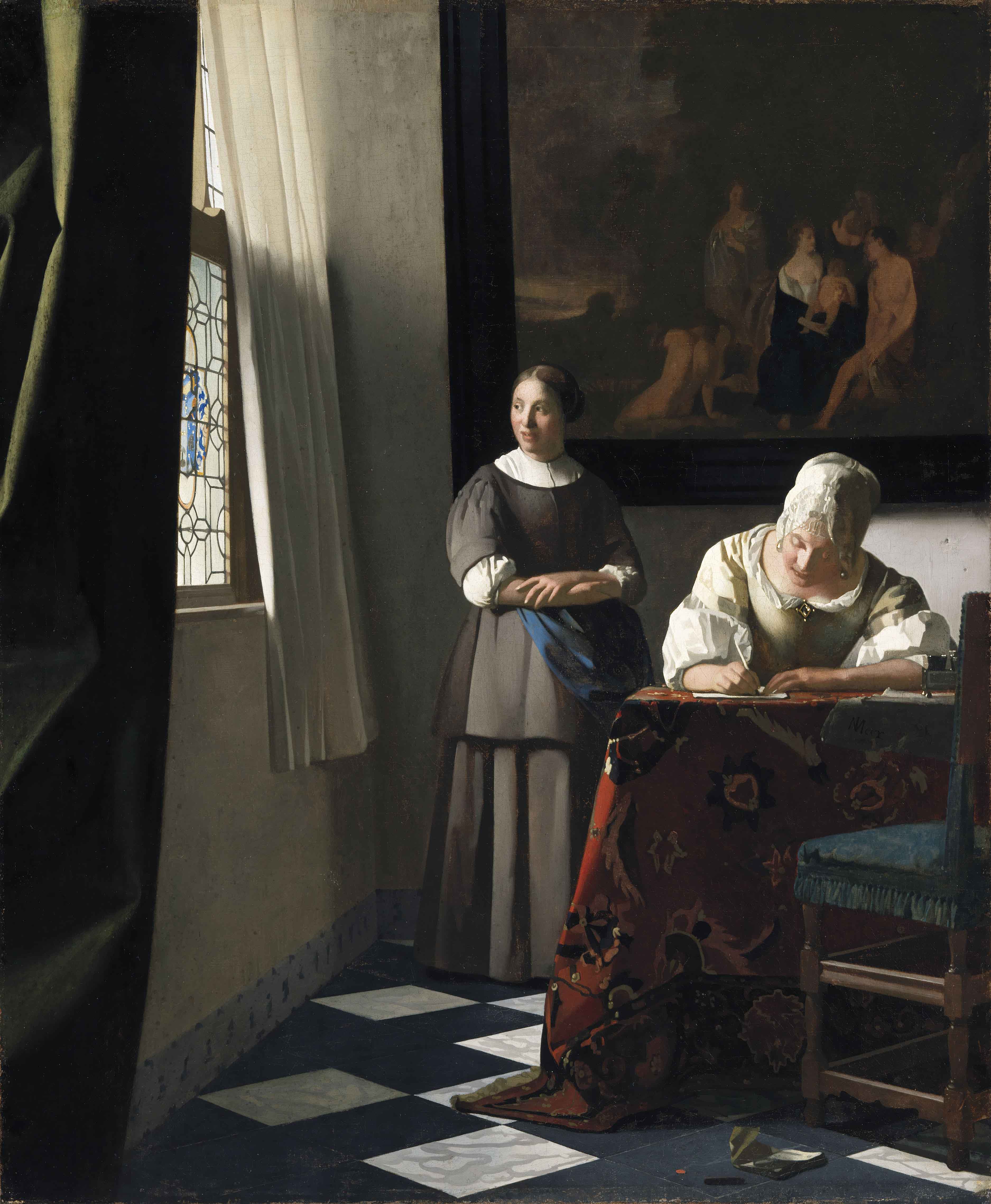
Fortunately, Carson's reflective novel is anything but boring. As with his Fishing for Amber, the novel becomes a reflective essay on all kinds of subjects, while also spinning out variations on his wonderful verse novel For All We Know: Gabriel and his correspondent Nina are the two characters from that book—or at least versions of them. Each of Gabriel's letters is a response to a cryptic postcard from his former lover Nina, and the pictures on the postcards introduce new chapters, as do pictures of the pens Gabriel uses to write each letter. My favorite picture is the Vermeer:


Saturday, May 07, 2011

The Quarry and the Lot

"Maybe writing is a hobby, you know? I might as well build shelves or go fishing."

So says Luke Owen, a poet and community-college teacher who is one of the four narrators of Mark Wallace's novel The Quarry and the Lot. He clearly uses the idea that writing might be a "hobby" as a negative point: "hobbies" are merely (to quote a definition) "something that one likes to do or study in one's spare time" and are of little importance to anyone else; a further definition at the same link says that a hobby is "engaged in primarily for pleasure." And Luke would not be writing just for his own pleasure.

Yet I have been pondering for quite a while the idea that considering writing a hobby might be a good idea. The rest of the first definition of hobby that I quoted above adds that a hobby is a "favorite pastime or avocation"—and it's the word "avocation" that is interesting here. One sense of the shorter word "vocation" is that of a calling, as to the priesthood, and that is, of course, what writers like to think of their writing as. A "vocation" is something serious; an "avocation" is apparently less serious.

But if I play briefly with the idea that Luke Owen is a real person, I'd have to conclude that he would find the idea of writing as a "vocation" in a spiritual sense ridiculous—I don't think he ever makes any explicitly anti-spiritual remarks, but his great skepticism about so many things (especially the suburbs he grew up in) would surely apply to such an idea as well. But if such a writer cannot see his writing as a "vocation," then what's left but to consider it an "avocation"—a "hobby."

But that would make it as apparently insignificant (from Luke's perspective) as "building shelves or going fishing." My immediate thought is to wonder what's wrong with either of those activities (and Nick, one of the novel's other narrators, does in fact run a furniture and carpentry shop he inherited from his father). It reminds me of my recent post about ham radio and hardcore. And in fact, in the novel, when Luke was first active in poetry in the DC area, he was also part of the hardcore scene, which suggests that he would see hardcore (if he were a musician rather than a writer) as something worthwhile that is more than "just a hobby."

Near the end of the novel, Luke has shifted ground on this issue. In a discussion with his father, he surprises his father by using the word "duty" ("I've never heard you use the word duty before") in a reference to "the duty of the artist." He explains what that duty is: "To keep doing what you're doing and let other people know." It's the second phrase there that makes "artistic" work (slightly) "more than just a hobby": you let other people know what you're doing not because you want to sell them shelves or go fishing with them or exchange codes on your shortwave radio, but because you want to communicate with them.

And in this sense, I'm grateful to Mark Wallace, because he "kept doing what he does" and also "let other people know" by publishing his book. There's much more to it than just Luke's crisis as a writer, and I recommend it wholeheartedly to ... well, to anyone whose hobby is to read thought-provoking novels.

Tuesday, January 11, 2011

Land of Marvels

The main character of Barry Unsworth's 2009 novel Land of Marvels (reviewed in the New York Times here) is John Somerville, an archaeologist doing an Assyrian dig shortly before World War One begins. At one point, he ponders the reign of Ashurnasirpal II, in a passage that makes clear what contemporary issues were on Unsworth's mind as he embarked on a novel set in what would one day become Iraq (which, it turns out, is the novel's last word):

Some change in the human spirit here, not in the doing but in the telling, the pride, some ugly twist of soul towards a new idea of supremacy. How? From where? Why among these people at this time? Bred by conquest, like an appetite that grows from feeding? With the blessing of their god Ashur to lend them a sense of mission, bloodshed would become a form of devotion. Since Ashur was above all other gods and the king was his earthly embodiment, there would be a duty to impose his cult, carry light into dark places. The light they had carried had been cast by the flames of devastation. They too, the light bearers, had ended in that same fire.

A later passage returns to the same considerations:

This story began with the second king called Ashurnasirpal, the first of them all to boast of his power to inflict suffering, the first to make this power the symbol and test of kingship, the first to aim not merely at conquest and plunder, as had his forebears, but at the permanent subjection of the conquered peoples, changing the very nature of the state, from one rich and strong within its borders and content to be so to one that gloried in dominion, ruthless in its greed for territory and vassalage, a policy that was to be followed by all his successors down to the last days, down to the fires in which the empire perished.

On the basis of these two passages, one of the concerns of Unsworth's novel is a variant of "those who don't know the past are doomed to repeat it," and the doomed party here would be today's United States, doomed to burn in the very fires of devastation that have been dominating its policies over the last nine-plus years.

But a novel that leaves it at that would hardly be worth commenting on. There is an American character in the novel, Alex Elliott, a geologist who, for strategic reasons involving oil, is pretending to be an archaeologist attached to Somerville's working party. This is a character who is marked in many ways as untrustworthy; in fact, he is even apparently selling his services as a geologist to the Americans, the British, and the Germans all at the same time. And this ambiguous figure is the one who actually states the principle of history: "As someone wiser than I has said, if we ignore the lessons of the past, we will be condemned to repeat our mistakes." He says this at the end of a dinner-table soliloquy about the Hittites—but of course he is not really an archaeologist at all, but a geologist who has boned up on archaeology in order to be able to pass as an archeologist, and he is not interested in the mistakes of the past but in the possibilities of the future, a future that, as he foresees, will be dominated by oil. This quotable quote from "someone wiser than" Elliott is thus deeply ironized in the novel, and any straightforward reading of Unsworth's implicit comparison of the Assyrians and the Americans is called into question by the novel as a whole. The comparison stands, of course, but Unsworth is both establishing the parallel and fictionally exploring its implications and imprecisions.

Friday, October 22, 2010

Fishing for Amber

Ciarán Carson's Fishing for Amber contains several passages that indirectly describe how the book works. Here's one:

For one thing leads to another, as it does in Holland. The cities, by means of canals, communicate with the sea; canals run from town to town, and from them to villages, which are themselves bound together with these watery ways, and are connected even to the houses scattered all over the country; smaller canals surround the fields, meadows, pastures and kitchen-gardens, serving at once as boundary wall, hedge and roadway; every house is a little port, in which you might hear stories from the seven seas. One can drift from any place to anywhere. (152-153)

While reading Fishing for Amber, I kept thinking of W. G. Sebald's books, so I was pleased to come across a reference to St. Sebald in Carson's Shamrock Tea (which I read immediately after reading Fishing for Amber). But when I was done with both these Carson books, I no longer thought of Shamrock Tea as being "Sebaldesque"; it ends up being quite different than anything Sebald wrote (except perhaps Austerlitz, which, like Shamrock Tea, is held together by a continuous narrative more than any of Sebald's other books, or than Fishing for Amber).

Instead, it is Fishing for Amber that actually feels Sebaldesque, with one significant difference: Sebald's work is very melancholy, even pessimistic, while Fishing for Amber uses similar associative techniques (encapsulated in the quotation above) but takes a much different kind of pleasure in those techniques, not the pleasure of melancholy that pervades Sebald but a pleasure in how full of wonders the world is. There is darkness in Carson as well (otherwise, the books would not be interesting), but the experience is of pleasure most of all, while in Sebald, the darkness is foregrounded, and the joy of reading his work comes in spite of the darkness, as it were.

In both Fishing for Amber and Shamrock Tea, Carson repeatedly contemplates paintings, especially Dutch paintings (the Arnolfini Double portrait by Jan van Eyck plays a crucial role in Shamrock Tea). But it was his description of a Vermeer painting in Fishing for Amber that struck me most, in part because I had just read another description of the same painting in Michael Donhauser's Nahe der Neige. Here's Carson on the painting:

... one of the essentials of comfort for a Dutch lady was the vuur stoof, a square box open on one side to admit an earthen pan filled with embers of turf, and perforated to allow the heat to ascend and warm the feet; it served as a footstool, and was concealed under the dress. The use of it was rarely dispensed with, whatever the season, indoors or out—the citizen's wife had it carried after her by her servant to church or at the theatre.

This, indeed, is the object depicted in the lower right corner of Vermeer's Woman Pouring Milk ... She's pouring white milk from a red earthenware jug into a brown glazed bowl and there's a loaf of bread in a wicker basket on the table and a lidded pitcher and other bits of broken bread on the tablecloth. (99-100)

What struck me was Carson's emphasis on the "vuur stoof" in his description of the painting, in contrast to his merely passing mention of the bread on the table. Donhauser emphasizes the bread, and mentions the stove only in passing:

Der Raum, worin das geschieht, ist ein Neben- oder Zwischenraum, der nicht wirklich als Küche erkennbar ist—es hängen da ein Korb und ein Messingbehälter, ein Stövchen steht auf dem Boden ... die Magd, die schaut nicht auf, sie bereitet ein Gericht namens Wentelteefje, wofür Brot gebrochen wurde und wofür die Magd nun Milch in eine Schüssel schenkt; das Brot wird dann etwa eine Stunde in der Milch eingeweicht werden ... (19-20)

I don't have anything to add to these two descriptions; I just enjoyed the (Sebaldesque?) coincidence of reading them both within a few days of each other, as well as how each author emphasized one thing while only barely mentioning the other, so that the two descriptions end up wonderfully complementing each other.

Saturday, February 06, 2010

Conversation (The Art Student's War)

I was moved by this passage from Brad Leithauser's The Art Student's War:

Bea had never known anyone so easy to talk to about nothing—although none of this felt like nothing, their rapid-fire chatter: oh, it felt like something, it felt like life itself.

Bea is falling in love, of course, and she's eighteen, and the sentence captures the breathlessness of falling in love at that age.

The passage also struck me in linguistic terms: "chatter" is a type of speaking that is often disparaged, but from a linguistic perspective, "chatter" is just as important as conversation that is full of "important content." And the passage captures its importance: "chatter" creates bonds between people, even when they are "talking about nothing."

A vague version of the above crossed my mind when I marked that passage, so I was pleased to find the following two pages later, as a kind of summary of what I had been thinking:

It was as though their remarks were gifts to each other—conversation as an exercise in gift giving.

Wednesday, February 03, 2010

The Art Student's War

I picked up Brad Leithauser's new novel The Art Student's War the other day and have read the first chapter and a half. The first chapter is a tour de force, even if it begins in the present tense, something I often find irritating in fiction. But Leithauser makes a brilliant transition to the past tense:

Everything changes—as it so often does—the moment she climbs down from the enclosure of the streetcar; time itself shifts, shifted. When, in the open air, she spoke the words once more, Bea felt a renewed sense of wistful impoverishment: "He didn't even hear me thank him." This time the phrase sounded dry and matter-of-fact, as though the soldier really did belong to the past tense and their story were over.

I did not notice the shift of "shifts, shifted" until the reference to the past tense at the end of the paragraph.

Here's a whole nother point: in the second chapter, a character says, "I have a whole nother thermos." Is that use of "a whole nother" old enough to have been used in 1943? (Which is when the opening scenes take place.) As my friend Dan once said, "What is the status of the word 'nother'?"