Showing posts with label William Shakespeare. Show all posts

Tuesday, November 15, 2011

"Then you get another guy"

In the "Talk of the Town" section of the November 7, 2011, issue of The New Yorker, there's a description of the singer Gillian Welch and her guitarist David Rawlings driving from Philadelphia to New York. The article is not available on-line (except for subscribers to the magazine or the magazine's archive); here's the bit I noted:

The other thing that Rawlings had brought to divert himself was a collected works of Shakespeare. "I've been reading the histories," he said. "I'm up to the third act of 'Henry V,' and when I'm done I might even start them again. I like how fatalistic they are. They feel a little like the Iliad and the Odyssey. I like it in the Iliad when Homer introduces a warrior and says who he was and where he grew up and who his parents and his grandparents were and what they did, and then Hector disembowels him. Then you get another guy."

I love a guitarist who reads Shakespeare on the road and compares the plays to Homer, with superb comic timing in the next-to-last sentence of the passage. What would it mean to play guitar like this, with a flurry of information and then a comic twist?

Since I'd not only read that passage but also read it out loud to my son Miles (who was not as amused as I was ...), it was striking to find the same point made in a different article in the same issue: "Battle Lines," Daniel Mendelsohn's review of Stephen Mitchell's new translation of the Iliad, which begins like this (also only in the on-line archive):

For sheer weirdness, it would be hard to find a passage in the Western canon that can compete with the tenth book of Homer's Iliad—the one classicists call the Doloneia, "the bit about Dolon." Not the least of the book's oddities is that it's named after a nobody: Dolon is a character whom the poet conjures merely so that he can kill him off, a few hundred lines later, in literature's nastiest episode of trick-or-treating.

This is not the first time I have come across such a doubling in the New Yorker. I wrote about a case a few years ago, when articles by Malcolm Gladwell and Caleb Crain referred to the same thing in consecutive issues. And in April of 2006, I also wrote about two profiles in the same issue (of Pete Seeger and Maurice Sendak), which both included images of the profiled celebrity interacting with a famous poet (Seeger with Edna St. Vincent Millay and Sendak with Marianne Moore). Amusingly, the Seeger profile is by Alec Wilkinson, who also wrote the bit about Welch and Rawlings.

Friday, July 29, 2011

The World's Pleasure

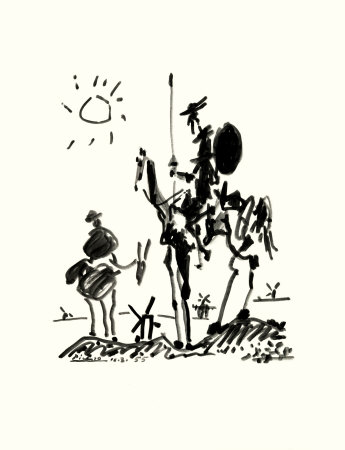
"Don't you see, sir, that the benefits of Don Quixote's recovery can't be compared with the pleasure that his antics provide?"

I found an echo of this remark from Don Quixote (a remark which is one of my touchstones) in All's Well That End's Well, when The Clown says to Parolles: "... much fool may you find in you, even to the world's pleasure and the increase of laughter."

But Parolles, of course, is not finding pleasure in his being treated like a fool, whereas Don Quixote surely does find pleasure in imagining himself to be not a fool. And Smokey Robinson does remind us, after all, that the clown does not necessarily take pleasure in his own foolishness.

Thursday, September 25, 2008

Shakespeare parodies

There are three fun Shakespeare parodies up at New Verse News:

McCoriolanus, by Bill Costley
William Shakespeare's Obameo and Johniette, by Olga Wayne
Johniette's Soliloquy, by Aaron Gillego

Nice coincidence that both Wayne and Gillego came up with those names!

Friday, September 05, 2008

The Ensemble, by Floyd Skloot

It seems like every time I read a poem by Floyd Skloot I like it. Today's example is on Poetry Daily: "The Ensemble."

I love the way it approaches Shakespeare without too much awe and reverence, but also without too much ambition; the poem seems pitched at just the right level. And, as Rob points out, the rhymes are delicious, as are the line breaks.

Gonna have to get me a Skloot collection one of these moons.

Monday, May 19, 2008

Snowdrops and Summer Snowflakes, Drooping

Another moment in Reginald Shepherd's Fata Morgana that caught my attention was this, from the poem "Snowdrops and Summer Snowflakes, Drooping":

The river is silted with sentiments, Ophelia
sings flowers in hell to all the goodnight
ladies martyred to plots ...

That makes this poem a much better version of one I wrote long ago, "Gretchen and Ophelia," which toyed around with the similarities between Gretchen in Goethe's Faust and Ophelia, the way that they die over and over again on stages all over the world.

Where is Hamlet being played tonight? Who is playing Hamlet? Who Ophelia? Where is Faust being played? And who is playing Gretchen? Questions like the claim that somewhere a radio station is playing a Beatles tune as you read this. Which station? What tune? "Things We Said Today" would be my choice.

Shepherd continues with all the things he would give Ophelia, all the flowers, and concludes with this:

... What I wouldn't give
to hear her shut up that infernal singing,
walk out of sullen water open-eyed.

Sunday, April 27, 2008

Much Ado about Nothing

[Click on the image to enlarge the poster for more information about the Gay Beggars' production of Much Ado about Nothing, running all through May in Basel.]