Saturday, February 25, 2012

Voices from the air

In a short prose text called "Voices from the Air" (from her book What Is Found There: Notebooks on Poetry and Politics, Norton, 1993), Adrienne Rich describes three scenes of hearing recorded poetry on the radio, with each scene exemplifying a different way of responding to poetry. In the first, while in the hospital recovering from an operation, Rich turned on the radio to look for music and heard instead a recording of The Duchess of Malfi, specifically, a passage that begins with the Duchess saying, "Who am I?" (it's about halfway through this scene):

BOSOLA: Thou art a box of worm-seed, at best but a salvatory
Of green mummy. What's this flesh? a little cruded milk
Fantastical puff-paste. Our bodies are weaker than those
Paper prisons boys use to keep flies in; more contemptible,
Since ours is to preserve earth-worms. Didst thou ever see
A lark in a cage? Such is the soul in the body: this world
Is like her little turf of grass, and the heaven o'er our heads,
Like her looking-glass, only gives us a miserable knowledge
Of the small compass of our prison.

DUCHESS: Am not I thy Duchess?

BOSOLA: Thou art some great woman, sure, for riot
Begins to sit on thy forehead (clad in gray hairs)
Twenty years sooner than on a merry milkmaid's.
Thou sleepest worse than if a mouse
Should be forced to take up her lodging in a cat's ear:
A little infant that breeds its teeth, should it lie with thee,
Would cry out, as if thou wert
The more unquiet bedfellow.

DUCHESS: I am Duchess of Malfi still.

BOSOLA: That makes thy sleep so broken:
Glories, like glowworms afar off shine bright,
But look'd to near, have neither heat nor light.

Rich found that hearing this brutal passage, which precedes Bosola's strangling of the Duchess, could "solace [her] consciousness to the point of relief. For that is one property of poetic language: to engage with states that themselves would deprive us of language and reduce us to passive sufferers." This is a particularly vivid example of the cathartic experience of tragedy, the purification of negative emotions ("pity and terror," in Aristotle's terms) into an experience of solace. The scene is strikingly different than the theatrical scene of tragedy—not a stage with actors performing for an audience in a well-prepared aesthetic experience, but a solitary sufferer listening to something on the radio that she had not even been looking for—but even in this unlikely situation, the play produces its effect, and its audience finds relief.

The second scene could hardly be more different, except for the accidental discovery of poetry on the radio that connects it to the first. Driving at night, Rich and a friend again come across a Wallace Stevens poem being read by Stevens himself (I tried to find this recording on the web somewhere, but had no luck):

The house was quiet and the world was calm.
The reader became the book; and summer night

Was like the conscious being of the book.
The house was quiet and the world was calm.

The words were spoken as if there was no book,
Except that the reader leaned above the page,

Wanted to lean, wanted much to be
The scholar to whom his book is true, to whom

The summer night is like a perfection of thought.
The house was quiet because it had to be.

The quiet was part of the meaning, part of the mind:
The access of perfection to the page.

And the world was calm. The truth in a calm world,
In which there is no other meaning, itself

Is calm, itself is summer and night, itself
Is the reader leaning late and reading there.

Rich writes of this experience: "And for those moments, on a mountain road on a calm night, for two listeners in a world we knew to be in fracture, the words ... rose in that flat, understated, actuarial voice to bind the actual night, the moving car, the two existences, almost as house, reader, meaning, truth, summer, and night are bound in the poem. For a few minutes, we could believe in it all." This is quite a different way of responding to a poem: not through a cathartic purging of negative emotions, but through identification: although the scene they experience in the poem in is quite different from the scene described in the poem, they find themselves identifying with the described experience and having an experience of their own that corresponds to it. "The words were spoken as if there were no book": and for Rich and her friend, of course, there was no book, as they heard Stevens read the poem on the radio.

But Rich then spins this scene in a different way, imagining a different person coming across the Stevens poem on the radio: someone driving over to her sister's house in the middle of the night to go to the emergency room with her sister, whose boyfriend has stabbed her. This listener also searches for music while driving, but comes across poetry instead. If you were this listener, Rich wonders, "what would make your hand pause on the dial, why would these words hold you?" Such a listener would not identify with the reader in the poem, because her house is not "quiet," and her world is not "calm." Nor would she experience catharsis, for the poem is far from being a tragedy that can "purge pity and fear." If she is drawn in, Rich imagines, it will be for another reason entirely: "You are drawn in not because this is a description of your world, but because you begin to be reminded of your own desire and need, because the poem is not about integration and fulfillment, but about the desire ... for those conditions." For such a listener, the poem provides not solace or confirmation but a vision of an alternative, a utopia even, in which solace and confirmation might be possible.

In all of these scenes, the listeners turn on the radio to look for music, and they get poetry instead. They look for distraction from their momentary existence, and instead they find a commentary on it. They do not get an experience of wholeness that erases their own experience and replaces it with a commodity; they get the experience of a desire for wholeness, a desire for "what is found there" in poetry, as the title of Rich's book puts it, in a reference to William Carlos Williams: "It is difficult / to get the news from poems / yet men die miserably every day / for lack / of what is found there." The misery of the lack of catharsis, the lack of identification, and the lack of a way to represent one's desires even (or especially) when one's world is fractured beyond hope of repair.

*

Click here for the context of the Williams quotation in his poem "Asphodel, That Greeny Flower." The quoted passage is right near the end.

*

Alex Ross has a beautiful and brief response to the Stevens poem here.

Wednesday, February 15, 2012

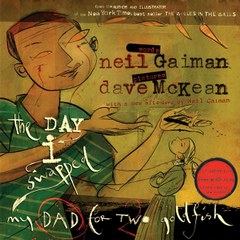
Updating "The Day I Swapped My Dad for Two Goldfish"

I love reading Neil Gaiman's picture books to my daughter Sara: "Crazy Hair," "The Wolves in the Walls," and "The Day I Swapped My Dad for Two Goldfish." It was the last of these that I read to her tonight. But even though the book was published in 2004, it is already out of date, so I had to update it.

It begins as follows:

One day my mom went out and left me home with just my little sister and my dad. My dad sat in front of the television, reading his newspaper. My Dad doesn't pay much attention to anything, when he's reading his newspaper.

I revised it as follows:

One day my mom went out and left me home with just my little sister and my dad. My dad sat in front of the television, reading his iPad. My Dad doesn't pay much attention to anything, when he's reading his iPad.

Yes, yes, that is much more up-to-date!

I should add that the book is hysterically funny. I laugh my head off about some of the bits, even though I know they are coming: "Mumf, mumf, mumf," said my little sister. You'll have to get the book yourself to know why that is hysterical. :-)

Monday, February 13, 2012

Streaming services and bands

My friend David Bauer wrote a quick defense of streaming services such as Spotify against the complaints musicians have about how little they earn from such services. It's in German here. (If you read German, the comments are worth reading, too.)

David's points are as follows:

1. Every band can choose whether or not to work with streaming services.

2. Bands earn money every single time a song is played on a streaming service. That's not comparable to the sale of a CD or other ways of earning money from selling music. (My comment: when you sell a CD, you don't earn money every time the consumer listens to each song.)

3. If a song is not available for streaming, that does not mean that you sell a CD. People can find free downloads or listen to something else.

4. Spotify is not making great profits. David provides a link to an article called "Why Spotify can never be profitable."

5. Spotify is not about making money for bands but about generating attention for their music. (My comment: it suddenly reminds me of the Grateful Dead: give away the right to record concerts and trade tapes, and the fans will come in droves, assuming the music is any good, especially if you promise a distinct concert at every show.)

David also links to this post of suggestions as to how Spotify can help musicians.

Curious what my musician friends have to say about this.

Friday, February 10, 2012

Home in on and hone in on

It begins with this status update from someone on Facebook:

Do people now accept "to hone in on" as in sharpen one's attention on something — as opposed to "to home in on"?

After a dozen or so comments that all denounced "hone in on," I entered the fray by referring the crowd to the Eggcorn Database and the page on the issue there:

eggcorns.lascribe.net/english/48/hone/

There's a link there to a lengthy discussion of the issue by Mark Liberman, from Language Log:

http://itre.cis.upenn.edu/~myl/languagelog/archives/000378.html

I noted the following about Liberman's discussion:

It's fascinating to note that "home in on" is definitely only a few years older than "hone in on," and that George HW Bush's use of "hone in on" suggests that the "hone" form might have arisen almost simultaneously with "home in on" (as he was a pilot in WW2).

 After a few more comments by others, along came this comment:

Sorry to be so harsh, but only a dribbling cretin would believe the former to be correct. 'Hone' - as many others have pointed out - has *always* denoted the act of polishing/refining.

This led me to write:

"Only a dribbling cretin": give me a break! Read the Mark Liberman link I posted; like a good linguist, he treats all users of a language as worthy of respect, and he ends up with a much deeper understanding of how language is used than those who insult people for making "mistakes."

Which eventually led the poster of the "dribbling cretin" comment to this remark:

 Thank you for the link, Andrew: extremely interesting - but anyone who possesses what you characterise as "a much deeper understanding of how language is used" would be forced to the inevitable conclusion that Liberman - albeit perhaps a little too subtly for some - is simply monitoring, with exemplary fair-mindedness, the continued use of a malapropism that unfortunately appears to have taken root among dribbling cretins everywhere.

As for "treating all users of a language as worthy of respect": do you accord the same respect to people who deploy (as two examples we see on Fakebbook every day) "your" rather than "you're" and "it's" rather than "its"? If not, then perhaps you'd care to explain *why* not?

So here is my response to this last comment.

On the eggcorn in question:

First of all, I would not call the use of "hone in on" instead of "home in on" a malapropism. In a malapropism, the misused word does not make any sense at all in the context it is used in. In an eggcorn, the new phrase is "different from the original, but plausible in the context" (to quote the Wikipedia page on "eggcorn," which begins by contrasting the two terms). Recall that Mrs. Malaprop misuses words because she wants to show off. Users of eggcorns are not showing off; there are good reasons for the construction of an eggcorn.

This particular case exemplifies those reasons (as Liberman argues quite cogently): there is a phonetic justification for the usage (home/hone is a minimal pair, and the distinguishing phonemes are often misconstrued). Further (and again, following Liberman), the metaphorical extension of "hone" in this context is semantically feasible. 

To me, though, Liberman's most interesting point is that "hone in on" appears relatively soon after "home in on." We are not talking about one expression ("home in on") that has existed for centuries and a new expression ("hone in on") that recently began to replace it. Instead, "home in on" appears, and shortly thereafter, "hone in on" appears. So this is an example of a new expression that immediately generates an alternative that is phonetically and semantically not without justification. (A related case is "could (not) care less," where the "incorrect" form follows very quickly after the "correct" form. There are Language Log discussions of this, too, such as the one here, again by Liberman, which provides links to many further posts on the topic.)

In addition, once people begin hearing the "alternative" expression, they will begin to use it, especially if everybody around them does. A different expression is both a good example here and a funny story in its own right: I once used the spoonerism "one swell foop" when talking to my friend Heather. This is just a form that I like to use sometimes because it's funny. Heather laughed and told me that her mother had always used the spoonerism for its comic effect, but that meant that Heather thought that the real expression was "one swell foop." Eventually, Heather heard "one fell swoop" and thought that that expression was a funny spoonerism. This did not make either Heather or her mother a "dribbling cretin"; the whole process was and is completely understandable. If you hear something all the time, you will pick it up and use it, because that's what you hear.

On treating language users with respect (and "your/you're" and "it's/its"):

The short answer is that I do respect users who mix these forms up, because I understand why they get mixed up. One source of the problem is touch-typing: I learned how to touch type almost 35 years ago (thanks, Mom, for insisting that I take the typing class!), and one thing I noticed pretty much immediately was that when I got faster, my fingers stopped typing individual letters, as it were, and typed whole words as units. My name, for example, is so programmed into my touch-typing fingers that if I try to type my wife's name (Andrea), I always end up typing my name first (Andrew), and then I have to go back and correct it. The same thing happens with the problem pairs with apostrophes (for me, it's usually not the two mentioned above but "their/there/they're" that cause trouble because of typing reflexes—and even as I typed them now, my finger reflexes got in the way again!).

Secondly, in the case of "it's/its," many people are probably posting on Facebook with their iPhones, and the iPhone autocorrect will turn "its" into "it's" almost every time! (I'm puzzled why it sometimes does not do so.) Similarly, the commenter in question uses hyphens for dashes, and that would be annoying in a printed context. But on Facebook, it doesn't matter at all, and it's completely understandable—after all, it's easier to type a hyphen than a dash on a computer, and it's much easier to do so on an iPhone.

Thirdly, I mostly come across those problems in unedited contexts (such as Facebook), and I simply write it off as an honest slip; I've certainly posted things before editing them often enough, only to discover a silly mistake after doing so. It's related to rapid production (I had to stop for a moment to check my "it's" there to make sure it was correct, and it slowed down my production for a moment!). Even in the comment above, such a "rapid production" mistake appears: the commenter writes "Fakebbook." I like the playful "Fakebook" for "Facebook" (that's what I assume it is), and the double "bb" is just a typo. The mistake caused by rapid production does not make him a cretin.

Finally, even in highly edited contexts, the mistake slips through. When I come across "it's" for "its" in poetry collections, I take note of them. I've come across a half-a-dozen instances in the past two or three years. And in every case, the mistake only appears once or twice, and "it's" is otherwise correctly used in the book. The same is true of novels. 

In the final analysis, these are not problems of grammar. They are problems of typography. People make such errors even if they largely write correctly otherwise. And to come back to the commenter's question: yes, even people who make such mistakes deserve to be treated with respect as far as their language use is concerned.

Thursday, February 09, 2012

Within Shouting Distance of the Coosa

A fine poem by R. T. Smith on Poetry Daily yesterday—but I have a problem with it. Read the poem first:

WITHIN SHOUTING DISTANCE OF THE COOSA

Once in Alabama when I was young
and given to aimless ambling,
I followed a red road between pines
where even at midday the cicadas
were complaining, and with nothing
on my mind and expecting nothing
I was about to pause for water
when the road's weedy roughness
opened to a clearing where boards
wounded by years of weather
formed a modest church, the peak
of its steeple gone and door scotched
open. The wind was scattering pollen,
and somewhere off in the needles
a mockingbird thought it was evening
and half-heartedly sang. Do I need
to say I forced the door and found
everything rain-soaked and broken,
the pews only planks whose cinder
blocks had fallen or were, as I've said,
ruined? But I heard a hum or what
I thought could be a hymn rising
from behind the altar and squinted
to see the worker bees dance and circle
where they'd swarmed. Young
as I was, I understood "not one step
closer, do not disturb," so backed
away, because I knew they believed
their honey holy and would not
suffer it to be troubled without
rushing to beset me, and besides I'd
already been touched by the Word
and held under down at the river
till I heard God's gold voice shining,
insects swarming the choir's serenade,
bee sound the very sound He made.

*

I stumbled at the question in the middle of the poem: "Do I need / to say ...?" Until this question (and after it, in fact), the poem presents a speaker remembering an experience, and the reading of the poem is itself an experience. The question about what one "needs to say" shifts away from the experience of a poem depicting an experience to the discursive nature of the poem itself. In itself, that's not a problem: there are many successful poems that address the discursive nature of poetry as a problem. But this question seems out of place to me.

Tuesday, February 07, 2012

Dream of publication

The other night, I dreamed that I was looking at a list of forthcoming titles from a poetry publisher, and one of the titles was a collection of my poems, something like "Poems 1988-2011." In the dream, I was surprised, because I could not remember having heard anything from the publisher (and I wasn't even sure I had sent the publisher a manuscript). Then somehow I was talking to the publisher, and he said, "But I was told you were dead, and somebody gave me all of your poems to edit for a book." I was most emphatically not dead, even in the dream, as the publisher admitted. That's all I remember from the dream, except this: the overall tone was not weird or uncanny; it was just funny.

Saturday, February 04, 2012

Habits

I recently had to replace my water boiler in the kitchen, which had started to leak. The new one is bigger, and it also boils the water much faster. So only now, when the water is done boiling much sooner than I unconsciously expected, have I noticed that I was in the habit of putting the water on and then taking my time in preparing my coffee filter to make my cup of coffee when the water finally boiled.

In this case, I only noticed that I even had a particular habit once the habit no longer functioned as such. It reminds me of this poem, which I wrote shortly before my second child was born:

HABIT


We've moved into the dining room,

and Miles into ours,

to make room for number two.

And every couple hours,


I head to what was once our room to get

something no longer there,

then turn around, amazed by habit,

by what I live in, unaware.


Light Quarterly 50, Autumn 2005

Friday, February 03, 2012

Blowin in the Wind parodies

I readthis morning that David Lee Roth has parodied Bob Dylan on the new Van Halen album: "How many roads must a man walk down / before he admits he is lost?"

Can you sue somebody for stealing a parody? After all, the Chenille Sisters got there first:


Tuesday, January 31, 2012

Stanley Jordan and Michael Hedges, plus Kaki King

One summer in the 1980s (probably the summer of 1984), I was working one Sunday afternoon at the Coffee House at Stanford, and there was a concert somebody had arranged. It was a guy named Stanley Jordan playing solo electric guitar. Shortly after he started playing (and made me take notice with his unusual touch-tapping technique), Michael Hedges, who lived in Palo Alto, happened to stop by to get a cup of coffee, as he very occasionally did at that time (once a year or so, in my experience). While I was getting his coffee, he was already not paying attention to me anymore, because he was paying attention to Stanley. I suspect he was just planning to drink his coffee and then head back off wherever he had been planning to go; instead, he sat down quite close to Stanley and watched him play, with this utterly stunned look on his face.

In the summer of 2003, I was in Seattle visiting my Dad, and we went to Jazz Alley to see Stanley play a concert. The opener was a young guitarist named Kaki King, and she played acoustic guitar like she was Michael Hedges. Now it was my turn to sit there with my jaw dropped, as I watched her channel Hedges from back in the 80s when I used to see him at the Varsity in Palo Alto. And she came out for an encore with Stanley and got into a wicked touch-tapping jam that, if I closed my eyes, made me think I was hearing something I never had the chance to see (and I don't know if it ever happened): Stanley jamming with Michael.

One of the things Stanley played that long-ago Sunday at the Coffee House was "My Favorite Things". There are no YT videos of him playing MFT, but here it is on Spotify.

Monday, January 30, 2012

Reading Backwards

Recently, while he and I were traveling together, my son Miles (12) came up with an experiment: he read a book backwards, just to see what it was like. (The book he chose was Ivy and Bean and the Ghost That Had To Go, by Annie Barrows, which I had bought for his sister Luisa.)

His conclusion: if you read a book forwards, it is like looking out a window and seeing something happen. But if you read a book backwards, it is like looking at the window itself.

Tuesday, January 17, 2012

Quiet Rooms

QUIET ROOMS

You know I think it's fine to talk about those things in quiet rooms. (Mitt Romney)

We talk about these things in quiet rooms
where nobody can sit alone for long.
We weave our words as if on ancient looms,
turning our measured voices into songs
everyone begins to sing as one.
We choose our usual places in the choir,
pursuing harmonies nobody spun
and tunes that leave us nothing to desire.

If several singers always take the lead,
it's only that their voices are the best.
If anyone's outside, why don't you come
and join us? We'll teach you what you need
to know to sing our songs, or play a drum.
Or just come in and listen. Be our guest.

Monday, January 16, 2012

Mark Wallace on Dieter M. Gräf

Mark Wallace recently reviewed Dieter M. Gräf's Tussi Research, the second of the two selections of Gräf's work for Green Integer. Thanks to Mark for his review, which is here.

Monday, December 12, 2011

Gross- und Kleinschreibung in der deutschen Lyrik

[Einmal etwas nur auf Deutsch]

Hier das heutige Gedicht des Tages von Fixpoetry:

Carl-Christian Elze


ich lebe in einem wasserturm am meer, was albern ist.

ich bin immer versalzen, aber das süße halt ich nicht aus.

eine katze schlich ums haus & hat sich auf den rücken geworfen.

was das nur soll? ich will keine ergebenheit, ich will liebe.

woher ich meine liebe nehme, ist mein größtes geheimnis.

ich habe einen tank voll davon, aber nicht in meinem turm.

ich bin oft betrunken vor liebe & oft ein stinkendes feld.

das meer ist eine katze, der ich nichts anvertrauen mag.

in den dünen finden sich manchmal die knochen von engeln.

trete ich aus meinem turm heraus, liebe ich heftig die sonne.


Hier mein Facebook-Kommentar dazu:

Mir gefällt dieses Gedicht, aber wie so oft, wenn alles kleingeschrieben ist, frage ich mich, warum das so sein muss. Wie ist das kleingeschriebene Gedicht anders als die mögliche grossgeschriebe Form? Was bringt es gegenüber die Standardschreibung:

Ich lebe in einem Wasserturm am Meer, was albern ist.

Ich bin immer versalzen, aber das Süße halt ich nicht aus.

Eine Katze schlich ums Haus & hat sich auf den Rücken geworfen.

Was das nur soll? Ich will keine Ergebenheit, ich will liebe.

Woher ich meine Liebe nehme, ist mein größtes Geheimnis.

Ich habe einen Tank voll davon, aber nicht in meinem Turm.

Ich bin oft betrunken vor Liebe & oft ein stinkendes Feld.

Das Meer ist eine Katze, der ich nichts anvertrauen mag.

In den Dünen finden sich manchmal die Knochen von Engeln.

Trete ich aus meinem Turm heraus, liebe ich heftig die Sonne.

Das ist letztendliche keine Kritik an Carl-Christian Elze, sondern eine generelle und sehr ernst gemeinte Frage an die zeitgenössischen deutschsprachigen Lyrikern, die so schreiben, von einem in der Schweiz wohnhaften amerikanischen Lyriker, Übersetzer und Songwriter, der einfach nicht versteht, warum diese Form so geläufig ist, da sie sich, meine Erfahrung nach, selten mit irgendeinem Gewinn gegenüber der Standardschreibung rechtfertigt, und relativ oft (obwohl nicht in diesem Fall) nur Verwirrung stiftet.

Tuesday, November 15, 2011

"Then you get another guy"

In the "Talk of the Town" section of the November 7, 2011, issue of The New Yorker, there's a description of the singer Gillian Welch and her guitarist David Rawlings driving from Philadelphia to New York. The article is not available on-line (except for subscribers to the magazine or the magazine's archive); here's the bit I noted:

The other thing that Rawlings had brought to divert himself was a collected works of Shakespeare. "I've been reading the histories," he said. "I'm up to the third act of 'Henry V,' and when I'm done I might even start them again. I like how fatalistic they are. They feel a little like the Iliad and the Odyssey. I like it in the Iliad when Homer introduces a warrior and says who he was and where he grew up and who his parents and his grandparents were and what they did, and then Hector disembowels him. Then you get another guy."

I love a guitarist who reads Shakespeare on the road and compares the plays to Homer, with superb comic timing in the next-to-last sentence of the passage. What would it mean to play guitar like this, with a flurry of information and then a comic twist?

Since I'd not only read that passage but also read it out loud to my son Miles (who was not as amused as I was ...), it was striking to find the same point made in a different article in the same issue: "Battle Lines," Daniel Mendelsohn's review of Stephen Mitchell's new translation of the Iliad, which begins like this (also only in the on-line archive):

For sheer weirdness, it would be hard to find a passage in the Western canon that can compete with the tenth book of Homer's Iliad—the one classicists call the Doloneia, "the bit about Dolon." Not the least of the book's oddities is that it's named after a nobody: Dolon is a character whom the poet conjures merely so that he can kill him off, a few hundred lines later, in literature's nastiest episode of trick-or-treating.

This is not the first time I have come across such a doubling in the New Yorker. I wrote about a case a few years ago, when articles by Malcolm Gladwell and Caleb Crain referred to the same thing in consecutive issues. And in April of 2006, I also wrote about two profiles in the same issue (of Pete Seeger and Maurice Sendak), which both included images of the profiled celebrity interacting with a famous poet (Seeger with Edna St. Vincent Millay and Sendak with Marianne Moore). Amusingly, the Seeger profile is by Alec Wilkinson, who also wrote the bit about Welch and Rawlings.

Saturday, November 12, 2011

Michael Hulse and Quinn Latimer, reading in Basel, Monday, November 21, 2011

ESP (English Seminar Poetry) presents:

Michael Hulse and Quinn Latimer will read from their poetry on Monday, November 21 2011, in the Grosser Hörsaal of the English Seminar of the University of Basel, at Nadelberg 6 in downtown Basel.

For more information, click on the image of the flyer below.

Sunday, October 30, 2011

Ashes of American Flags

"I wonder why / we listen to poets," sings Jeff Tweedy in Wilco's "Ashes of American Flags." It's a somewhat odd way of putting it, since mostly poets get read, rather than listened to. But the range of possible meanings is still quite limited: it might refer to poetry readings (where we listen to poets, rather than read them), it might mean "listen to" in the sense of "do as someone tells you to do" (with poets as sources of moral guidance), or it might mean that lyricists who sing their poems are also poets (opening up the "are lyrics poetry?" can of worms). The rest of the lyric might help one decide among these three readings, if that's what one is inclined to do.

When I said that "Art of Almost" seemed primarily "suggestive" and not much more, I meant that the lyrics were so open to interpretation that even such an enumeration of the straightforward readings would not be possible. "Ashes of American Flags" is more than "suggestive," in this sense, because its text is more limiting in its possible interpretations.


Ashes of American Flags

the cash machine
is blue and green
for a hundred in twenties
and a small service fee
I could spend three dollars
and sixty-three cents
on diet coca-cola
and unlit cigarettes

I wonder why
we listen to poets
when nobody gives a fuck
how hot and sorrowful
this machine begs for luck
all my lies are always wishes

I know I would die
if I could come back new

I want a good life
with a nose for things
a fresh wind and bright sky
to enjoy my suffering
a hole without a key
if I break my tongue
speaking of tomorrow
how will it ever come
all my lies are always wishes

I know I would die
if I could come back new

I'm down on my hands and knees
every time the doorbell rings
I shake like a toothache
when I hear myself sing
all my lies are only wishes

I know I would die
if I could come back new

I would like to salute
the ashes of American flags
and all the falling leaves
filling up shopping bags

Saturday, October 29, 2011

The Art of Almost

It's great to hear bands push the envelope of what is expected of them, and that's what Wilco does with "The Art of Almost," the first song on their latest CD, The Whole Love. It sounds to me, in fact, like this song is the best Radiohead song released this year (better than anything on King of Limbs, at least).

If the music of the song is fantastic, the lyrics settle for being suggestive. But most lyrics do (not every songwriter is Conor Oberst, not even Jeff Tweedy).

While searching for the lyrics, I discovered that the Wilco website has all their lyrics, and that you can request songs for concerts. So I requested "Hummingbird" and "Impossible Germany" for Basel. You can even dedicate your requests!

Here's a live video of "The Art of Almost," followed by the lyrics:


The Art of Almost

No!
I froze
I can’t be so
Far away from my wasteland
I never know when I might
Ambulance
Hoist the horns with my own hands
Almost
Almost

I heard a faint olé
True love but
I had other ways to hurt myself
Like calling
I could open up my heart
And fall in and
I could blame it all on dust
The Art of Almost
Almost
Almost
Almost

I’ll hold it up
I’ll shake the grail
Disobey across the waves
Tomorrow
I’ll have all the love I could ever ache
And I’ll leave almost with you
All of almost
Almost

Sunday, October 23, 2011

Antiphon

The first issue of Antiphon, a new online poetry journal based in the UK, includes my poem "The View From Here."

On reading through the rest of the journal, a few of the poems struck me in particular:

"Why do you live on your own, without any children?", by Michaela Ridgway
Nil by m0uth, week 3, by Cora Greenhill
Triptych, by Claire Dyer

But most of all I liked Archie's Paris, by David Harmer, which reminded me of the first sentence of Reginald Shepherd's essay "Why I Write" (which I quoted in my brief eulogy for him when he died, over three years ago now).

Thursday, October 13, 2011

Wilco, "A.M."

In anticipation of Wilco's concert in Basel on November 7, I picked up almost all the Wilco albums I did not already have, and now I am listening to them in chronological order. Their first album was A.M., from 1995, released right after I moved to Basel (which is neither here or there, of course). This one I did not have before, and on a first listening, I'm impressed by how they seemed to be channeling the Rolling Stones of Exile on Main Street at times, especially when they get more rocking, as on "Casino Queen":


(This version doesn't quite do the Stones comparison as much justice as the studio version, actually.)

Some might think an "altcountry" band should not be compared to "the world's greatest rock and roll band," but as my friend Geoff once pointed out to me, on Exile, the Stones also proved that they are the world's greatest country band, and reminded us all that country and rock-and-roll come from the same sources, and that the original distinctions between them were all about marketing and radio formats ...

Tuesday, October 11, 2011

Fish on a Stick


This Wondermark comic from mid-September struck me as a little lesson in linguistics, although as is often the case, I am not enough of an expert in linguistics to really figure out how to talk about it. I'm only good enough to see that there is some linguistics to be talked about here.

The lesson is that language involves not just what is said but a whole bunch of assumptions that we have that help us interpret what is said. I thought this might have something to do with the Gricean maxims, but I can't figure out how the two speakers' assumptions violate those maxims of quality, quantity, relevance, or manner.

The second man assumes that if something is carrying something and shouting out a description of it, that it must be for sale. The man with the fish, though, interprets the question not as "how much do you want for it?" but as "how much of the fish is on the stick?"

Any linguists out there want to help me with this one? Perhaps I should send it to Mark Liberman of Language Log.

Monday, October 10, 2011

Rob A. Mackenzie and Katy Evans-Bush, reading in Basel, Thursday, October 20, 2011

ESP (English Seminar Poetry) presents:

Salt poets Rob A. Mackenzie and Katy Evans-Bush will read from their poetry on Thursday, October 20, 2011, in Room 11 of the English Seminar of the University of Basel, at Nadelberg 6 in downtown Basel.

For more information, click on the image of the flyer below.

The next ESP reading will feature Michael Hulse and Quinn Latimer on November 21, 2011.

Sunday, October 09, 2011

Cleanse Song

See the new pyramids down in old Manhattan
From the roof of a friend's I watched an empire ending

Bright Eyes, "Cleanse Song"

A few months ago, I was listening to Bright Eyes, as I was obsessively doing at the time, and up came "Cleanse Song," a beautiful ballad from their album Cassadaga. While I love the song, I had to differ with Conor Oberst about the above lines: it was not the end of an empire. Nor was it the beginning, of course. It was an opportunity for the leaders of the empire to reassert and even vastly expand their empire's reach, both abroad and, especially, at home.


Saturday, October 08, 2011

No Need for Due Process

In this column on October 3, 2011, Glenn Greenwald included a link to a White House Press Conference with Press Secretary Jay Carney, which I recommend that you watch:


Kudos to Jake Tapper of ABC News for asking the important questions. I would say "non-kudos to Carney," but he's just doing his job. The real "non-kudos" have to go to the President.

As Tapper asks, what would "Constitutional Law Professor Barack Obama" say about how President Barack Obama is handling the Constitution? And all American citizens and residents should be asking themselves, "Do we want to live in a country where the President can order people to be executed without trial?" If even a large minority, let alone a majority, answers that question with "Yes," that is a very sad state of affairs.

One thing that I think should be made as clear as possible about this sad state of affairs: in the end, it's not about ordering the assassination of an American citizen. That's just an extra turn of the screw. The real problem is the President reserving the right to order the assassination of anybody anywhere.

UPDATE: Here's a more recent Greenwald column about how people get put on the list for assassination. As Greenwald puts it:

Seriously: if you’re willing to endorse having White House functionaries meet in secret — with no known guidelines, no oversight, no transparency — and compile lists of American citizens to be killed by the CIA without due process, what aren’t you willing to support?

Thursday, October 06, 2011

Michael Donhauser reading in Basel, October 25, 2011

The wonderful poet Michael Donhauser will be reading from his work (in German) on Tuesday, October 25, 2011, in Basel. The reading will be at 10:15 a.m. at Nadelberg 6, "Schönes Haus," home of the English Department; the reading is sponsored by the Philosophy Department and Professor Angelika Krebs. Click on the flyer for a larger version and more details.


Sunday, October 02, 2011

Footnotes

The main period of my life when I used a lot of footnotes was, unsurprisingly, in graduate school from 1988-1995. I wrote my dissertation on a Mac Classic (or perhaps it was a Classic II), using the version of Microsoft Word that existed way back then, and footnotes were added by typing apple-E. But since I veered away from scholarship into translation after finishing my doctorate, I have rarely written anything since then that called for footnotes.

This weekend, I'm translating an academic text with footnotes, and whenever I want to type a footnote, the old apple-E reflex takes over, and I end up with the text centered instead of with a footnote. It's not that I want to know what keystroke produces a footnote (I'm perfectly happy to go the Insert menu and select Footnotes). What strikes me is that this ancient reflex is still there, as it has never been over-ridden by a different reflex for generating footnotes or by a different use for apple-E.

There's probably a bit of deep psychology to be done here, but it's all just an anecdote really.

Tuesday, September 13, 2011

Bad Linguistics ... and Good Linguistics

One of the things I have learned from several years of reading Language Log is just how absent the science of linguistics is from the radar of your average intellectual. Otherwise highly educated people spout nonsense about language that has long since been utterly discredited by serious scholarly study of language.

So I should not have been surprised to read a tweet by Ben Goldacre that addressed the use of the passive voice: "dear everyone, when i read your passive sentence constructions i sort of have to convert them into active ones in my head because i'm thick." I was not surprised, but I was disappointed, since I love Goldacre's ongoing critique of "Bad Science" on his blog and in his Guardian column and his book with that title. He is unrelenting, for example, on the nonsense that is "alternative medicine," while also being highly critical of "bad science" when he finds it in more mainstream scientific settings.

His critique of the passive voice as a supposed "stylistic problem," however, is first-order bad science — perhaps not quite on the order of homeopathy, but still utterly unfounded. If you, like Goldacre, think that "passive voice should be avoided," then you should read some good science by Geoffrey Pullum from Language Log: "The Passive in English." I hope that Goldacre, too, will follow my tip and recognize the Language Log linguists as his fellow campaigners against "bad science."

Sunday, September 11, 2011

The Rule of Law

THE RULE OF LAW

what might have been

The suicidal perpetrators died,
but those behind the scenes were hunted down
and put on trial for the crimes they had
abetted. Now they are in jail for life.

The citizens feel safe to know their land
is ruled by law, not fear, nor force, nor vengeance.

Friday, September 02, 2011

Spelling Rage

I just saw a Facebook page called "Learning How To Fucking Spell Properly":

1. When I first read it, I put the fourth word after the fifth word, which changed the meaning.

2. Then I wondered why such a page would be necessary anyway: I rarely see anyone misspell "properly."

3. Then it struck me as odd that someone with spelling rage would split an infinitive. Not that split infinitives are incorrect, but that most people with spelling-rage issues also have grammar-rage issues.

Tennis and The Change

12 years ago, Venus Williams was the emerging star in a sport that wasn’t always so hospitable to a young woman of color who dared to be great.

All Madison Keys heard on Wednesday were cheers and chants of “Maddy.” On the subject of change, it was the kind that a 16-year-old with a long climb ahead could believe in.

This is the end of Harvey Araton's September 1 New York Times article "As Williamses Age, Here Comes Youth." For most readers, the final sentence will read like a reference to Barack Obama's election slogan "change you can believe in." But for followers of the American poetry scene, there's another echo: Tony Hoagland's poem "The Change," the subject of much recent discussion on racism in poetry.

Whether Hoagland's poem is a depiction of racism or is itself racist, this article shows that there has been a change in the tennis world: when the Williams sisters emerged as the dominant forces in women's tennis, much latent racism became manifest. And now, Madison Keys's victory in the first round of the US Open and hard-fought, three-set loss in the second round is simply celebrated by the fans and the press as the success of a promising young American player.

Thursday, September 01, 2011

What is a monster?

This Wondermark cartoon (in a very different style than usual; see the note to the cartoon) nicely captures the problem of identifying the monstrous. The bull-headed minotaur of mythology might seem like a monster to the knight in the image, but he won't seem like a monster to himself. And the man-headed monster that chases them both probably thinks they are the monsters.

Something to keep in mind whenever you consider somebody "monstrous" in some way: his actions probably seem "human" to him, while yours may seem "monstrous."

At first, I thought this was another angle on "the banality of evil," but perhaps it's not:

In short, the true horror of Eichmann and his like is not that their actions were blind. On the contrary, it is that they saw clearly what they did, and believed it to be the right thing to do.

The monsters, that is, do not see themselves as monsters.

Saturday, August 27, 2011

Partitions

After a fire destroys his home, Dr. Ibrahim Masud, a Muslim living on the Indian side of the new India-Pakistan border in Amit Majmudar's novel Partitions, decides to head to his clinic by bicycle, as he does every morning: "Violence would not trespass on the dominion of illness." In literature, such a conviction is immediately punished, so when Masud arrives at his clinic, it is no surprise that it has been destroyed. Beyond that, Masud's conviction is proved more generally erroneous throughout the novel, as violence repeatedly "trespasses on dominions" that are supposed to be exempt from it.

When I remembered the line later, I misquoted it to myself, replacing the word "dominion" with the word "domain." But "dominion" is the right word here: both in the novel and in the world in general, the trespasses of violence are aimed not at "domains" (places in general) but at "dominions" (places that are governed or ordered in some way by some authority). Where a boundary has been established, a dominion is created, and violence will seek to trespass on that dominion.

More specifically, "dominion" is the word used in the British Commonwealth to refer to some former colonies, including, apparently, Pakistan. And the creation of Pakistan and India in 1947 set up "dominions" in which violence was not seen as "trespassing" as long as it was directed at others: the Muslims in India, like Masud; the Hindus and Sikhs in Pakistan, like the novel's three other main characters.

In the end, this wonderful novel reminded me of Wayne Wang's movie Smoke, in its implication that the bonds of blood, family, and religion are weaker than the bonds one chooses to establish with others. The former establish dominions that are all to likely to attract the trespassing power of violence—or even to generate that violence within themselves. The latter, the chosen bonds, may be utopian in the negative sense of "unrealistic," but in their rejection of "partitions," they are also utopian in the positive, visionary sense.

Thursday, August 18, 2011

Inspiration

I recently discovered Brian Brodeur's blog "How a Poem Happens." Each post has a poem and a series of questions for the poet—mostly the same questions, which makes for interesting comparisons in terms of how the poets work and how they think about what they are doing. My favorite section in most of the recent ones I read is, "Do you believe in inspiration?" And my favorite answer is the one given by David Hernandez:

Inspiration is a lazy architect who gives you a blueprint with only the front door drawn, then snoozes on a hammock while you build the entire house.

Saturday, August 06, 2011

Rosy-Cheeked Shuffle

Even when the band stretches out and demonstrates its cohesiveness, you feel the ghost of Jerry Garcia and his rosy-cheeked shuffle.

So writes Sasha Frere-Jones in his New Yorker review of My Morning Jacket's latest album, Circuital. Jerry Garcia as Santa Claus? I kind of like the idea, as in this picture I just found on the web, but Jerry-bashing in order to praise MMJ's "cohesiveness" even when "stretching out" misses the cohesiveness of Jerry's own playing. And when Frere-Jones goes on to discuss MMJ's jam-band self-marketing in the next paragraph, he messes up the history entirely:

Something wonderfully odd has happened: though the punks famously want nothing to do with the system, it was the hippies—because of jam bands like Phish and the String Cheese Incident—who were the first to abandon the traditional music business, at least in part. They built enormous fan bases by touring endlessly. They earned reasonable salaries and were largely freed from worrying about how many records they sold or whether they were played on the radio.

As Phish and SCI would be the first to tell you, it was the Grateful Dead (with their rosy-cheeked shuffle) who first built their fan base by focusing on touring and thus freed themselves from record sales and radio airplay. If you're going to bash Jerry as a sweet old hippie, Mr. F-J, at least get your facts right!

And just to belie the image of Jerry as some sort of sweet musical Santa, here's Jerry and the Dead getting into a close encounter in 1978:


Friday, August 05, 2011

Touchstones

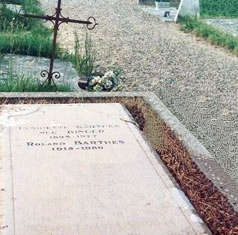
Most of my touchstones make implicit or explicit claims that I in some way agree with. Kafka's "Das nächste Dorf" is not just a pleasant paradox that amuses me but a complex statement about time that helps me sort out how it passes. But sometimes I refer to something again and again primarily because it is a pleasant paradox, as with Roland Barthes's claim about re-reading: if you read a lot of books one time each, you keep reading the same book, but if you read one book twice, then you've read two different books. I've been quoting this claim for over twenty years now, and I don't even remember where it comes from—or whether I even read it at all. Perhaps some grad-school buddy quoted it to me; perhaps he or she has long since forgotten it, while it stuck with me, to be fingered now and then.

It came to me again the other day, this pleasant paradox, and now I've realized that I have always read it in a way that contradicts its content: by quoting it so often, I re-read it multiple times over the years, but it was always the same. And now it's different, and only now that it's different do I understand that it is more than the pleasant paradox I long held it to be. Without realizing it, I'd always understood it in terms of re-reading a book twice in quick succession (perhaps because that's what one does in grad school when writing about a book). Now I see Barthes's claim in terms of re-reading something years or even decades later—or seeing a touchstone anew, after many years of referring to it. The works that accompany me change with me as I grow older—but so do the little fragments that I've torn out of context even as I "re-read" them every time I quote them. And every new book or poem or song or quotation I come across is the same book, poem, song, or quotation as all the others until I give it my attention a second time—or until it makes me pay attention to it a second time. I never know in advance which ones will become new touchstones, but at least I know that the old ones will always be new every time I take them out to touch them.

Thursday, August 04, 2011

Furthur and The Grateful Dead

Furthur is the current band of the Grateful Dead's Bob Weir and Phil Lesh, with John Kadlecik on lead guitar, Jeff Chimenti on keyboards, Joe Russo on drums, and Jeff Pehrson and Sunshine Garcia Becker on backing vocals. The band has played over 100 shows since their first gig in September 2009, and though I have not had a chance to hear them live (since I live in Switzerland and they have not been in Europe yet, and I always miss them by days when I'm in the U.S.), I have listened to recordings of all their shows, thanks to the Live Music Archive and Furthur's own live downloads. Gradually, despite my being a veteran Deadhead (83 shows from 1982-1995), I have come to the conclusion (with a couple of caveats) that Furthur is a better band than the Grateful Dead.

The primary reason is Jeff Chimenti on keyboards. Chimenti's background is primarily in jazz, and he has played with Bob Weir's band Ratdog since the late 1990s, as well as being on keyboards with the various incarnations of The Dead (as the surviving members of the Grateful Dead—Weir, Lesh, Mickey Hart, and Bill Kreutzmann—called themselves in 1003-4 and 2008-9). Simply put, Chimenti is a much better player than any of the Grateful Dead's keyboard players. None of them (Pigpen, Tom Constanten, Keith Godchaux, Brent Mydland, Vince Welnick, or even Bruce Hornsby, whose tenure on piano with the GD was brief but wonderful) ever had the chops to provide a serious second lead instrument alongside Jerry Garcia's leads—and that is exactly what Chimenti adds to the mix. While Garcia always rightly insisted that his lead playing was just part of what the band was doing, the sound of Furthur benefits hugely from Chimenti's leads, both as a compliment to Kadlicek's lead guitar and in how his keyboard solos (whether on piano or organ) take the band's jams in ever new directions.

Drummer Joe Russo is also a better drummer than Mickey Hart and Bill Kreutzmann ever were. I always liked the lightness of Hart and Kreutzmann's playing together, the way they kept the band afloat by never overemphasizing the beat but always playing colors and textures around it. When they started playing the beat more heavily in the late 80s, it detracted from the band's feel to my ears (although this might have been a matter of mixing the snare drum higher, in good 80s style, à la Phil Collins). Russo plays the beat with emphasis and drive, while also keeping the rhythm floating. Both Chimenti and Russo's potent contributions to Furthur can be heard in exemplary fashion in the first set of the July 22 show at the Gathering of the Vibes festival in Bridgeport, Connecticut, especially on "Sugaree," "Deal," and "Big River." (That just happens to be the show I listened to this morning.)

Furthur's quality also derives from the vocal arrangements. The backup singers and the band's obvious serious rehearsal of the vocals give Furthur something the Grateful Dead never had: consistent high-quality harmonies. I love the old recordings of "Uncle John's Band," say, as much as any Deadhead, but Furthur just nails the vocals all the time, while with the Grateful Dead, the vocals were always hit and miss at best. While listening to the Bridgeport "Sugaree" and "Deal," it struck me that, in this respect, Furthur is more like the Jerry Garcia Band in the 80s and 90s, with his excellent background singers. (I even hope that Lesh and Weir will give their backup singers a chance to step forward and sing lead ...)

So Furthur is a better band than the Grateful Dead—but of course, they owe everything to the Grateful Dead. Weir and Lesh are still playing their Grateful Dead repertoire, most of which (despite excellent contributions from Weir and Lesh) was written by Garcia. They should, of course: it's a great catalogue! There are a couple of Furthur originals, and one or two get played per show, but it would be a waste if Weir and Lesh played together without playing their back catalogue together, and as with the Grateful Dead, they play almost the whole catalogue, with no repeats from one show to the next.

Now it's time to discuss the elephant in the room: Jerry Garcia. Overall, Furthur is a better group of musicians than the Grateful Dead, but Furthur doesn't have a Garcia, who was simply one of the best musicians in rock history (and even beyond rock, as his work with David Grisman shows). Yet Garcia was not always at his best, and John Kadlecik is much more consistent than Garcia was in the last few years of his life. Like Chimenti, Kadlecik also has great jazz chops. Early in my listening to Furthur, I kept hearing traces of John Abercrombie in Kadlecik's playing, which turned out to be a matter of the wrong John: Kadlecik's primary early influence (even before he began listening to the Grateful Dead and Garcia)was John McLaughlin. As the lead player in the Dead cover band The Dark Star Orchestra for over a decade, Kadlecik knows how to "be" Garcia; interestingly, Furthur gives him a chance to play Garcia's music while being himself.

So the two caveats on my claim are that Furthur doesn't have Garcia, and that Furthur plays Grateful Dead music and is thus implicitly "derivative." But my argument is finally that Furthur does take the Grateful Dead's music "further," primarily but not only because of the unique contributions of Chimenti and Russo to the band's sound.

A while back, I read a comment on a Furthur show at the Live Music Archive that pointed out that in 20 years, when Furthur is long gone, Deadheads will be listening to the Grateful Dead and not to Furthur. Because of Garcia, that's probably true, even for this Furthur fan, but my response is also that the Grateful Dead's run ended in 1995, and Furthur is happening now. I hope I get a chance to hear them live before they stop happening.

Friday, July 29, 2011

Train Ride

Just before Christmas last year, my family and I were part of a little comic scene on a train, after which my son Miles and I wrote this poem.

TRAIN RIDE

I went down to the station
and made a reservation
to take the train back home.

On the platform, there I stood;
I was feeling very good;
I was talking to my baby on the phone.

The train came down the track,
and without looking back,
I got on and hunted for my spot.

There was a family sitting there,
and they didn't seem to care
about any reservation that I'd got.

I showed my ticket to the guy,
and he could tell me why
my seat was already occupied.

I had gone the wrong way!
I laughed, said, "What a day!"
and tried to enjoy the ride.

Miles Delpho and Andrew Shields
23 December 2010

The World's Pleasure

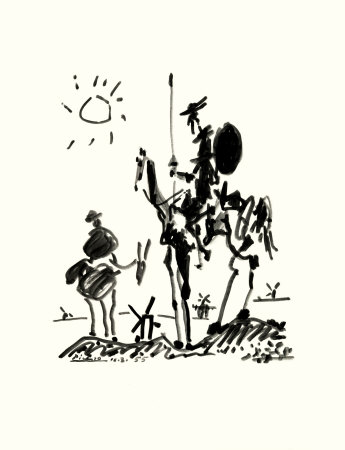
"Don't you see, sir, that the benefits of Don Quixote's recovery can't be compared with the pleasure that his antics provide?"

I found an echo of this remark from Don Quixote (a remark which is one of my touchstones) in All's Well That End's Well, when The Clown says to Parolles: "... much fool may you find in you, even to the world's pleasure and the increase of laughter."

But Parolles, of course, is not finding pleasure in his being treated like a fool, whereas Don Quixote surely does find pleasure in imagining himself to be not a fool. And Smokey Robinson does remind us, after all, that the clown does not necessarily take pleasure in his own foolishness.

Wednesday, July 27, 2011

Bericht für eine Akademie

Ihr Affentum, meine Herren, soferne Sie etwas Derartiges hinter sich haben, kann Ihnen nicht ferner sein als mir das meine.

The ape who narrates Kafka's "Bericht für eine Akademie" was captured in the jungle five years before he speaks to the scientific academy mentioned in the title. In those five years, he has gone through the million-plus years of evolution from his common ancestor with the humans he addresses. Such extreme contrasts are a feature of Kafka's worka, one of my favorite examples being the lifetime that separates one village from another in "Das nächste Dorf".

Here, the extra twist is that one could almost say that all human children go through those eons of evolution as they grow up. But of course it does not quite work, as human children are not apes when they are born, but already quite human.

Still, Kafka's ape does learn like humans do, whether as children or as adults: he learns by "aping" humans:

Ich rechnete nicht so menschlich, aber unter dem Einfluß meiner Umgebung verhielt ich mich so, wie wenn ich gerechnet hätte.

He may not be calculating, but he acts as if he were calculating, and in response to his environment. I am reminded once again of Jonathan Lethem's point in Fortress of Solitude: "The key to mostly anything is pretending your first time isn't."

But there's more to the ape than that, because he is desperate to learn, so he learns/studies the way someone who wants to escape a ghetto might learn/study:

Und ich lernte, meine Herren. Ach, man lernt, wenn man muß; man lernt, wenn man einen Ausweg will; man lernt rücksichtslos.

I had a student once in Saarbrücken who was from a coal-mining family, and he was like Kafka's ape: he worked harder at learning than anyone I have ever met, because, as he explicitly told me, he did not want to be metaphorically trapped in the mine, in a dying industry, so he went to night school to get his high-school diploma (Abitur), and he went to college to get a teaching credential, so that he could teach in his former school, and help others find a way out. No one I have ever taught has been so determined.

As Kafka's ape emphasizes, one does this to find a way out, because only that can truly liberate one who is trapped. Flight is useless; only the way out of going in (into humanity, in the ape's case) can help. There's something slightly frightening about this idea: in order for the outsider to not be trapped completely by his outsiderdom, he must fully integrate himself into the mainstream, at the loss of what makes him an outsider. He must "enter the academy," as it were.

Near the end of his report, the ape produces another image quite common in Kafka's work: sitting by the window and looking out:

Die Hände in den Hosentaschen, die Weinflasche auf dem Tisch, liege ich halb, halb sitze ich im Schaukelstuhl und schaue aus dem Fenster.

Kafka surely dearly loved sitting by the window and looking out in a distracted way, as in the title "Zerstreutes Hinauschauen," but elsewhere as well, as in the wonderful final line of "Eine kaiserliche Botschaft", when the message from the emperor, it is finally admitted, will never get through to you: "Du aber sitzt an deinem Fenster und erträumst sie dir, wenn der Abend kommt."

Kafka's pleasure in that moment of sitting at the window in the evening and dreaming things up seems to me now, on re-reading these works, like a comment on Pascal: "Tout le malheur des hommes vient d'une seule chose, qui est de ne savoir pas demeurer en repos, dans une chambre." Are there any windows in Pascal's room?

Tuesday, July 26, 2011

Calmy-Rey instead of Monet

I've been to several museums in the last few days with my nephew Daniel. Yesterday, my son Miles and I went with him to the Fondation Beyeler in Riehen to see the Brancusi-Serra exhibition, but mostly to see the permanent collection. We were looking forward to seeing Monet's Waterlilies (visible in the middle window of the picture above) and my favorite painting there, Kandinsky's Improvisation 10:But instead, we did not get to see much of the permanent collection at all, because it was closed because a film was being made.

Near the end of our visit, we talked to a guard who was watching the barrier between the final Brancusi-Serra room and the lovely room of Rothkos that was closed, and he told us that the film was a recording of a speech for the Swiss National Day next week by Federal Councillor Micheline Calmy-Rey:

So we did not get to see Monet because of Calmy-Rey.


Saturday, June 18, 2011

The Pen Friend


... a cheap modern cartridge pen by Parker or Sheaffer will last you for years, and write unhesitatingly with a consistent line every time you pick it up.

Ciaran Carson, The Pen Friend

Ciaran Carson's The Pen Friend is an epistolary novel whose narrator, Gabriel, is a collector of vintage fountain pens. Each letter contains a discussion of the pen or pens he uses to write the letter, and the book gradually becomes a celebration of fine writing—meaning fine handwriting, and the tools used to produce it. So it was with great pleasure that I read Gabriel's admission, late in the book, that the beautiful pens he loves so are actually not very good tools for writing. In fact, he admits, cheap modern pens are much better tools than his collection of older, more elegant pens. The modern ones may be boring, but they write better.

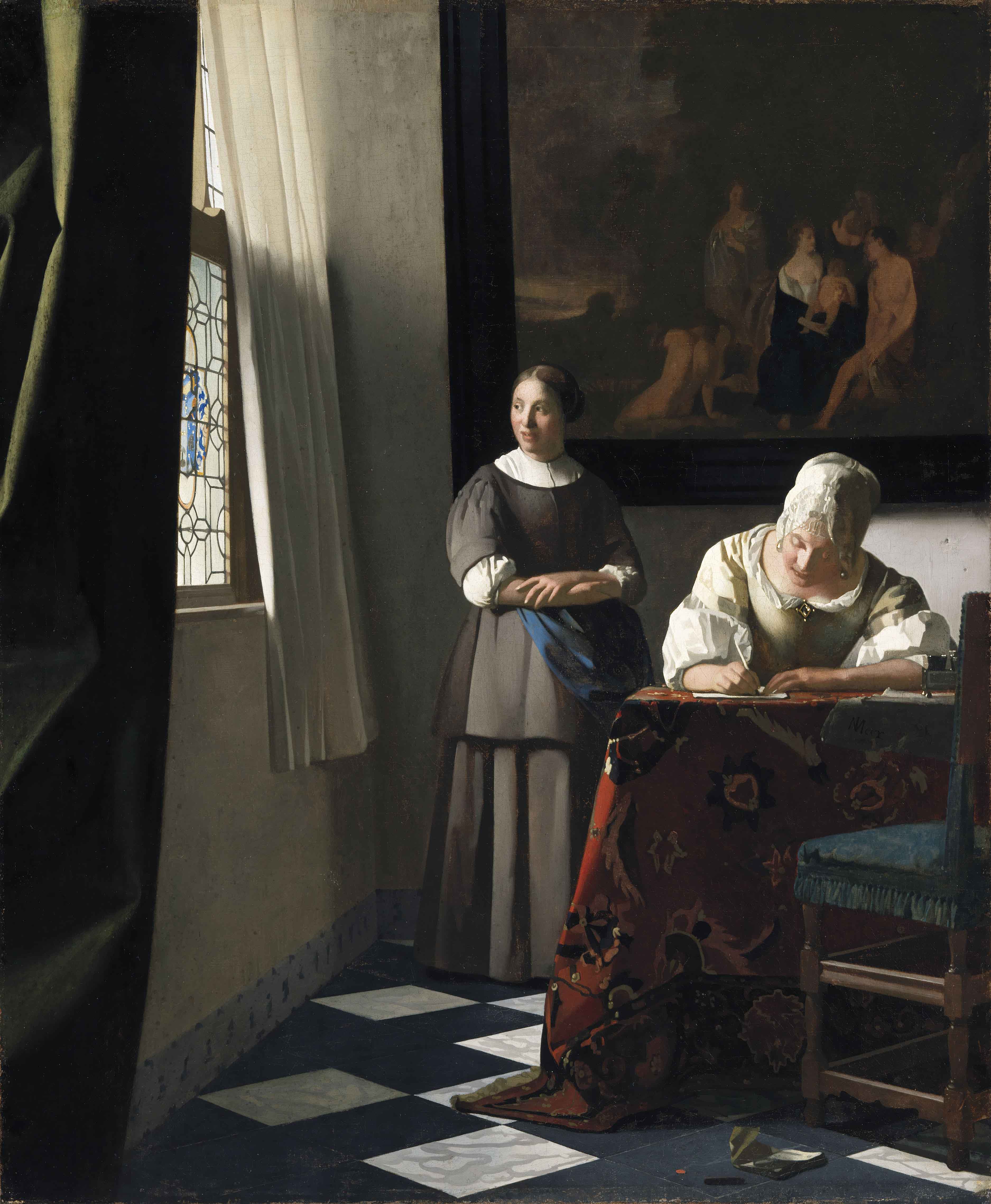
Fortunately, Carson's reflective novel is anything but boring. As with his Fishing for Amber, the novel becomes a reflective essay on all kinds of subjects, while also spinning out variations on his wonderful verse novel For All We Know: Gabriel and his correspondent Nina are the two characters from that book—or at least versions of them. Each of Gabriel's letters is a response to a cryptic postcard from his former lover Nina, and the pictures on the postcards introduce new chapters, as do pictures of the pens Gabriel uses to write each letter. My favorite picture is the Vermeer:


Friday, June 17, 2011

Bright Eyes in Zurich, Bloomsday 2011

At one point in the Bright Eyes show at Kaufleuten in Zurich last night, Conor Oberst asked the audience if it was Thursday. I shouted several times that it was Bloomsday, but all he heard was Tuesday. Perhaps he doesn't know his James Joyce and was thus not aware of the significance of playing the city where Joyce died on the day that Ulysses takes place.

But that's almost the only negative thing I have to say about the show. The band opened with my two favorite Bright Eyes songs, but if I was briefly worried that things would go downhill from there, they proved me wrong. The arrangements were full of dynamic range, from quiet folk-picking passages to explosions of aggressive guitar and punk drumming, and Oberst's singing is just as good live as it is on record: sweet and childlike at times, then veering quickly into a kind of in-tune shouting that is quite hard to pull off.

I said "almost" the only negative thing above, because I do have one negative comment to add, even though it is one that has to do with my expectations about live music rather than the band's performance: they stick quite close to the album arrangements of the songs throughout, giving themselves little room to take the songs to other places. I found this especially ironic in "Beginner's Mind," which Oberst introduced as being about "keeping an open mind when everything is telling you not to," which made the tightly controlled arrangement seem to contradict the song's intent. Only in the three songs of the encore did the band begin to muck about with the studio arrangements to any significant degree—and to great effect, especially in an overwhelming version of "Road to Joy."

But that's me; clearly, Oberst and his cohort are aiming at playing tight arrangements well, and not at exploring more open arrangements. And they do play their arrangements superbly, so it's really only a minor quibble. (And I just happened to look up one of the songs to make sure I was remembering it correctly, and the arrangement on a live YouTube video from 2007 is radically different.)

Setlist:

At the Bottom of Everything
Four Winds
Haile Selassie
Take It Easy (Love Nothing)
Jejune Stars
Shell Games
Approximate Sunlight
Arc of Time (Time Code)
Cartoon Blues
Poison Oak
Old Soul Song (For the New World Order)
Hot Knives
Bowl of Oranges
Lover I Don't Have To Love
Beginner's Mind
The Calendar Hung Itself
The Ladder Song

Land Locked Blues
Road to Joy
One for You, One for Me

Saturday, June 11, 2011

Mystery Dance

On the cover of his first album, My Aim Is True, Elvis Costello strikes a Buddy Holly pose, but the album's music has less Buddy Holly in it—except for "Mystery Dance." Its stops and starts and driving shuffle rhythm recall "Not Fade Away," but Costell0's lyrics provide a completely different perspective on eternal love, the main subject of so many of Holly's songs. "Mystery Dance" shows how early rock-and-roll's euphemistic presentation of sexual desire in terms of dancing and romantic love leaves its listeners unable to just "do it."

The "mystery dance" of sex is what the singer wants to learn, but in the second verse, when an opportunity to try it out comes up, he and his potential partner are at a loss:

Well, I remember when the lights went out.
I was trying to make it look like it was never in doubt.
She thought that I knew, and I thought that she knew.
So both of us were willing but we didn't know how to do it.

The music offers Buddy Holly as a possible place to learn about such things, while the first verse turns to another possible source of information about love for teenagers:

Romeo was restless; he was ready to kill.
He jumped out the window 'cause he couldn't sit still.
Juliet was waiting with a safety net.
He said, "Don't bury me 'cause I'm not dead yet."

Romeo and Juliet are exemplary figures of teenagers in love who are misunderstood by the world around them: the outside world does not want them to "know how to do it." But even they do not actually show or tell their audience what to do when the moment of truth comes.

If classic literature and pop music fail, maybe pornography will help:

Well, I was down under the covers in the middle of the night,
Trying to discover my left foot from my right.
You can see those pictures in any magazine,
But what's the use of looking if you don't know what they mean.

In fact, it's not just pornographic pictures that don't help (in this case, not with sex, but with masturbation), but those "in any magazine": sexy advertisements don't do the job either.

Perhaps the singer ought to ask someone for help, which is what he does in the chorus:

Why don't you tell me 'bout the mystery dance?
I wanna know about the mystery dance.
Why don't you show me 'cause I've tried and I've tried but I'm still mystified.
I can't do it any more and I'm not satisfied.

In a sense, though, he does not ask for help: though he wants to know how to do "the mystery dance," he actually asks why nobody will tell him or show what to do. In a way, he's wondering why nobody has given him a sex-ed class!

The demo version of "Mystery Dance" contains one last verse that turns to one other possible source of information, beyond literature, music, and magazines:

I'm gonna walk right up to heaven dodging lightning and rods.
I'm gonna have this very personal conversation with god.
I said, "You've got the information; why don't you say so?"
He said, "Well, I've been around, and I still don't know."

Religion doesn't help either, and the singer is left with nothing to do but repeat his frustration while the song fades out: "I can't do it anymore and I'm not satisfied."

The singer's lack of satisfaction echoes another bit of earlier rock-and-roll, of course: "(I Can't Get No) Satisfaction." Even Mick Jagger, though, does not offer any help to a frustrated young man: he talks about how unsatisfied he is because of how the radio and the television present images to him that do not satisfy him. Only in the song's final verse does he address sex specifically—but only to refer to a girl who turned him down! We all know that "Satisfaction" is about "the mystery dance," but it's no help for that song's frustrated singer either!

*

The Buddy Holly feel of "Mystery Dance" is already gone by the time the Attractions start playing it:


And these days, the song can sound quite different:


When Bob Dylan does that to his songs, people hate it!