Saturday, March 29, 2008

Smartish Pace 15

Issue 15 of Smartish Pace contains three of my translations from the French of poems by Jacques Réda: "The Jay," "The Milk of Dawn" (a favorite of mine), and "The Dead House." (Note that, as of this writing, the issue is not on-line; I'm referring to the print edition.)

Of the other poems in the issue, I especially enjoyed quite a few:

Gary J. Whitehead's "The Mouse in the House" juxtaposes the sound of a mouse in the house with the memory of the speaker's mother tearing up her late husband's unsent letters to his estranged sister. How's that for a unique approach to the "late-parent" poem?

Mark Yakich has two poems from a sequence called "Green Zone New Orleans," the second of which I put an asterisk by. "You'll never / See your own // Corpse and nobody / Will ever know // Your mind."

Brooks Haxton's "Consort at Bay Window" begins with the beautiful line "Pine ribs in the body of a lute" (I'm a sucker for poems with lutes and mandolins in them).

Christopher Cunningham's contribution, "The Absinthe Drinker," is an ekphrastic poem based on Degas's painting "L'Absinthe."

Jacqueline Berger's "Cigarettes" is a very unusual poem—a "my parents died" poem apparently written before the fact (or at least "before" for the speaker), with the additional twist of its being the smoking fantasies of a non-smoker:

I'm not a smoker,
but I always imagine myself with a cigarette
when my brother and I visit our parents' graves
.

There are two of David Kirby's long, chatty poems; for me, the contrast between the two shows how tricky it is to make his style work: the first, "The Only Good Question" (which turns out to be "What the fuck?"), weaves its various threads together so that they disappear and return with a good sense of timing and a final sense of closure. The second, "Sigourney Weaver, Certified Public Accountant," may be as funny as its title promises, but all the riffing ends up feeling like unmotivated free association without the strong sense of timing and closure of "The Only Good Question." Or rather, "Sigourney Weaver" may provide an intellectual sense of closure, but it does not (at least for this reader) provide an emotional closure.

I read Bradley Paul's "How to Stop Your Doppelgänger from Plagiarizing You" as an excellent variation on "Borges and I," which opens up the dual scene of Borges's test into a triangle: speaker, Doppelgänger, and a "you" that the poem introduces at just the right time (the timing helps the poem be more than just a repetition of Borges).

Bob Hicok has four memorable poems in the issue: "Les fenêtres" juxtaposes a translation of Baudelaire (a translation that seems to be done by someone who does not quite understand the French) with the speaker's inadvertent assumption of a role as a midwife (!). The other three all have some great lines:

We are boring people who thrust our arms
out of cars in the belief that flying
will notice and come to wrap us in the lift-off.

("Hope is a Thing with Feathers That Smacks into a Window")

In a poem about Kenneth Koch:

... I feel free
when reading his "no rabbit stew" poems
to not read them or read bits of them or start one
and think, this is boring, because on the next page
there will be one about which I think, this is like being
a speed-boat painter while the speed boat's
on the lake and tearing my hair out.

("Why Would Your First Guess Be Cock?")

In "Reading to Jesus," which is also addressed to Jesus, the speaker wonders about apologizing to Jesus:

to apologize for ever saying "Jesus fucking Christ,"
for parsing breath into such a twisty
implication of divine self-love, though if anyone
could fuck himself it would be You

And the poem concludes with a dramatic shift of register:

... I bet
You never won at tag, and when the hammer struck
the first time, did You curse the old man or love
this last chance to feel human?

The Hicok poems are followed by Reginald Shepherd's "Miroirs." I have just finished reading his book Fata Morgana, and I am overwhelmed there and in this poem by how wonderfully Shepherd's poems fulfill an aim that he has talked about on his blog and in his essays: how the poem should be an emotional experience prior to understanding. Again and again, his poems produce an emotional effect that can be overwhelming, one that draws me in and makes me want to decipher some of the more riddling passages (the ones that non-readers of poetry would reject as "difficult").

Joseph Harrison's "The Catch" is a ballad stanza that reads like a humorous companion piece to Elizabeth Bishop's "The Fish"; part of the humor comes from the fish at the center of the poem: Asian big head carp, which, the epigraph tells us, "are known for jumping into fishermen's boats."

Gail Mazur's "Little Tempest" recalls the day after the last hurricane: "Everyone was out strolling, everyone seemed pleased / in the aftermath. That cold clear light." (But then, I am a sucker for the word "aftermath.")

Dawn McGuire's "I Sleep in My Clothes" depicts a stroke victim who can still write but cannot read. McGuire, a neurologist herself, boldly approaches her figure in his first-person voice.

Finally, Joanne Lowery's "Pleasing Others" describes how "unsuccessful so far" at doing so, the speaker buries herself, to be dug up after "centuries of solitude" as a major archaeological find, when she will finally "know that I do not disappoint."

The play between understanding and emotion also features in one of my Réda translations, "The Milk of Dawn," which is about hearing Woody Herman as a youth:

In our initiation into poetry,
A major moment was the song beginning: "Milkman,
Keep those bottles quiet" — we never really fully
Understood all of what followed that command.

Robert Fagles

I read and loved the Homer translations by Robert Fagles, and I have his Aeneid on my shelf, waiting for the summer (great summer beach reading, I'm sure!). Sad to hear that he passed away.

Then down they lay at last and took the gift of sleep. (Iliad, 7:558)

carry your well-planed oar until you come
to a race of people who know nothing of the sea
(Odyssey, 11: 139-140)

Thursday, March 27, 2008

To Richard Boyle

When I was reading Alexander Pope a few weeks ago (see my previous posts here and here), I was struck by a point made twice in his poem "To Richard Boyle, Earl of Burlington" (Boyle was an architect):

You show us, Rome was glorious, not profuse,
And pompous buildings once were things of use
.

Or, as Pope puts it later:

'Tis use alone that sanctifies expense,
And splendor borrows all her rays from sense.


I was reminded of Goethe's remarks in Spoleto, at the end of the same century, with the same emphasis on the utility of Roman architecture, in contrast to the alleged uselessness of the architecture of Pope and Goethe's respective contemporaries.

Wednesday, March 26, 2008

Containment

My favorite poem in the March issue of Poetry is "Containment," by one of my favorite poets, A. E. Stallings. She so wonderfully balances the issue of balance, and so precisely captures the scene at the heart of her simile: "a face to match the scolding."

In the Q&A about his poems, Terrance Hayes hauntingly summarizes the skeptic's world view: "There are always questions sleeping next to any of my beliefs." He also quotes something that might help explain the frustration of Barack Obama's pastor: "Have you ever suffered political despair, despair at the organization of things?" Of his poems, I particularly enjoyed "Ode to Big Trend."

All the poets in the issue have such Q&A sections; in his, H.L. Hix addresses the real figures behind the unidentified people in his poems here: "from my point of view a reader will 'get' the poems not by identifying the speaker and the other characters but by identifying with them." Further, he adds, "I mean to invite each reader to hear his or her own emotional experience anew, through the emotional experience of this speaker." In other words, poetry is not about deciphering the hidden secrets of a text but about providing the basis for an emotional experience. To me, Hix leaves out something important: the controlling force of the poem in this experience. The poem is not a realm for the projection of the reader's experience; instead, it projects itself into the reader.

W. S. di Piero's "Johnny One Note" starts from Bobby Hutcherson, the jazz vibraphonist, and does startling things with the sound of the vibes.

The April issue is already online, which shows how long it took me, first, to get the issue in Switzerland, secondly, to read it, and thirdly, to finally post something about it! :-)

Tuesday, March 25, 2008

Memory, Writing, and Democracy

A workshop on "Memory, Writing, and Democracy" will be taking place in Basel on April 4. The focus of the program is on South Africa. The interdisciplinary workshop is organized by the Zentrum Gender Studies, the Department of History, the Department of English and the Centre for African Studies Basel. It is aimed at all interested advanced and doctoral students.

For more information, click here.

Monday, March 24, 2008

Sir Gawain and the Green Knight, translated by Simon Armitage

... I spent so long in your lordship's land / and was hosted in your house ...

Sir Gawain and the Green Knight, translated by Simon Armitage

I read Sir Gawain a few years ago, as translated by Brian Stone, and I enjoyed it, but I ended up with very little clear memory of the story. Everything seemed vague and dreamy in retrospect, even shortly after I had read it.

I doubt that will be the case with Simon Armitage's new translation, which is full of energy and clarity. I enjoyed reading it so much that I tried to convince Miles to let me read it out loud to him, and he let me read the first part and a bit of the second part to him before he got bored, wanting more action. The pleasure of reading this:

So summer comes in season with its subtle airs,
when the west wind sighs among shoots and seeds,
and those plants which flower and flourish are a pleasure
as their leaves let drip their drink of dew
and they sparkle and glitter when glanced by sunlight.
Then autumn arrives to harden the harvest
and with it comes a warning to ripen before winter.
The drying airs arrive, driving up dust
from the face of the earth to the heights of heaven,
and wild sky wrestles the sun with its winds,
and the leaves of the lime lay littered on the ground,
and grass that was green turns withered and grey.
Then all which had risen over-ripens and rots
and yesterday on yesterday the year dies away,
and winter returns, as is the way of the world
through time.

Armitage's alliterations never grow stale, and his attention to the form keeps the language focused and clear. Surprise: I recommend this book highly!

Sunday, March 23, 2008

Fourth Daily Poem Project, Week Five Call for Votes

THE FOURTH DAILY POEM PROJECT, WEEK FIVE

Here are the poems to vote for in week five of my fourth Daily Poem Project (the poems on Poetry Daily from Monday, March 17, to Sunday, March 23):

29. Point of View, by Mary Jo Salter
30. Gardens Down To The Sea, by Samantha Wynne-Rhydderch
31. Future Structures, by William D. Waltz
32. Infinity, by Christopher Buckley
33. Sun Sutra, by Dana Levin
34. The Polish Immigrant, by Peter Skrzynecki
35. Procession, by Michael Miller

This is the fifth week of twelve weeks, at the end of which the twelve winners will be put together for a final vote.

HOW TO VOTE: You can send your vote to me by email or as a comment on the blog. If you want to vote by commenting but do not want your vote to appear on the blog, you just have to say so in your comment (I moderate all comments). (If you read this on Facebook, please vote on my blog and not as a comment on Facebook.) I will post comments as they come in (unless you tell me not to post the comment, of course).

You may vote by the title, the author's name, or the number of the poem in the list above. Please make a final decision and vote for only one poem (although it is always interesting to see people's lists).

Please VOTE BY FRIDAY, March 28! But I will still accept votes as long as I have not posted the final results, which might only be on March 29 or 30. If you would like to receive an email announcing the posting of the results, make sure to get me your email address somehow (if it is not available through your blogger profile or the like, say).

The winner of week 1 was Alison Brackenbury's "Edward Thomas's daughter."
The winner of week 2 was Martha Zweig's "Overturn."
The winner of week 3 was B. T. Shaw's "We End, Like Galileo."
The winner of week 4 was Damian Walford Davies's "Plague."

Fourth Daily Poem Project, Week Four Results

THE FOURTH DAILY POEM PROJECT, WEEK FOUR RESULTS

The winner of the fourth week of my fourth Daily Poem Project is "Plague," by Damian Walford Davies, which received 4 votes out of 13 cast.

The vote was again quite close, with two poems receiving three votes: "Black Baldwin Grand," by Gretchen Steele Pratt, and "Mud Cap," by Dana Roeser. The comments on the votes were fascinating (see the call for votes post).

My thanks to everyone who voted. I'll be posting the call for votes for week five in a few minutes.

Winner of week one: Alison Brackenbury's "Edward Thomas's daughter"
Winner of week two: Martha Zweig's "Overturn"
Winner of week three: B. T. Shaw's "We End, Like Galileo"

Sunday, March 16, 2008

Shake the Hand

My friend Lee Altenberg wrote me an email a few weeks ago with this anecdote. — Warning: Deadhead stuff! :-)

I shook Phil Lesh's hand by the baggage claim in SFO tonight. Both his right and left hands.

When I saw him standing there, I wasn't sure it was him. I haven't seen photos of him since the Grateful Dead, so I am comparing my memories of 13 years ago with this fellow. I looked at how he was dressed — finely tailored leather jacket. Don't rock stars wear leather? My posterior probability was raised.

He was right by the baggage claim chute. I got up the nerve to ask, "Are you stationed right there to grab your bass as soon as it comes down? I ask because you look like a famous bass player, I know."

He said, "I wouldn't check my bass."

Ahah! It was him. "So, you're Phil?"

"Yes."

"May I shake your hand?"

He shook my hand. I had shaken the hand of Bobby Weir years ago when he walked up the car ramp at the Pauley Pavilion. My brother had a method of sneaking back stage where you hide under the bleachers after the show until everyone is gone, and then you just walk out confidently and go back stage — if you are there at that time then you are supposed to be there. We had successfully done this but didn't last long back stage before we were ejected, and ended up by the exit that Bob Weir and his woman would take a bit later. Weir's arms were full, so he gave me his left hand which I shook. Flashing back to the present moment with Phil Lesh, I asked, "Can I shake your left hand? I shook Bobby's left hand years ago."

And he gave me his left hand.

I said, "I love your bass playing, man," and departed. I soon realized that I wish I had really told him of the extent of my appreciation: "I want to thank you for giving me the greatest musical experiences of my life, which I treasure along with Beethoven." Alas, the moment had passed...

Fourth Daily Poem Project, Week Four Call for Votes

THE FOURTH DAILY POEM PROJECT, WEEK FOUR

Here are the poems to vote for in week four of my fourth Daily Poem Project (the poems on Poetry Daily from Monday, March 10, to Sunday, March 16):

22. "Afar," by Allen Grossman
23. "Plague," by Damian Walford Davies
24. "Everything to Measure," by Julia Hartwig / tr. by John and Bogdana Carpenter (please vote only on the first poem)
25. "The Mission," by Matthew Sweeney (please vote only on the first poem)
26. "The Heavenly Ladder," by John Witte
27. "Black Baldwin Grand," by Gretchen Steele Pratt
28. "Mud Cap," by Dana Roeser

This is the fourth week of twelve weeks, at the end of which the twelve winners will be put together for a final vote.

HOW TO VOTE: You can send your vote to me by email or as a comment on the blog. If you want to vote by commenting but do not want your vote to appear on the blog, you just have to say so in your comment (I moderate all comments). (If you read this on Facebook, please vote on my blog and not as a comment on Facebook.) I will post comments as they come in (unless you tell me not to post the comment, of course).

You may vote by the title, the author's name, or the number of the poem in the list above. Please make a final decision and vote for only one poem (although it is always interesting to see people's lists).

I will be out of town for Easter, returning late on Easter Sunday. So I will accept votes until Sunday, March 23 (and I will probably only post the results on Monday, March 24, and the call for votes for week 5). If you would like to receive an email announcing the posting of the results, make sure to get me your email address somehow (if it is not available through your blogger profile or the like, say).

The winner of week 1 was Alison Brackenbury's "Edward Thomas's daughter."
The winner of week 2 was Martha Zweig's "Overturn."
The winner of week 3 was B. T. Shaw's "We End, Like Galileo."

Essay on Man

My edition of Pope begins with "An Essay on Criticism," then things got kind of slow for me for a while; even "The Rape of the Lock" (the title poem of the edition) did not really thrill me. "Windsor Forest" is a charming poem that reminded me of Ausonius's fourth-century poem to the Mosel (the earliest piece of literature known to have been written in what is now Germany), but of course Ausonius himself was working in a long-existing genre, celebrating a particular place in verse. Pope's "Eloïsa to Abelard" did not add much to my understanding of those celebrated lovers, but I was surprised to discover the line "Eternal sunshine of the spotless mind." I've never seen the movie, but it does make me wonder whether it contains a Pope reference or not!

"An Essay on Man," though is a fabulous work. I've always had the lines about "Know then thyself" in my head, without ever having read the poem itself, and I was pleased to discover lots of quotable passages:

Why has not Man a microscopic eye?
For this plain reason, Man is not a Fly.


Behold the child, by nature's kindly law,
Pleased with a rattle, tickled with a straw:
Some livelier play-thing gives his youth delight,
A little louder, but as empty quite:
Scarfs, garters, gold, amuse his riper stage,
And beads and prayer books are the toys of age:
Pleased with this bauble still, as that before;
Till tired he sleeps, and Life's poor play is o'er.

One passage reminded me of Nietzsche's essay on the use and abuse of history:

To each unthinking being, Heaven is a friend,
Gives not the useless knowledge of its end

Pope rejects (as I do) Hobbes's idea of a violent "state of nature" ("her" here refers to "Nature"):

Self-love and Social at her birth began.

I have different reasons for assuming that early humans were social beings, and not isolated enemies à la Hobbes: the gregariousness of the other great apes. Yes, chimps can be pretty violent, but mostly outside their own social group.

It's amusing to come across an idea promulgated by contemporary supporters of free trade:

What War could ravish, Commerce could bestow,
And he returned a friend, who came a foe
.

How does the line go? Something about how no two countries that both have McDonalds franchises have ever fought a war against each other. :-)

My maternal grandmother's maiden name was Howard (I think it's her birthday today; she's ... 93, I think. I better call her!), so I was amused by this couplet:

What can ennoble sots, or slaves, or cowards?
Alas! Not all the blood of all the Howards!


And for those of us who have ever felt the itch to be famous (which is all of us, isn't it?), Pope has an antidote:

What's Fame? a fancied life in others' breath,
A thing beyond us, even before our death
.

"A fancied life in others' breath" so beautifully captures one of the main features of fame!

Now, let's see if I really know the "Know then thyself" couplet:

Know then thyself, presume not God to scan,
The proper study of mankind is man.


I did not get the capitalization of "Man" right, but otherwise, I have always been quoting it correctly. The memorability of the heroic couplet—one reason, apparently, that Pope chose to write even his "essays" in his favorite (only?) poetic form.

Saturday, March 15, 2008

Essay on Criticism

I took Alexander Pope off the shelf off a few days ago, an edition of The Rape of the Lock and Other Poems that I picked up in the U.S. last summer. The first poem in the book is "Essay on Criticism," which surprised me, first of all, by being the source of three proverbial statements:

A little learning is a dangerous thing.

To err is human, to forgive divine.

For fools rush in where angels fear to tread.


But the poem is, of course, much more than its quotable quotes. I was equally struck by Pope's sense of the interplay between rules and the breaking of rules:

If, where the rules not far enough extend,
(Since rules were made but to promote their end)
Some lucky licence answer to the full
The intent proposed, that licence is a rule.

By breaking the rules, then, one may "snatch a grace beyond the reach of art."


As a poet playing the critic of critics, Pope tends to defend the poets, where they deserve defense, in his eyes. The errors one may detect may well turn out to be one's own (in what I have since discovered is an allusion to Horace):

Those oft are stratagems which errors seem,
Nor is it Homer nods, but we that dream.

Or, as I would put it, once a writer or artist has proven to be brilliantly successful in some significant number of works, one should assume that what looks like "nodding" was intentional. I'm not sure I would go as far as Pope to suggest that the problem is then always in the reader, but I am well aware of the role of my own "dreaming" in my response to works. But then, if I dream, perhaps it is not that I am not paying attention, but that the author is not holding my attention.


But perhaps Pope's point, in his reference to Homer, is one he reiterates later, one I wholeheartedly agree with:

A perfect judge will read each work of wit
With the same spirit that its author writ

All too often, critics condemn works for not living up to conventions or standards that the author of the work was simply not interested in. The work should be responded to on its own terms, and not on terms imposed by the critic.


Its didactic side is perhaps the most significant feature, then, of Pope's "Essay on Criticism": Pope wants to tell you how to be a critic. Some of the advice is worth sending to various contemporary critics, for example:

And speak, though sure, with seeming diffidence
...
Blunt truths more mischief than nice falsehoods do.

There is a lot to be said for the confidence of the strong critic, but Pope's points here (and in the whole passage starting in line 560) make clear that an arrogant approach and a self-styled bluntness end up saying less about the work in question than about the critic. For example, I do enjoy William Logan's critical skewerings, but not as commentaries on the poets and collections he addresses. Rather, they are simply performances in their own right—and they lack something truly good reviewing always has: the communication to each reader of the simple sense of whether he or she will like the work, independent of whether the reviewer likes the work. (In fact, it's only as I was thinking about this that I realized that that is lacking in Logan's criticism—I may know that he dislikes a particular collection, but after reading his criticism, I have no sense of whether I will like it or not.)

Fourth Daily Poem Project, Week Three Results

THE FOURTH DAILY POEM PROJECT, WEEK THREE RESULTS

The winner of the third week of my fourth Daily Poem Project is B. T. Shaw's "We End, Like Galileo," which received 6 votes out of 15 cast.

The vote was incredible close the whole way, with the final vote deciding the issue, sending Frank O'Hara's "For Grace, After a Party" into second place with 5 votes. The only other poems to receive votes were the three translations.

Some of the votes, along with comments by some of the voters, are in the comments section of the call for votes from last Sunday.

My thanks to everyone who voted. I'll be posting the call for votes for week four on Sunday (tomorrow).

Winner of week one: Alison Brackenbury's "Edward Thomas's daughter"
Winner of week two: Martha Zweig's "Overturn"

Friday, March 14, 2008

Tyrannosaurus Rex versus The Corduroy Kid

I finally got around to reading Simon Armitage's 2006 collection Tyrannosaurus Rex versus The Corduroy Kid (I had lots of time to read while recovering from pneumonia).

I was not surprised to be so pleased, as I generally enjoy Armitage's poems quite a bit. I'll just mention two here that I particulary liked: "Horses, M62" and this one:

EVENING

You’re twelve. Thirteen at most.
You’re leaving the house by the back door.
There’s still time. You’ve promised
not to be long, not to go far.

One day you’ll learn the names of the trees.
You fork left under the ridge,
pick up the bridleway between two streams.
Here is Wool Clough. Here is Royd Edge.

The peak still lit by sun. But
evening. Evening overtakes you up the slope.
Dusk walks its fingers up the knuckles of your spine.
Turn on your heel. Back home

your child sleeps in her bed, too big for a cot.
Your wife makes and mends under the light.
You’re sorry. You thought
it was early. How did it get so late?

Below the poem, I wrote "and miles to go before I sleep." I highly recommend this collection.

Kurzer Bericht an einer Akademie

Zeilen wie diese überrollten mich, bevor ein Verständnis sie auffangen konnte. (Durs Grünbein, "Kurzer Bericht an einer Akademie")

Lines like the Hölderlin passage he has just cited "rolled over him before an understanding could catch them," says Grünbein in his "Brief Report to an Academy," the speech he gave in October 1995 at the Darmstadt Academy. He was being given the Georg Büchner Prize, for which he gave a different speech; this "brief report" was presented the evening before, when the new members of the academy are asked to introduce themselves (and then the Büchner Prize winner gives a reading from his or her work).

This passage caught my eye when I was rereading the "Brief Report" this week: it so strikingly captures how the experience of poetry comes before any understanding of it. The mystery of the lines "rolls over" the reader and, if the poem is working, suspends the problem of understanding.

This does not mean that "understanding" a poem is not important, though: a poem that cannot be understood at all eventually becomes boring, even if the lines are overpowering (see Clive James on Ezra Pound; my comment on it is here). But the process of understanding is a secondary step; it comes after an experience that makes one want to understand.

*

I was at the Büchner Prize ceremony in 1995. I met Grünbein that day, and Michael Krüger, whose novel The Cello Player I later translated (and who published my poems and an essay on W. G. Sebald in Akzente). But the most memorable event was the self-introduction of the new members. Grünbein's speech was very memorable, as were those by Thomas Hürlimann and Odo Marquard, both of which I can still talk about in detail until this day.

You can ask me about them over a beer sometime. :-)

Thursday, March 13, 2008

Spring

... yesterday, the sky was blue, the wind was slightly chilly, and I drove my son Miles to his drum lesson, opened up the sun roof, and cranked up the Grateful Dead. "Look for a while at the China cat sunflower ..." That's spring ...

Wednesday, March 12, 2008

Snakeskin, March 2008

I have three poems in the March 2008 issue of the on-line journal Snakeskin: "Cigarette," "Baby Clothes," and "Melinda Compton." My apologies to Melinda. :-)

Of the other poems in the issue, I particularly enjoyed Alison Brackenbury's "Three," Maggie Butt's "List," and Colin Will's "Iron Road to Lhasa." Colin's poem reminded me of Christoph Ransmayr's verse novel Der fliegende Berg, which, unfortunately, has still not been translated into English.

My "Cigarette" is a further, even more dramatic example (than "River") of a poem that took its time getting published: it was the first poem I wrote in Philadelphia, which means I wrote it in September 1988. The moral again: stick with the poems you believe in and eventually they will find a home!

Monday, March 10, 2008

For All We Know

The maitre d’ was looking at us in a funny way
as if he caught the drift I sought between the lines you spoke.

Here, in "Second Time Around," the first poem in Ciaran Carson's For All We Know (a perfect example of a verse novel, but one the author has not called that himself), Carson's narrator pursues various ways in which meaning can be elsewhere (anywhere but here, that is): "between the lines you spoke" (a traditional example of meaning being elsewhere), but "the drift I sought" there (trying to find the meaning in what another person says), while the waiter seems to have "caught [that] drift" (trying to find the meaning in a conversation one overhears).

Carson continues with words "insinuating something else," again embedded in the dialogue between the speaker and his conversation partner:

For one word never came across as just itself, but you
would put it over as insinuating something else.

The particular "insinuations" of this couple's conversations are the issue here, not the general philosophical-literary-linguistic problem of slippery language. This is made even clearer in the image that follows:

Then slowly, slowly we would draw in on one another
until everything was implicated like wool spooled

from my yawning hands as you wound the yarn into a ball.

This "drawing in on one another" complicates the previous image of "you" talking and "me" listening, in the process rendering another cliché vivid: after "between the lines," the idea of a story as a "yarn" is suddenly much more complex, involving wool, hands, and the winding of a ball of yarn.


This imagery begins a story that is "told slant," to echo Emily Dickinson. The central event is the couple's first meeting, which does not get presented until halfway through the first section of the book, in "Fall," where they have just "exchanged names" when "the bomb went off at the end of the block":

... and drowned all

conversation. All the more difficult to find the words
for what things have been disrupted by aftershock and shock,

a fall of glass still toppling from the astonished windows,
difficult to ponder how we met, if it was for this.


The line about the "fall of glass" took my breath away while I was reading and was my initial reason to quote this passage, but of course it also plays into the theme of uncertain, ambiguous meaning that opens the book.

Shortly thereafter, "Birthright" explores the identities one tries to establish for oneself and the identity that one is finally unable to abandon:

For all that you assumed a sevenfold identity
the mark of your people's people blazes on your forehead.

The malleability of meanings ends up running into the immutable identity one receives at birth: being Irish, being Catholic or Protestant. Still, "whatever happens to you next is nothing personal."


When you begin Part Two of For All We Know, something will seem familiar: the title of the first poem, which is again called "Second Time Around." In fact, the poems in the second part of the book have the same titles as those in the first, in the same sequence. This doubling allows Carson to explore what is "between the lines" further, as the second poem always reflects (if often only indirectly) back on the first.

That does not keep the individual poems from standing out on their own terms. In the second poem called "Treaty," for example, the poem's "you" tells the narrator about growing up "between languages": "My mother spoke one tongue to me, my father another." This resonates with me, though not because of my own upbringing—my wife and I are raising bilingual children. And the resonance is increased when the speaker later adds: "When I learned to write, that was another language again." My children learn English and German at home, and Basel German dialect at day care, then learn to write in German at school, so their layering is similar to that of the speaker's experience here.

The doublings of the poems through the repetitions of the titles is most explicit in the pair of poems called "The Shadow." Echoing a scene from the beginning of the film "The Lives of Others," in which Ulrich Mühe is lecturing to future Stasi officers, the first poem begins:

You know how you know when someone's telling lies? you said. They
get their story right every time, down to the last word.

Whereas when they tell the truth, it's never the same twice. They
reformulate.

The poem later refers to Herman Hesse's The Glass-Bead Game, which becomes the central topic of the longer, second poem called "The Shadow":

It's like this, you said. Those who play the Glass Bead Game don't know
there's a war on they're so wrapped up in themselves and their game.


I've discussed this book at some length in order to more than simply say "get this, it's brilliant." But that's what I want to say in a nutshell. Like his namesake Anne Carson in Autobiography of Red, Ciaran Carson has used the narrative form to channel his playful, explosive side into a shape whose power only increases as one continues reading. In the past, I have always been impressed by C. Carson's work, but not moved. This book is deeply moving, and it concludes with an allusion to a deeply moving film that is just as elusive, Hiroshima mon amour:

You woke up one morning and said, I must go to Nevers.

All that's left after this second poem called "Je reviens" is the concluding poem, "Zugzwang," built, like the first "Zugzwang," around a long, Dante-esque simile. Six times the speaker begins couplets with "as" before concluding:

so I return to the question of those staggered repeats
as my memories of you recede into the future.

*

For All We Know is the Poetry Book Society Choice for Spring 2008. I've read the recommendations already, too:

Jen Hadfield, Nigh-No-Name
Julie O'Callaghan, Tell Me This Is Normal
Stephen Romer, The Yellow Studio
Kathryn Simmonds, Sunday at the Skin Launderette


Hadfield's book (the first one I read) struck me as quite flat, except for two excellent cat poems at the end. That was a disappointing start, but things got better through the rest of the Recommendations and then Carson's book.

Stephen Romer is another expat, an English poet who is a professor in Tours. His Yellow Studio is a book full of excellent details, along with a goodly number of strong individual poems. There's a fullness to his writing that makes it resonant even with the poems that are not as strong individually.

there were tears, along with tequilas ... ("Recognition")

He requires a definition // and all we can give him are instances... ("A Bridgehead of Sorts")


O'Callaghan's book is a "New and Selected," so it would have been quite startling to have the book seem as flat Hadfield's collection; after all, you should have a certain degree of quality to reach the stage of a "selected poems"! And her book is quite strong. The poems are often quite humorous: "Life is way too short / for blasé colours" ("Spring Robe"). Or a description of Dietrich Fischer-Dieskau singing, in "Saturday Afternoon in Dublin":

Dietrich, meanwhile, has moved on to a beautiful, sad,
song with harps—I'm glad I don't know any German—
it's even sadder hearing words sung
that make no sense.
He says, "Ja, ja," better than anyone.

O'Callaghan was born and raised in Chicago, but lives in Ireland, so it's no surprise, I guess, that she has some expatriate poems that move this expatriate (born in Detroit, living in Switzerland), such as "Home," which you can read all of here (scroll down a bit). The reverse of being an expat is the experience of being back where you raised and finding things different, if only in the slightest ways, as in the poem "Sipper Lids," where O'Callaghan describes not having known what to do with the sipper lid on her hot cup of coffee to go!

In her debut Sunday at the Skin Launderette, Kathryn Simmonds demonstrates that she is a great lister—in fact, though her lists are always convincing and interesting, she demonstrates her skill with lists a tad too often. Still, when her lists are not the whole poem, but are fully embedded in scenes, then the poems work exceedingly well, as in "The Men I Wish I'd Kissed," or even more so in "The Woman Who Worries Herself to Death" and "Handbag Thief." And "Tate Modern" is a memorable poem about contemporary art, as the speaker discovers at the end of the poem that the installation she had liked best (with its abandoned coffee cup, stepladder, and tools, among other things) was a room that was "out of use," that is, closed for renovation.

All in all, not a bad set of Choice and Recommendations: a superb Choice (Carson), two very strong collections (O'Callaghan's and Romer's), one promising debut (Simmonds), and only one book that left me flat (Hadfield's).

(One thing I've noticed: write about a collection by an American poet, and you're bound to find lots of on-line poems to link to. British and Irish poets do not publish as many poems in advance, so many fewer end up on-line as possible links for a blog review!)

Garfield Minus Garfield

Thanks to Seth Abramson for the link to the truly brilliant Garfield Minus Garfield, in which an intrepid Photoshop editor removes Garfield from Garfield strips and produces something quite brilliant.

Sunday, March 09, 2008

Fourth Daily Poem Project, Week Three Call for Votes

THE FOURTH DAILY POEM PROJECT, WEEK THREE

Here are the poems to vote for in week three of my fourth Daily Poem Project (the poems on Poetry Daily from Monday, March 3, to Sunday, March 9):

15. The Other, by Eugenio Montejo / tr. from Spanish by Kirk Nesset
16. For Grace, After a Party, by Frank O'Hara (please vote only on the first poem)
17. Lane of Blue Mist, by James Haug
18. Family Dinner, by Marina Colasanti / tr. from Portuguese by Cristina Ferreira-Pinto Bailey
19. We End, Like Galileo, by B. T. Shaw
20. The Moment of Exchange, by Emmy Hunter (please vote only on the first poem)
21. The Return, by Ronald Augusto / tr. from Portuguese by Isis McElroy

This is the third week of twelve weeks, at the end of which the twelve winners will be put together for a final vote.

HOW TO VOTE: You can send your vote to me by email or as a comment on the blog. If you want to vote by commenting but do not want your vote to appear on the blog, you just have to say so in your comment (I moderate all comments). (If you read this on Facebook, please vote on my blog and not as a comment on Facebook.) I will post comments as they come in (unless you tell me not to post the comment, of course).

You may vote by the title, the author's name, or the number of the poem in the list above. Please make a final decision and vote for only one poem (although it is always interesting to see people's lists).

Please VOTE BY FRIDAY, March 14! But I will still accept votes as long as I have not posted the final results, which might only be on March 15 or 16. If you would like to receive an email announcing the posting of the results, make sure to get me your email address somehow (if it is not available through your blogger profile or the like, say).

The winner of week 1 was Alison Brackenbury's "Edward Thomas's daughter."
The winner of week 2 was Martha Zweig's "Overturn."

Saturday, March 08, 2008

Fourth Daily Poem Project, Week Two results

THE FOURTH DAILY POEM PROJECT, WEEK TWO RESULTS

The winner of the second week of my fourth Daily Poem Project is Martha Zweig's "Overturn, "which received 5 votes out of 17 cast.

Two poems tied for second with 3 votes: Ciaran Berry's "For the Birds" and Adélia Prado's "The Dictator in Prison" (tr. Ellen Doré Watson).

Some of the votes, along with comments by some of the voters, are in the comments section of the call for votes from last Sunday.

My thanks to everyone who voted. I'll be posting the call for votes for week three on Sunday morning.

Winner of week one: Alison Brackenbury's Edward Thomas's daughter

(In case you did not see her comments, Brackenbury commented on my post about her poem.)

Thursday, March 06, 2008

Jeff Tweedy on migraines

Fans of Wilco, as well as those who suffer from migraines (or know those who do), will be interested in Wilco front-man Jeff Tweedy's discussion of his migraines (and depression and panic attacks) on the New York Times blog about migraines.

Sunday, March 02, 2008

Fourth Daily Poem Project, Week Two call for votes

THE FOURTH DAILY POEM PROJECT, WEEK TWO

Here are the poems to vote for in week two of my fourth Daily Poem Project (the poems on Poetry Daily from Monday, February 25, to Sunday, March 2):

8. For the Birds, by Ciaran Berry
9. Overturn, by Martha Zweig
10. Dwarf in the Shade of a Eucalyptus, by Elton Glaser
11. The Dictator in Prison, by Adélia Prado / translated from the Portuguese by Ellen Doré Watson
12. A Place in Tuscany, by David Malouf
13. Prepare, by Danielle Grace Warren
14. Nora Barnacle's House, by Gerard Smyth

This is the second week of twelve weeks, at the end of which the twelve winners will be put together for a final vote.

HOW TO VOTE: You can send your vote to me by email or as a comment on the blog. If you want to vote by commenting but do not want your vote to appear on the blog, you just have to say so in your comment (I moderate all comments). (If you read this on Facebook, please vote on my blog and not as a comment on Facebook.) I will post comments as they come in (unless you tell me not to post the comment, of course).

You may vote by the title, the author's name, or the number of the poem in the list above. Please make a final decision and vote for only one poem (although it is always interesting to see people's lists).

Please VOTE BY FRIDAY, March 6! But I will still accept votes as long as I have not posted the final results, which might only be on March 7 or 8. If you would like to receive an email announcing the posting of the results, make sure to get me your email address somehow (if it is not available through your blogger profile or the like, say).

The winner of week 1 was Alison Brackenbury's Edward Thomas's daughter.

Saturday, March 01, 2008

Basement Brothers


Soul-music fans in Basel should head out to the Rossstall at the Kaserne next Friday, March 7, to get down and dirty with The Basement Brothers, featuring The Kitchenettes (what a long band name!). You can hear some samples on their MySpace page.

Here's the German announcement:

CD TAUFE

Speak Up! (When You Say Love) - die brandneue CD der Basler Soul Band The Basement Brothers feat. The Kitchenettes wird mit einer grossen Party getauft. Die Band spielt ein komplett neues Programm und hat einige Gäste mit auf der Bühne! Hörproben gibts jetzt schon auf Myspace.

Kaserne Basel, Rosstall
7. März 2008, 21.00
Aftershowparty: Rude Attack DJs, Northern Soul und Early Reggae vom feinsten!
VVK: Roxy Records oder
https://www.starticket.ch/0Numberoftix.aspShowID=18024&CategoryID=30611&ZoneID=&ShowDetails=1


http://www.kaserne-basel.ch/go/id/gph/date/gpi/

http://www.kitchenettes.ch/
http://www.myspace.com/thebasementbrothersfeaturingthekitchenettes


Neues vom alten Soul
Am 7. März 2008 um 22 Uhr ist es soweit: The Basement Brothers feat. The Kitchenettes aus Basel taufen ihre erste CD mit eigenen Northern-Soul-Stücken in der Kaserne. In der After-Show Party legen Rude Attack aus Luzern auf. Pomade ins Haar, Tanzschuhe an die Füsse und los geht's!
Vier Jahre hat es gedauert - von der Gründung der Band an gerechnet - bis The Basement Brothers feat. The Kitchenettes ihre erste Platte mit eigenen Stücken im Studio eingespielt haben. Gut Ding will eben Weile haben. Dafür ist dabei ein äusserst gut Ding entstanden: Aufgenommen in Ray Davies Konk-Studios in London kommt hier eine Platte auf den Markt, die alle echten Fans des ehrwürdigen Northern Soul begeistern wird. Songs für die Tanzfreudigen fehlen ebenso wenig wie die ruhigeren Töne. ?SPEAK UP (when you say love)" ist eine CD mit zwölf eingängigen Songs, die an den Northern Soul angelehnt und mit eigenen Ideen gewürzt sind. Die CD erscheint unter dem Hamburger Label copaseDisques und wird vertrieben von Cargo Records Deutschland. Erhältlich wird das Werk zum Beispiel im Roxy in Basel sein.

Ohren- und Augenschmaus garantiert!
Wenn sieben smarte Jungs, die ihr Instrument beherrschen und drei Mädels, die den Soul in der Stimme und in den Hüften haben, auf der selben Bühne stehen, ist ein Feuerwerk garantiert. Extra für die CD-Taufe kommen nun aber noch vier Streicherinnen - sie haben die Band bei der CD-Aufnahme bereits unterstützt - und ein Perkussionist/Vibraphonist. Ob 15 Leute auf der Rossstall-Bühne der Kaserne Platz haben? Keine Ahnung, aber heiss wird es auf jeden Fall! Die eigenen Songs ergänzt die Band mit neu einstudierten alten Soul-Perlen. Neue Streicherinnen, neuer Perkussionist, neue Songs, neue Hüftschwünge, gute alte Musik: Das Publikum darf gespannt sein!

Bis die Nacht zum Morgen wird...
...können alle Soulfans an diesem 7. März tanzen. Im Anschluss an das Konzert legen Rude Attack aus Luzern early Reggae und Soul auf, bis die Vögel pfeifen. Die besten 60er Jahre DJ's, welche die Schweiz zu bieten hat zum krönenden Abschluss dieser Soulnacht, was will man mehr? Also nichts wie los: Tickets gibt's im Vorverkauf bei Roxy Records oder unter www.kaserne-basel.ch.

Fourth Daily Poem Project, Week One Results

THE FOURTH DAILY POEM PROJECT, WEEK ONE RESULTS

The winner of the first week of my fourth Daily Poem Project is Alison Brackenbury's Edward Thomas's daughter, which received a clear plurality: 7 votes out of 18 cast.

In second place was Bob Hicok's By way of introduction, which received 4 of the remaining votes.

Some of the votes, with some comments by the voters, are in the comments section of the call for votes from last Sunday.

The first and second place poems were two of the three I considered voting for; in the end, though, I voted for Stemming from Stevens, by Lisa Williams. I seem to have been the only person who liked that poem, as I was the only one to vote for it!

I posted a separate post on Brackenbury's poem here.

My thanks to everyone who voted. I'll be posting the call for votes for week two on Sunday morning.

Friday, February 29, 2008

LSD

[Here's another piece of prose from the last millennium.]

LSD

The first time was in a nightclub. Chris held the three small tabs of pink gel on his palm for Doug and me to look at. We each took one, washing them down with a swig of beer. The metal dance floor in front of the stage was slick and cold despite the summer heat. When the band came on, Doug danced in the back, while the stage pressed me and Chris against the people behind us. The fingers on the frets played all of my strings.

The second time was at another concert, at a fairground by the beach. Dave and I had spent the night with my brother twenty miles up the coast; I had drunk too much beer and was sick. Still, on our way to the concert, I took the dose I had brought along. We strolled across the dusty parking lot and went through the gates — more dust, yellow paint on Dave's loose all-white outfit. While the band played, seagulls flew over the stage like lost words; I spoke them, joined them as they veered above the waves.

On our way back to my brother's apartment that evening, we hitched a ride in a pickup truck. Afraid to sit in the back, I chose the passenger seat in the cab, leaving Dave to feel the wind. Only as we were on the highway heading straight west into the setting sun burning orange over the ocean into my eyes did I think that I would have to talk to the driver. My mangled syntax must have clued him in: as he dropped us off he said, "Have a nice trip."

My brother wasn't home. We sat on the lawn outside his apartment complex, waiting. Dave made an ironic remark about not having his burgling tools; as I did not know how locks work, he began to draw pictures on paper from his notebook, explaining keys first and then how to trick a lock into thinking the burglar's various metal strips were really the key to open it. Suddenly a police car was circling into the parking lot. "This is not the best place to be talking about burglary!" Dave noticed. I laughed: "Especially while tripping!" "You're tripping?" Dave exclaimed. "Then we definitely better not sit here any longer."

Across the highway was a restaurant with great milkshakes which I'd had before with my brother. The cold chocolate iced my mouth; I only spoke to say, "I'll try to call my brother again now." Finally he came home, and we headed back over the highway for the night.


Eric and his friend Cran came to the café and asked for some of my liquid for a trip in the hills under the full moon. My shift was just ending, so I went home with them, decided to join them. We took the drops and began to head toward the foothills behind town, me tying on a bandana, Eric tying his jeans shirt around his waist. "Don't you want to leave that in my room?" I asked; "No," he laughed, "you never know when you might need a good heavy shirt."

The road into the hills branched at the top of a steep climb; we split the difference and headed through the long yellow summer grass. In a valley on the other side were the dry bones of mammoths; lifted, they became intricate old branches, far from any tree. Up another hill, we saw a tree the branches might have come from; its canopy enclosed us; it held us as we climbed. Jumping down, our bodies left trails in our eyes. Further up the hill, a narrow asphalt road was giving off the day's heat into the night. The untraveled way surrounded us as we lay on the warmth, looking at the moon and stars, listening to the heat turn into voices, and then a couple walked up with their dog, she in a mini-skirt, he bare-chested. "Beautiful evening," he said. "Yeah," was all we could answer, sitting up.

The road curved around the crest of the hill, but we went straight over the crest to a steep descent on the other side, the grass brushing our legs, the footing unsure. When I met the road again, ahead of the others, a log by the side of the road offered me a place to sit for a moment to wait for Eric and Cran.

Something moved on my finger. I brushed it away, hot iron burned my hand, sent me into the air, springing across the narrow road, Eric and Cran stock still as they heard me scream, "The buzzing! The buzzing!"

The swarm around my ears chased me back down that steep road we'd come up before. "The buzzing! The buzzing!" — and Eric had caught me, enclosed me in his tight embrace, "There's no buzzing! There's no ..." — he had heard the swarm and as I broke from his loosening grip Cran cried, "It's in his hair!" — coming up behind me to tear off my bandana and set free the wasp trapped behind my ear.

The adrenalin was gone, though my heart was still beating. "I thought I had finally seen someone freak out on acid," said Cran. "Do you want my shirt?" asked Eric.

Thursday, February 28, 2008

Ethics

[Here's a story I wrote a while back (before 1999 at least). I've got a few of these short shorts lying around, back from when I still occasionally put stories in prose.]

ETHICS

She walked slowly across the parking lot, feeling the heat from the asphalt through her thin sandals and on her bare legs, precariously balancing her donut on the hot Styrofoam cup of coffee while fumbling with her keys. As she was putting the coffee onto the roof of the car, a young man trying to steer his bicycle while carrying a large bag of groceries lost control and fell over onto the hood of the car.

They looked at each other.

She saw a young man with long hair, a scraggly beard, an outrageously bright tie-dye T-shirt, and cut-off jeans with holes around the pockets. He put the bag carefully down and untangled himself from his bike.

"I hope you haven't made a dent," she said as he picked up the stray groceries and put them back into the bag.

"I don't think so," he said, glancing at the hood for a moment. "Looks all right to me." He picked up his bag and reached down carefully to pick up his bike.

"I don't know," she said, leaning down for a closer look. "Isn't this where you fell?" she asked, pointing.

He followed her finger. "Yeah, I guess it is," he said with a sigh. Reaching his leg cautiously over his bike, he added, "It's not such a big deal, is it? I don't know much about cars, but it looks pretty easy to fix." He set his foot on the pedal.

"This is a brand-new car. I just bought it last week."

He looked at her. "So?"

"When they hammer out the dent, they'll have to repaint the hood," she added.

"But if it's new, it's covered by a guarantee, isn't it?"

"Accidents aren't covered by guarantees. Don't you have a car?"

"If I had a car, I wouldn't be carrying groceries on my bicycle." He laughed. "In fact, I've never owned a car."

"Oh." She paused. "Look, I'm in a hurry right now. Give me your name and I'll call you when I've gotten an estimate."

"An estimate?"

"An estimate of how much it will cost to repair this."

"You want me to pay for it? Doesn't insurance cover stuff like this? It's just a tiny dent."

"Your insurance would cover it, if you had any. My insurance rates would go up if I asked them to pay for it. Is that fair?"

"No, I guess not. Look, I'll give you my name if you give me yours."

"Okay," she said, pulling two of her cards out of her wallet. She gave him one and wrote his name and telephone number on the other.

"Oh, you're at the university," he said. "Assistant Professor of Ethics. I just graduated last year."

"I just started this year," she said, climbing into her car. "Look, I'll call you as soon as I have the estimate."

"Okay. Bye."

"Bye."

As she waited to turn into the street, she saw him riding off. Once he got some momentum, he seemed to be in complete control of his bike.


At first, she thought she had lost his number. A friend had told her she was stupid anyway: "He's almost sure to have lied to you. Would you have given your real name and phone number to someone in such a situation? You should have asked to look at his license or something."

"Well, I didn't think of it. The whole thing took me by surprise."

"Your insurance would probably cover it without raising your rates. Why not try them?"

"Are you kidding? With my last car my rates kept going up every time I reported anything. It got so it seemed like they'd raise my rates every time I ran low on gas."

So when she finally found the card again and dialed the number, she didn't expect anything more than those three shrill tones and the announcement that the number was "not in service at this time."

Instead, a woman answered, somewhat older from her voice, but probably not old enough to be the young man's mother. She asked for him.

"Sure, just a second." She heard a loud voice calling the young man's name, and a "coming" echoing back.

Another extension. "Hello?" It was the same young man.

"Well, I'm happy to hear your voice."

"Oh, hi. Did you get an estimate?"

"Yes. Was that your mother?"

"No, my Mom lives back East. That was my landlady. I work as an au pair for her family. She has a four-year-old son."

This was a bit surprising, so she didn't say anything for a moment.

"So what's the damage?" he asked.

"Around three-hundred-fifty dollars."

"Shit."

"You don't have it, do you?"

"Well, no."

"Don't you get any money for your work?"

"Well, I was working part-time and doing the au pairing, but I just quit my job, and my cash flow is almost nonexistent."

"Well, where does that leave me?"

"Look, I have a friend who owns a garage. He said he could give me a good deal on it. Could we get a second estimate?"

She was surprised again. "I don't know. I don't know this friend of yours, after all."

"Well, it can't hurt to get an estimate, can it?"

"Look," she said. "It's my car. I want the repairs done by someone I know and trust."

Now he seemed surprised. "But --"

"All I want to know," she interrupted, "is whether you can get the money or not. Otherwise I'll have to go to my insurance company, and they'll come and ask you for the money."

"Really?"

"Yes," she said. "But I don't want to have to do that. You were nice enough to give me your real name, so I'd rather not have to hassle you with the insurance company."

"Did you think I would have lied about my name?"

"I wasn't sure. A friend of mine was sure you would have lied. She said I should have asked you for your license."

"But I said I don't have a car. Would you have lied in my position?"

She didn't answer. She didn't want to answer. "Are you going to be able to get the money?"

"Okay, look. Maybe I can. I have to check with my Mom. I'll call you again tomorrow."

"Make it tomorrow afternoon. I'll be teaching in the morning."

"Okay, I'll call you around two," he said. "Bye."

"Bye."


At 1:30, after eating lunch, she sat down on the deck with her newspaper, which she'd saved that morning just for this purpose. She didn't want to try to do any work before he called; the call would just break her train of thought. So she settled down with the news, which she hadn't been able to follow very closely lately.

She loved to take the time to read the newspaper closely, especially on such a lovely afternoon. The wood on the deck was beginning to get quite hot, but a light breeze was blowing, just enough to keep her from wanting to go inside. She sipped a drink and slowly turned the pages.

After she'd worked her way through two sections of the paper, with a break between to read the comics, she looked at the clock. It was 2:30. Maybe he was turning out to be a flake after all. Her friend had continued to doubt him: "Why didn't you get his address? You should have asked for his mother's address. Some people like that are always asking their parents for money. You're really much too trusting!"

She got up to go call him herself, but then the phone rang just as she was reaching for it.

"Hello?" she said.

"Hi, it's me," he said.

"Good. I was just about to call you."

"You were?"

"Well, it's 2:30. You said two o'clock. I can't wait for your call all afternoon. I've got work to do."

"Sorry. I had to wait until Trevor's Mom came home."

"Trevor?"

"He's the kid I take care of. Really cool. He sees right through anything people see. It's almost uncanny sometimes."

"Look, did you talk to your mother?"

"Yeah, she's going to send me the money. But things might get a little complicated."

"Complicated?"

"Well, she's mailing me a check, which will take a couple of days. Then the check has to clear. But by the time it clears, I'll be gone, so I can only mail you a check from my account."

"You want to mail me the check?"

"Yeah, is something wrong with that?"

"Where are you going?"

"See, I'm leaving to go off to grad school next week -- in five days, to be precise. That's why I quit my job. All my stuff is packed up and stored or being shipped -- everything's ready. And somehow I have to get this check to you without having it bounce."

"Okay, look. You can mail it to me -- my address is on the card, right? But you're going to mail it, right? And it's going to be good?"

"Hey, don't worry about it. If I've gone this far, I'm not going to rip you off now. As long as you don't deposit the check too quickly, then everything'll be okay."

"Okay, okay." She paused. "What are you going to study?"

"Philosophy," he said. "Ethics."


When the check arrived, earlier than she'd expected, she put it on her things-to-do pile with several other checks, setting aside the envelope with his note in it. When she went to the bank the next day, she took all the checks with her and deposited them. She was rather annoyed when the check bounced.

"I was very disappointed," she wrote, "that your check wasn't good, after you'd been so trustworthy until now. Please send me another check as soon as possible."

His reply was prompt. The check was enclosed with a brief note complaining that she had deposited the first check too soon, even though he had asked her not to in his letter. "What letter?" she thought, and then she remembered the note that she had only glanced at.

The second check was good.

Wednesday, February 27, 2008

Tussi Research

My latest book publication is now available from Green Integer: Tussi Research, by Dieter M. Gräf, translated from the German by yours truly. Get yourself a copy from GI directly; check the GI blog for more info here.

My first volume of Gräf translations, Tousled Beauty, is still available, too, of course.

Here's something from Tussi Research:

31.8., DIANA

since when then does blood
come out of plastic chairs?,

their red: just can't keep
throbbing!, but it dissolves,

now it's dripping from
the radio, too, a trickle

toward the clearing. The
yapping dogs. There

she lies: snapped, dead.

Blandus

I love the coincidences that poetry provides its readers with. This morning, reading Durs Grünbein's Strophen für Übermorgen while suffering from laryngitis:

BLANDUS

Fern die Stimme, wie vom Häusermeer bedrückt:
Dieser Hauch Metropolis, der Mitleid weckt.
Schnell verhalt ist sie am Stahlbeton der Brücken.
Kurz nach Luft geschnappt, hat keinen angesteckt.
Die Sekunde Gegenwartsie gibt ihr Halt.
Psyche, im Versteck der Stadt, wie immer bland,
Schattenlos dort hüscht sie über den Asphalt.
Schwach die Stimme, ist sich selber unbekannt.

Essay on Rooms

ESSAY ON ROOMS

Gerhard Richter: Ein Saal und ein Kabinett für die Sammlung, Kunstmuseum Winterthur, 1998
Andreas Gursky: Photographs 1994-1998, Photomuseum Winterthur, 1998
Andreas Gursky, Kunstmuseum Basel, 2007-2008

I still remember how the room was hung:
the student nurses, black-and-white, adorned
the farthest wall but caught the entering eye
as much as the painted-over copies of Titian,
the 1,024 distinct squares
of color in the color field, the flat
expanse of an all-gray painting, or
the Technicolor smearings of abstraction
pursued in the vertical painting at the near end.

I'd gone to Winterthur to see that room,
so the impression that it made was partly
merely satisfying expectations.
But art remembered even ten years later
as vividly as victory or trauma
has done what it's supposed to do: become
experience, not opinion, an idea
that one has felt, a feeling one has thought.

There was a second room that day that did
the same, becoming vivid memory,
without anticipation as a factor.
In another museum, photographs:
a stock exchange, at the height of trading;
computer operators in their rows;
a night-time high-rise, so many windows lit;
a hotel's open, layered atrium;
a plain of snow in front of mountains, crossed
by Nordic skiers—escaping, I first thought,
from the everyday stress depicted in
all the other photographs. But later
I learned it was a skiing marathon,
a race that made the room into a place
with no way out, between the mass of skiers
and endless lines of sellers, terminals,
skyscraper windows, and hotel floors and doors.
The mass experience put into a room
for individuals to recognize.

It stuck with me for years, that room, a vision
of the world in which we've come to live.
Exaggerated, even simplified,
but brought down to the level of perception;
too general, abstract, but palpable,
returning as a feeling in the mind
in every place where rows and lines would form;
in airports and railway stations; on beaches and highways;
wherever I took a ticket to be served.

And now, a decade later, room after room
of photographs that have expanded with
the artist's stature—one room first and foremost:
a Grand Prix racetrack in the Bahrain desert,
seen from so high up the cars are lines
of brightness barely seen against the track;
the Tour de France, a climbing stage, the switchbacks
ascended by as many cars as bikes,
past the greetings painted on the road;
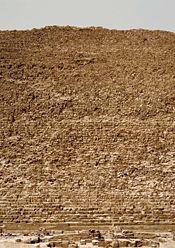
and "Cheops," nothing but stones so neatly stacked
three thousand years ago. If the skiers seemed
at first to be a way to get away
but then became one race among so many,
the pyramid seems at first anomalous,
a remnant from a time before races.
But history is no escape; the lines
constructed by the Pharaoh's slaves reveal
how long the races have been run already.

(And if I did not feel the same about
the other photos in the new exhibit?
They made me think about the spectacles
the artist chose to photograph—the pit stops;
the North Korean festival with endless rows
of gymnasts forming one enormous bouquet;
the artificial islands in Dubai
that you can buy if you can pay the price—
but all those thoughts were not the kind one feels,
which make a room into a memory.)

Devil

Her thing for the Devil—it wasn't love. No, she could take or leave the Devil in the end. Nicola only did it because it was good fun and it made God mad.

(Martin Amis, London Fields, p. 123)

as tagged by Sam of the Ten Thousand Things

How to play:
1. Pick up the nearest book (of at least 123 pages).
2. Open the book to page 123.
3. Find the fifth sentence.
4. Post the next three sentences.
5. Tag five people.

Tag: Mr. Jumbo, Rob, Colin, Matt, Jane

Tuesday, February 26, 2008

Edward Thomas's Daughter

Here's one of the poems included in this week's Daily Poem Project, by Alison Brackenbury:

Edward Thomas's daughter

Now winter prowls upon the hills
I write to her, her head so old
The war before the last war fills
Her mind. She lists her father's songs.

A man, I tell her, I admire:
Who steps as close as a lost child.
They sang, she tells me, by the fire
Wild Army songs before he died.

My fingertips once touched that world.
I saw it linger, washing boil,
The fire chill as long ashes curled.
Will Russia's gas put out our lights?

The robin brushes me at dusk.
Our good bones fail. We leave no mark.
His voice, she writes, was clear and quiet.
I hear him singing in the dark.

This is a beautiful and evocative poem, merging so many different levels and images, from the poet's reading of another poet to her encounter with that other poet's daughter, and several other layers as well ("Russia's gas" being perhaps the most startling).

But the syntax of the poem conflicts too much with the lineation for me, without generating any gain to make up for it. In the first stanza, I wonder if a single comma at the end of the first line might help me read the lines better:

Now winter prowls upon the hills,
I write to her, her head so old
The war before the last war fills
Her mind. She lists her father's songs.

Just that additional comma makes it much easier to read the line breaks at the end of lines two and three, but without that comma, I stumble at the end of line one, and then as a result I stumble at the ends of the next two lines as well.

This is another example of a problem I have commented on before, the omission of a comma at the end of a line.

Monday, February 25, 2008

830

Here's an article about the highest-scoring Scrabble game ever.

The author should have noted the record setter's own "quixotry" (the best-scoring word ever) in his style of play!

My Facebook friends know: I am addicted to Scrabble. :-)

Sunday, February 24, 2008

Fourth Daily Poem Project, Week One call for votes

THE FOURTH DAILY POEM PROJECT, WEEK ONE

Here are the poems to vote for in week one, the first week of my fourth Daily Poem Project (the poems on Poetry Daily from Monday, February 18, to Sunday, February 24):

1. Edward Thomas's daughter, by Alison Brackenbury
2. In the Coffee House, by Tony Towle
3. A Suitable Expression, by Gregory Woods (only the first poem)
4. By way of introduction, by Bob Hicok
5. Transitory, by Lee Sharkey (only the first poem)
6. For the Sightsingers, by Muriel Nelson
7. Stemming from Stevens, by Lisa Williams

The project will run for twelve weeks, and then the twelve weekly winners will be put together for a final vote.

HOW TO VOTE: You can send your vote to me by email or as a comment on the blog. If you want to vote by commenting but do not want your vote to appear on the blog, you just have to say so in your comment (I moderate all comments). (If you read this on Facebook, please vote on my blog and not as a comment on Facebook.)

In the past, I posted the comments only after the final vote was in, but this time around, I will post comments as they come in (so it is no longer a completely secret ballot if you vote early). I'm doing this because some voters (and potential voters) said they thought it would be more interesting this way.

You may vote by the title, the author's name, or the number of the poem in the list above. Please make a final decision and vote for only one poem (although it is always interesting to see people's lists).

Please VOTE BY FRIDAY, FEBRUARY 29! But I will still accept votes as long as I have not posted the final results, which might only be on March 1 or 2.

The winners of the previous projects:

1DPP: "The Shout," by Simon Armitage
2DPP: "Fragment," by A. E. Stallings.
3DPP: "Inside the Maze (II, III, and IV)", by Hadara Bar-Nadav (blog vote)
3DPP: "Friends", by Laure-Anne Bosselaar (class vote)

Thursday, February 21, 2008

Jazz and Health, Poetry and Health

One of the ongoing issues in the world of jazz made the New York Times today: jazz musicians often have no health insurance, so when they get ill, their friends have to organize benefit performances for them.

This is, of course, a reason to be for universal health insurance (says the American living in Switzerland), but in the absence of that, it's also a reason for performing artists to have teaching jobs if they cannot afford to pay for health insurance.

By extension, this is one of my arguments in favor of giving poets teaching jobs: they get health insurance!

So if you're one of those poets who thinks that creative-writing programs are ruining poetry, just remember that, in one sense at least, they are keeping poetry alive—by keeping poets alive.

*

Here's the spectacular photo of John Scofield and Joe Lovano from the above article:


(Scofield and Lovano fans: don't worry, they're not sick.)

Monday, February 18, 2008

Fourth Daily Poem Project

The Daily Poem Project (fondly dubbed "Poetry Idol" by C. Dale Young) involves reading the poem on Poetry Daily every day for a week, then voting for the poem you like best. We do this for twelve weeks, and at the end there is a final vote among the twelve winners to determine an overall winner. (For a list of previous winners, see below.)

I am starting the new project with the PD poem from today (the first day of the first-ever Spring Semester at the University of Basel). I'll be posting a call for votes for the first week this coming Sunday. If you want to begin thinking about what poem to vote for, here are the poets whose work will be considered this week (their poems will be appearing on Poetry Daily from today until Sunday):

Monday - Alison Brackenbury
Tuesday - Tony Towle
Wednesday - Gregory Woods
Thursday - Bob Hicok
Friday - Lee Sharkey
Saturday - Muriel Nelson
Sunday - Lisa Williams

I will be doing one thing differently this time around: I will still moderate comments (and hence votes), but I will be posting them as they come in (between the posting of the call for votes and the deadline for voting), so that people can argue with each other if they want to!

The winners of the previous projects:

1DPP: "The Shout," by Simon Armitage
2DPP: "Fragment," by A. E. Stallings.
3DPP: "Inside the Maze (II, III, and IV)", by Hadara Bar-Nadav (blog vote)
3DPP: "Friends", by Laure-Anne Bosselaar (class vote)

This time around, though, I will be having only one set of votes (as I am not running this project in tandem with any particular class).

Any questions?

Sunday, February 17, 2008

On Ilya Kaminsky

Allow me to recommend Don Brown's excellent discussion of Ilya Kaminsky, whom Don recently heard read at Yale.

Edinburgh

Yep, that's me listed by Rob Mackenzie among the poets reading at his Great Grog series in Edinburgh next February. Gonna be buying me an EasyJet thing or the like! :-)

Friday, February 15, 2008

Where Sadness Comes From

One of the finalists from my Daily Poem Project last spring and summer, Maurice Manning's "Where Sadness Comes From," is discussed in Peter Campion's essay on sincerity in the February 08 issue of Poetry.

I'm not quite sure I follow Campion's essay as a whole (perhaps I don't understand his motivation for writing it; that seems to be an issue for me these days), but his reading of Manning's poem is quite well done, as is his discussion of Elizabeth Arnold's "Civilization."

By the way, I'll be starting a new Daily Poem Project in a week; the first call for votes will cover the Poetry Daily poems from Monday, February 18, to Sunday, February 24.

Yet another post from Todtnauberg. :-)

Children of the Ghetto

Along with Louise Glück's "Midsummer" (which I commented on here), I was struck by two other poems in the February 2008 issue of Poetry, both by George Szirtes: "Ross: Children of the Ghetto" and "Petersen: Kleichen and a Man." The former is one of those rare villanelles that fully justifies its form by putting the villanelle's obsessive repetition to perfect use. The latter is a wonderful nonce form in which the last six lines repeat the end words of the first six lines in reverse order. (Or does this form have a name?)

The two poems are part of a set of seven Szirtes poems based on photographs, "In the Face of History."

This post was made from Todtnauberg, but I don't think that makes it Heideggerian (or a Celanian critique of Heidegger). :-)

Tuesday, February 12, 2008

Bruni

Last year, I read an article somewhere about an album by a European singer with lyrics taken from famous English-language poets. I was interested, but not enough to get the album.

In the meantime, the singer has become famous for marrying the President of France. Here's an article about Carla Bruni's use of poems for her album "No Promises."

(Jonathan Mayhew will wince at the idea that Dickinson's hymnal stanzas can be sung to the tune of "Gilligan's Island," but at least that's a change from the usual reference to "The Yellow Rose of Texas.")

Monday, February 11, 2008

Threadsuns

HENDAYE

The orange pepperwort,
stick it behind your forehead,
silence the barb out of the wire,
with which she flatters, even now,
listen to it,
for the span of an impatience.

Paul Celan, tr. Pierre Joris

This is one of the beautiful translations in Threadsuns, Pierre Joris's English rendition of Paul Celan's Fadensonnen. Here are a couple more:

On the rainsoaked spoor
silence's little juggler sermon.

It's as if you could hear,
as if I still loved you.

*

IRISH

Give me the right of way
across the grain ladder into your sleep,
the right of way
across the sleep trail,
the right, for me to cut peat
along the heart's hillside,
tomorrow.

*

Near, in the aortic arch,
in the light-blood:
the light-word.

Mother Rachel
weeps no more.
Carried over:
all the weepings.

Quiet, in the coronary arteries,
unconstricted:
Ziv, that light.

*

Still, despite the quality of these translations, and of many of the others (at least in part), I find myself forced to disagree with some of the fundamental decisions Joris made when undertaking his translations of Celan.

My first criticism is really a quibble, perhaps the result of my déformation professionelle as an English teacher: all too often, Joris retains German commas that should clearly be left out in English, as in line 5 of "Irish" (see above), which surely should read "the right for me to cut peat" (with no comma between "right" and "for").

The other two problems I have really mark a difference between philosophies of translation as much as anything else: Joris's decisions are consistent, so they must be intended. The first of these two problems involves compound words: Joris generally tends to translate Celan's German compounds as English compounds (as in the book's title). This seems to me to make Celan much stranger than he actually is, as the nonce compounding of nouns is an everyday practice in German and not in English. By generally translating Celan's compounds as English compounds, Joris adds a layer of "oddity" to Celan's poems that is not really there in the German. (I had long discussions with Dieter M. Gräf about compounds when I was translating Dieter's poems.)

The second problem involves a special grammatical construction that Celan uses quite often. Here's an example (the next-to-last poem in the book):

No name, that would name:
its consonance
knots us under the
in song to be stiffened
lighttent.

(Note the superfluous comma in line 1 and the compound in line 5, as examples of my first two criticisms.) The phrase translated by line 4 is dense in German, but it is not hard to parse: "unters / steifzusingende / Hellzelt" is a prepositional phrase with an adjective modifying the object of the preposition. In English, Joris's phrase makes no sense at all: preposition + article + preposition + noun + passive infinitive + noun. Huh?

Over and over again, then, Joris takes such complex participial constructions positioned between an article and a noun—perfectly standard in German—and translates them as if such constructions existed in English. If I were to write the previous sentence like that, then it would say "Joris takes such between an article and a noun positioned complex participial constructions."

It turns out that I was correct to assume that Joris was doing this on purpose, as he discusses and defends his translation of this very structure in the preface to Breathturn. But the proof of the translation is in the reading, and only those who know German will be able to make sense of the phrases where Joris retains the German word order.

My approach to translation is quite different in these two cases: I use compounds much more sparingly in my English versions of German poems than they are used in the originals, because excessive compounding is weird in English, while German poets who use compounding often (such as Celan, or Gräf, or Anne Duden) are only taking an everyday gesture further.

Nor do I see the point in following German word order when it produces bizarre or even incorrect English grammar or syntax. If the German is incorrect, then of course the English should be incorrect, too, as in this passage from a poem by Brigitte Oleschinski: "I / is the sleeper that journeys."

Beyond this difference in philosophy, though, I think Joris, for all his merits as a translator of Celan who has brought so many poems into English so beautifully (such as those I quoted above), often does Celan a disservice by making Celan seem not only "difficult," but simply bizarre. Celan may push the limits of German grammar, but he does not violate its rules (or perhaps I should say "hardly ever violates," just to be safe). Instead, he takes advantage of all the correct grammatical structures the German language offers him, fully exploiting their nuances and their power. To follow German syntax in an English version is to make him into a very different poet than he actually was and risk stripping him of all that nuance and power. A poet many people consider "difficult" largely because they have been told he is "difficult" does not need to have further difficulties like this added in the process of translation.

Sunday, February 10, 2008

Midsummer

And the next day, we were kids again, sitting on the front steps in the morning,
eating a peach.  Just that, but it seemed an honor to have a mouth.

Louise Glück, "Midsummer"

I don't think I have ever really been moved by a poem by Louise Glück before, but this one from the February 2008 issue of Poetry really struck me.

Saturday, February 09, 2008

Depp?


No, this is not Johnny Depp, even though I think it is every time I see this self-portrait by Gustave Courbet.

Iran, a Winter Journey

I also have new translations of poems and prose by Franzobel and Julian Schutting in an absolutely stunning book called Iran, a Winter Journey, published by X-CHANGE in Vienna.

Never again, oh I swear, will the towers fall silent,
Never at night.
Day has not yet begun ending; already
Everything silently silenced awakens;
Oaths of the death god are broken by silence:
All silenced to death are the towers of silence,
They're going to be filled by such echoing voices—

Julian Schutting, "The Towers of Silence of Yazd"