Saturday, March 01, 2008

Basement Brothers


Soul-music fans in Basel should head out to the Rossstall at the Kaserne next Friday, March 7, to get down and dirty with The Basement Brothers, featuring The Kitchenettes (what a long band name!). You can hear some samples on their MySpace page.

Here's the German announcement:

CD TAUFE

Speak Up! (When You Say Love) - die brandneue CD der Basler Soul Band The Basement Brothers feat. The Kitchenettes wird mit einer grossen Party getauft. Die Band spielt ein komplett neues Programm und hat einige Gäste mit auf der Bühne! Hörproben gibts jetzt schon auf Myspace.

Kaserne Basel, Rosstall
7. März 2008, 21.00
Aftershowparty: Rude Attack DJs, Northern Soul und Early Reggae vom feinsten!
VVK: Roxy Records oder
https://www.starticket.ch/0Numberoftix.aspShowID=18024&CategoryID=30611&ZoneID=&ShowDetails=1


http://www.kaserne-basel.ch/go/id/gph/date/gpi/

http://www.kitchenettes.ch/
http://www.myspace.com/thebasementbrothersfeaturingthekitchenettes


Neues vom alten Soul
Am 7. März 2008 um 22 Uhr ist es soweit: The Basement Brothers feat. The Kitchenettes aus Basel taufen ihre erste CD mit eigenen Northern-Soul-Stücken in der Kaserne. In der After-Show Party legen Rude Attack aus Luzern auf. Pomade ins Haar, Tanzschuhe an die Füsse und los geht's!
Vier Jahre hat es gedauert - von der Gründung der Band an gerechnet - bis The Basement Brothers feat. The Kitchenettes ihre erste Platte mit eigenen Stücken im Studio eingespielt haben. Gut Ding will eben Weile haben. Dafür ist dabei ein äusserst gut Ding entstanden: Aufgenommen in Ray Davies Konk-Studios in London kommt hier eine Platte auf den Markt, die alle echten Fans des ehrwürdigen Northern Soul begeistern wird. Songs für die Tanzfreudigen fehlen ebenso wenig wie die ruhigeren Töne. ?SPEAK UP (when you say love)" ist eine CD mit zwölf eingängigen Songs, die an den Northern Soul angelehnt und mit eigenen Ideen gewürzt sind. Die CD erscheint unter dem Hamburger Label copaseDisques und wird vertrieben von Cargo Records Deutschland. Erhältlich wird das Werk zum Beispiel im Roxy in Basel sein.

Ohren- und Augenschmaus garantiert!
Wenn sieben smarte Jungs, die ihr Instrument beherrschen und drei Mädels, die den Soul in der Stimme und in den Hüften haben, auf der selben Bühne stehen, ist ein Feuerwerk garantiert. Extra für die CD-Taufe kommen nun aber noch vier Streicherinnen - sie haben die Band bei der CD-Aufnahme bereits unterstützt - und ein Perkussionist/Vibraphonist. Ob 15 Leute auf der Rossstall-Bühne der Kaserne Platz haben? Keine Ahnung, aber heiss wird es auf jeden Fall! Die eigenen Songs ergänzt die Band mit neu einstudierten alten Soul-Perlen. Neue Streicherinnen, neuer Perkussionist, neue Songs, neue Hüftschwünge, gute alte Musik: Das Publikum darf gespannt sein!

Bis die Nacht zum Morgen wird...
...können alle Soulfans an diesem 7. März tanzen. Im Anschluss an das Konzert legen Rude Attack aus Luzern early Reggae und Soul auf, bis die Vögel pfeifen. Die besten 60er Jahre DJ's, welche die Schweiz zu bieten hat zum krönenden Abschluss dieser Soulnacht, was will man mehr? Also nichts wie los: Tickets gibt's im Vorverkauf bei Roxy Records oder unter www.kaserne-basel.ch.

Fourth Daily Poem Project, Week One Results

THE FOURTH DAILY POEM PROJECT, WEEK ONE RESULTS

The winner of the first week of my fourth Daily Poem Project is Alison Brackenbury's Edward Thomas's daughter, which received a clear plurality: 7 votes out of 18 cast.

In second place was Bob Hicok's By way of introduction, which received 4 of the remaining votes.

Some of the votes, with some comments by the voters, are in the comments section of the call for votes from last Sunday.

The first and second place poems were two of the three I considered voting for; in the end, though, I voted for Stemming from Stevens, by Lisa Williams. I seem to have been the only person who liked that poem, as I was the only one to vote for it!

I posted a separate post on Brackenbury's poem here.

My thanks to everyone who voted. I'll be posting the call for votes for week two on Sunday morning.

Friday, February 29, 2008

LSD

[Here's another piece of prose from the last millennium.]

LSD

The first time was in a nightclub. Chris held the three small tabs of pink gel on his palm for Doug and me to look at. We each took one, washing them down with a swig of beer. The metal dance floor in front of the stage was slick and cold despite the summer heat. When the band came on, Doug danced in the back, while the stage pressed me and Chris against the people behind us. The fingers on the frets played all of my strings.

The second time was at another concert, at a fairground by the beach. Dave and I had spent the night with my brother twenty miles up the coast; I had drunk too much beer and was sick. Still, on our way to the concert, I took the dose I had brought along. We strolled across the dusty parking lot and went through the gates — more dust, yellow paint on Dave's loose all-white outfit. While the band played, seagulls flew over the stage like lost words; I spoke them, joined them as they veered above the waves.

On our way back to my brother's apartment that evening, we hitched a ride in a pickup truck. Afraid to sit in the back, I chose the passenger seat in the cab, leaving Dave to feel the wind. Only as we were on the highway heading straight west into the setting sun burning orange over the ocean into my eyes did I think that I would have to talk to the driver. My mangled syntax must have clued him in: as he dropped us off he said, "Have a nice trip."

My brother wasn't home. We sat on the lawn outside his apartment complex, waiting. Dave made an ironic remark about not having his burgling tools; as I did not know how locks work, he began to draw pictures on paper from his notebook, explaining keys first and then how to trick a lock into thinking the burglar's various metal strips were really the key to open it. Suddenly a police car was circling into the parking lot. "This is not the best place to be talking about burglary!" Dave noticed. I laughed: "Especially while tripping!" "You're tripping?" Dave exclaimed. "Then we definitely better not sit here any longer."

Across the highway was a restaurant with great milkshakes which I'd had before with my brother. The cold chocolate iced my mouth; I only spoke to say, "I'll try to call my brother again now." Finally he came home, and we headed back over the highway for the night.


Eric and his friend Cran came to the café and asked for some of my liquid for a trip in the hills under the full moon. My shift was just ending, so I went home with them, decided to join them. We took the drops and began to head toward the foothills behind town, me tying on a bandana, Eric tying his jeans shirt around his waist. "Don't you want to leave that in my room?" I asked; "No," he laughed, "you never know when you might need a good heavy shirt."

The road into the hills branched at the top of a steep climb; we split the difference and headed through the long yellow summer grass. In a valley on the other side were the dry bones of mammoths; lifted, they became intricate old branches, far from any tree. Up another hill, we saw a tree the branches might have come from; its canopy enclosed us; it held us as we climbed. Jumping down, our bodies left trails in our eyes. Further up the hill, a narrow asphalt road was giving off the day's heat into the night. The untraveled way surrounded us as we lay on the warmth, looking at the moon and stars, listening to the heat turn into voices, and then a couple walked up with their dog, she in a mini-skirt, he bare-chested. "Beautiful evening," he said. "Yeah," was all we could answer, sitting up.

The road curved around the crest of the hill, but we went straight over the crest to a steep descent on the other side, the grass brushing our legs, the footing unsure. When I met the road again, ahead of the others, a log by the side of the road offered me a place to sit for a moment to wait for Eric and Cran.

Something moved on my finger. I brushed it away, hot iron burned my hand, sent me into the air, springing across the narrow road, Eric and Cran stock still as they heard me scream, "The buzzing! The buzzing!"

The swarm around my ears chased me back down that steep road we'd come up before. "The buzzing! The buzzing!" — and Eric had caught me, enclosed me in his tight embrace, "There's no buzzing! There's no ..." — he had heard the swarm and as I broke from his loosening grip Cran cried, "It's in his hair!" — coming up behind me to tear off my bandana and set free the wasp trapped behind my ear.

The adrenalin was gone, though my heart was still beating. "I thought I had finally seen someone freak out on acid," said Cran. "Do you want my shirt?" asked Eric.

Thursday, February 28, 2008

Ethics

[Here's a story I wrote a while back (before 1999 at least). I've got a few of these short shorts lying around, back from when I still occasionally put stories in prose.]

ETHICS

She walked slowly across the parking lot, feeling the heat from the asphalt through her thin sandals and on her bare legs, precariously balancing her donut on the hot Styrofoam cup of coffee while fumbling with her keys. As she was putting the coffee onto the roof of the car, a young man trying to steer his bicycle while carrying a large bag of groceries lost control and fell over onto the hood of the car.

They looked at each other.

She saw a young man with long hair, a scraggly beard, an outrageously bright tie-dye T-shirt, and cut-off jeans with holes around the pockets. He put the bag carefully down and untangled himself from his bike.

"I hope you haven't made a dent," she said as he picked up the stray groceries and put them back into the bag.

"I don't think so," he said, glancing at the hood for a moment. "Looks all right to me." He picked up his bag and reached down carefully to pick up his bike.

"I don't know," she said, leaning down for a closer look. "Isn't this where you fell?" she asked, pointing.

He followed her finger. "Yeah, I guess it is," he said with a sigh. Reaching his leg cautiously over his bike, he added, "It's not such a big deal, is it? I don't know much about cars, but it looks pretty easy to fix." He set his foot on the pedal.

"This is a brand-new car. I just bought it last week."

He looked at her. "So?"

"When they hammer out the dent, they'll have to repaint the hood," she added.

"But if it's new, it's covered by a guarantee, isn't it?"

"Accidents aren't covered by guarantees. Don't you have a car?"

"If I had a car, I wouldn't be carrying groceries on my bicycle." He laughed. "In fact, I've never owned a car."

"Oh." She paused. "Look, I'm in a hurry right now. Give me your name and I'll call you when I've gotten an estimate."

"An estimate?"

"An estimate of how much it will cost to repair this."

"You want me to pay for it? Doesn't insurance cover stuff like this? It's just a tiny dent."

"Your insurance would cover it, if you had any. My insurance rates would go up if I asked them to pay for it. Is that fair?"

"No, I guess not. Look, I'll give you my name if you give me yours."

"Okay," she said, pulling two of her cards out of her wallet. She gave him one and wrote his name and telephone number on the other.

"Oh, you're at the university," he said. "Assistant Professor of Ethics. I just graduated last year."

"I just started this year," she said, climbing into her car. "Look, I'll call you as soon as I have the estimate."

"Okay. Bye."

"Bye."

As she waited to turn into the street, she saw him riding off. Once he got some momentum, he seemed to be in complete control of his bike.


At first, she thought she had lost his number. A friend had told her she was stupid anyway: "He's almost sure to have lied to you. Would you have given your real name and phone number to someone in such a situation? You should have asked to look at his license or something."

"Well, I didn't think of it. The whole thing took me by surprise."

"Your insurance would probably cover it without raising your rates. Why not try them?"

"Are you kidding? With my last car my rates kept going up every time I reported anything. It got so it seemed like they'd raise my rates every time I ran low on gas."

So when she finally found the card again and dialed the number, she didn't expect anything more than those three shrill tones and the announcement that the number was "not in service at this time."

Instead, a woman answered, somewhat older from her voice, but probably not old enough to be the young man's mother. She asked for him.

"Sure, just a second." She heard a loud voice calling the young man's name, and a "coming" echoing back.

Another extension. "Hello?" It was the same young man.

"Well, I'm happy to hear your voice."

"Oh, hi. Did you get an estimate?"

"Yes. Was that your mother?"

"No, my Mom lives back East. That was my landlady. I work as an au pair for her family. She has a four-year-old son."

This was a bit surprising, so she didn't say anything for a moment.

"So what's the damage?" he asked.

"Around three-hundred-fifty dollars."

"Shit."

"You don't have it, do you?"

"Well, no."

"Don't you get any money for your work?"

"Well, I was working part-time and doing the au pairing, but I just quit my job, and my cash flow is almost nonexistent."

"Well, where does that leave me?"

"Look, I have a friend who owns a garage. He said he could give me a good deal on it. Could we get a second estimate?"

She was surprised again. "I don't know. I don't know this friend of yours, after all."

"Well, it can't hurt to get an estimate, can it?"

"Look," she said. "It's my car. I want the repairs done by someone I know and trust."

Now he seemed surprised. "But --"

"All I want to know," she interrupted, "is whether you can get the money or not. Otherwise I'll have to go to my insurance company, and they'll come and ask you for the money."

"Really?"

"Yes," she said. "But I don't want to have to do that. You were nice enough to give me your real name, so I'd rather not have to hassle you with the insurance company."

"Did you think I would have lied about my name?"

"I wasn't sure. A friend of mine was sure you would have lied. She said I should have asked you for your license."

"But I said I don't have a car. Would you have lied in my position?"

She didn't answer. She didn't want to answer. "Are you going to be able to get the money?"

"Okay, look. Maybe I can. I have to check with my Mom. I'll call you again tomorrow."

"Make it tomorrow afternoon. I'll be teaching in the morning."

"Okay, I'll call you around two," he said. "Bye."

"Bye."


At 1:30, after eating lunch, she sat down on the deck with her newspaper, which she'd saved that morning just for this purpose. She didn't want to try to do any work before he called; the call would just break her train of thought. So she settled down with the news, which she hadn't been able to follow very closely lately.

She loved to take the time to read the newspaper closely, especially on such a lovely afternoon. The wood on the deck was beginning to get quite hot, but a light breeze was blowing, just enough to keep her from wanting to go inside. She sipped a drink and slowly turned the pages.

After she'd worked her way through two sections of the paper, with a break between to read the comics, she looked at the clock. It was 2:30. Maybe he was turning out to be a flake after all. Her friend had continued to doubt him: "Why didn't you get his address? You should have asked for his mother's address. Some people like that are always asking their parents for money. You're really much too trusting!"

She got up to go call him herself, but then the phone rang just as she was reaching for it.

"Hello?" she said.

"Hi, it's me," he said.

"Good. I was just about to call you."

"You were?"

"Well, it's 2:30. You said two o'clock. I can't wait for your call all afternoon. I've got work to do."

"Sorry. I had to wait until Trevor's Mom came home."

"Trevor?"

"He's the kid I take care of. Really cool. He sees right through anything people see. It's almost uncanny sometimes."

"Look, did you talk to your mother?"

"Yeah, she's going to send me the money. But things might get a little complicated."

"Complicated?"

"Well, she's mailing me a check, which will take a couple of days. Then the check has to clear. But by the time it clears, I'll be gone, so I can only mail you a check from my account."

"You want to mail me the check?"

"Yeah, is something wrong with that?"

"Where are you going?"

"See, I'm leaving to go off to grad school next week -- in five days, to be precise. That's why I quit my job. All my stuff is packed up and stored or being shipped -- everything's ready. And somehow I have to get this check to you without having it bounce."

"Okay, look. You can mail it to me -- my address is on the card, right? But you're going to mail it, right? And it's going to be good?"

"Hey, don't worry about it. If I've gone this far, I'm not going to rip you off now. As long as you don't deposit the check too quickly, then everything'll be okay."

"Okay, okay." She paused. "What are you going to study?"

"Philosophy," he said. "Ethics."


When the check arrived, earlier than she'd expected, she put it on her things-to-do pile with several other checks, setting aside the envelope with his note in it. When she went to the bank the next day, she took all the checks with her and deposited them. She was rather annoyed when the check bounced.

"I was very disappointed," she wrote, "that your check wasn't good, after you'd been so trustworthy until now. Please send me another check as soon as possible."

His reply was prompt. The check was enclosed with a brief note complaining that she had deposited the first check too soon, even though he had asked her not to in his letter. "What letter?" she thought, and then she remembered the note that she had only glanced at.

The second check was good.

Wednesday, February 27, 2008

Tussi Research

My latest book publication is now available from Green Integer: Tussi Research, by Dieter M. Gräf, translated from the German by yours truly. Get yourself a copy from GI directly; check the GI blog for more info here.

My first volume of Gräf translations, Tousled Beauty, is still available, too, of course.

Here's something from Tussi Research:

31.8., DIANA

since when then does blood
come out of plastic chairs?,

their red: just can't keep
throbbing!, but it dissolves,

now it's dripping from
the radio, too, a trickle

toward the clearing. The
yapping dogs. There

she lies: snapped, dead.

Blandus

I love the coincidences that poetry provides its readers with. This morning, reading Durs Grünbein's Strophen für Übermorgen while suffering from laryngitis:

BLANDUS

Fern die Stimme, wie vom Häusermeer bedrückt:
Dieser Hauch Metropolis, der Mitleid weckt.
Schnell verhalt ist sie am Stahlbeton der Brücken.
Kurz nach Luft geschnappt, hat keinen angesteckt.
Die Sekunde Gegenwartsie gibt ihr Halt.
Psyche, im Versteck der Stadt, wie immer bland,
Schattenlos dort hüscht sie über den Asphalt.
Schwach die Stimme, ist sich selber unbekannt.

Essay on Rooms

ESSAY ON ROOMS

Gerhard Richter: Ein Saal und ein Kabinett für die Sammlung, Kunstmuseum Winterthur, 1998
Andreas Gursky: Photographs 1994-1998, Photomuseum Winterthur, 1998
Andreas Gursky, Kunstmuseum Basel, 2007-2008

I still remember how the room was hung:
the student nurses, black-and-white, adorned
the farthest wall but caught the entering eye
as much as the painted-over copies of Titian,
the 1,024 distinct squares
of color in the color field, the flat
expanse of an all-gray painting, or
the Technicolor smearings of abstraction
pursued in the vertical painting at the near end.

I'd gone to Winterthur to see that room,
so the impression that it made was partly
merely satisfying expectations.
But art remembered even ten years later
as vividly as victory or trauma
has done what it's supposed to do: become
experience, not opinion, an idea
that one has felt, a feeling one has thought.

There was a second room that day that did
the same, becoming vivid memory,
without anticipation as a factor.
In another museum, photographs:
a stock exchange, at the height of trading;
computer operators in their rows;
a night-time high-rise, so many windows lit;
a hotel's open, layered atrium;
a plain of snow in front of mountains, crossed
by Nordic skiers—escaping, I first thought,
from the everyday stress depicted in
all the other photographs. But later
I learned it was a skiing marathon,
a race that made the room into a place
with no way out, between the mass of skiers
and endless lines of sellers, terminals,
skyscraper windows, and hotel floors and doors.
The mass experience put into a room
for individuals to recognize.

It stuck with me for years, that room, a vision
of the world in which we've come to live.
Exaggerated, even simplified,
but brought down to the level of perception;
too general, abstract, but palpable,
returning as a feeling in the mind
in every place where rows and lines would form;
in airports and railway stations; on beaches and highways;
wherever I took a ticket to be served.

And now, a decade later, room after room
of photographs that have expanded with
the artist's stature—one room first and foremost:
a Grand Prix racetrack in the Bahrain desert,
seen from so high up the cars are lines
of brightness barely seen against the track;
the Tour de France, a climbing stage, the switchbacks
ascended by as many cars as bikes,
past the greetings painted on the road;
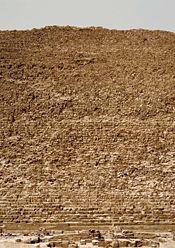
and "Cheops," nothing but stones so neatly stacked
three thousand years ago. If the skiers seemed
at first to be a way to get away
but then became one race among so many,
the pyramid seems at first anomalous,
a remnant from a time before races.
But history is no escape; the lines
constructed by the Pharaoh's slaves reveal
how long the races have been run already.

(And if I did not feel the same about
the other photos in the new exhibit?
They made me think about the spectacles
the artist chose to photograph—the pit stops;
the North Korean festival with endless rows
of gymnasts forming one enormous bouquet;
the artificial islands in Dubai
that you can buy if you can pay the price—
but all those thoughts were not the kind one feels,
which make a room into a memory.)

Devil

Her thing for the Devil—it wasn't love. No, she could take or leave the Devil in the end. Nicola only did it because it was good fun and it made God mad.

(Martin Amis, London Fields, p. 123)

as tagged by Sam of the Ten Thousand Things

How to play:
1. Pick up the nearest book (of at least 123 pages).
2. Open the book to page 123.
3. Find the fifth sentence.
4. Post the next three sentences.
5. Tag five people.

Tag: Mr. Jumbo, Rob, Colin, Matt, Jane

Tuesday, February 26, 2008

Edward Thomas's Daughter

Here's one of the poems included in this week's Daily Poem Project, by Alison Brackenbury:

Edward Thomas's daughter

Now winter prowls upon the hills
I write to her, her head so old
The war before the last war fills
Her mind. She lists her father's songs.

A man, I tell her, I admire:
Who steps as close as a lost child.
They sang, she tells me, by the fire
Wild Army songs before he died.

My fingertips once touched that world.
I saw it linger, washing boil,
The fire chill as long ashes curled.
Will Russia's gas put out our lights?

The robin brushes me at dusk.
Our good bones fail. We leave no mark.
His voice, she writes, was clear and quiet.
I hear him singing in the dark.

This is a beautiful and evocative poem, merging so many different levels and images, from the poet's reading of another poet to her encounter with that other poet's daughter, and several other layers as well ("Russia's gas" being perhaps the most startling).

But the syntax of the poem conflicts too much with the lineation for me, without generating any gain to make up for it. In the first stanza, I wonder if a single comma at the end of the first line might help me read the lines better:

Now winter prowls upon the hills,
I write to her, her head so old
The war before the last war fills
Her mind. She lists her father's songs.

Just that additional comma makes it much easier to read the line breaks at the end of lines two and three, but without that comma, I stumble at the end of line one, and then as a result I stumble at the ends of the next two lines as well.

This is another example of a problem I have commented on before, the omission of a comma at the end of a line.

Monday, February 25, 2008

830

Here's an article about the highest-scoring Scrabble game ever.

The author should have noted the record setter's own "quixotry" (the best-scoring word ever) in his style of play!

My Facebook friends know: I am addicted to Scrabble. :-)

Sunday, February 24, 2008

Fourth Daily Poem Project, Week One call for votes

THE FOURTH DAILY POEM PROJECT, WEEK ONE

Here are the poems to vote for in week one, the first week of my fourth Daily Poem Project (the poems on Poetry Daily from Monday, February 18, to Sunday, February 24):

1. Edward Thomas's daughter, by Alison Brackenbury
2. In the Coffee House, by Tony Towle
3. A Suitable Expression, by Gregory Woods (only the first poem)
4. By way of introduction, by Bob Hicok
5. Transitory, by Lee Sharkey (only the first poem)
6. For the Sightsingers, by Muriel Nelson
7. Stemming from Stevens, by Lisa Williams

The project will run for twelve weeks, and then the twelve weekly winners will be put together for a final vote.

HOW TO VOTE: You can send your vote to me by email or as a comment on the blog. If you want to vote by commenting but do not want your vote to appear on the blog, you just have to say so in your comment (I moderate all comments). (If you read this on Facebook, please vote on my blog and not as a comment on Facebook.)

In the past, I posted the comments only after the final vote was in, but this time around, I will post comments as they come in (so it is no longer a completely secret ballot if you vote early). I'm doing this because some voters (and potential voters) said they thought it would be more interesting this way.

You may vote by the title, the author's name, or the number of the poem in the list above. Please make a final decision and vote for only one poem (although it is always interesting to see people's lists).

Please VOTE BY FRIDAY, FEBRUARY 29! But I will still accept votes as long as I have not posted the final results, which might only be on March 1 or 2.

The winners of the previous projects:

1DPP: "The Shout," by Simon Armitage
2DPP: "Fragment," by A. E. Stallings.
3DPP: "Inside the Maze (II, III, and IV)", by Hadara Bar-Nadav (blog vote)
3DPP: "Friends", by Laure-Anne Bosselaar (class vote)

Thursday, February 21, 2008

Jazz and Health, Poetry and Health

One of the ongoing issues in the world of jazz made the New York Times today: jazz musicians often have no health insurance, so when they get ill, their friends have to organize benefit performances for them.

This is, of course, a reason to be for universal health insurance (says the American living in Switzerland), but in the absence of that, it's also a reason for performing artists to have teaching jobs if they cannot afford to pay for health insurance.

By extension, this is one of my arguments in favor of giving poets teaching jobs: they get health insurance!

So if you're one of those poets who thinks that creative-writing programs are ruining poetry, just remember that, in one sense at least, they are keeping poetry alive—by keeping poets alive.

*

Here's the spectacular photo of John Scofield and Joe Lovano from the above article:


(Scofield and Lovano fans: don't worry, they're not sick.)

Monday, February 18, 2008

Fourth Daily Poem Project

The Daily Poem Project (fondly dubbed "Poetry Idol" by C. Dale Young) involves reading the poem on Poetry Daily every day for a week, then voting for the poem you like best. We do this for twelve weeks, and at the end there is a final vote among the twelve winners to determine an overall winner. (For a list of previous winners, see below.)

I am starting the new project with the PD poem from today (the first day of the first-ever Spring Semester at the University of Basel). I'll be posting a call for votes for the first week this coming Sunday. If you want to begin thinking about what poem to vote for, here are the poets whose work will be considered this week (their poems will be appearing on Poetry Daily from today until Sunday):

Monday - Alison Brackenbury
Tuesday - Tony Towle
Wednesday - Gregory Woods
Thursday - Bob Hicok
Friday - Lee Sharkey
Saturday - Muriel Nelson
Sunday - Lisa Williams

I will be doing one thing differently this time around: I will still moderate comments (and hence votes), but I will be posting them as they come in (between the posting of the call for votes and the deadline for voting), so that people can argue with each other if they want to!

The winners of the previous projects:

1DPP: "The Shout," by Simon Armitage
2DPP: "Fragment," by A. E. Stallings.
3DPP: "Inside the Maze (II, III, and IV)", by Hadara Bar-Nadav (blog vote)
3DPP: "Friends", by Laure-Anne Bosselaar (class vote)

This time around, though, I will be having only one set of votes (as I am not running this project in tandem with any particular class).

Any questions?

Sunday, February 17, 2008

On Ilya Kaminsky

Allow me to recommend Don Brown's excellent discussion of Ilya Kaminsky, whom Don recently heard read at Yale.

Edinburgh

Yep, that's me listed by Rob Mackenzie among the poets reading at his Great Grog series in Edinburgh next February. Gonna be buying me an EasyJet thing or the like! :-)

Friday, February 15, 2008

Where Sadness Comes From

One of the finalists from my Daily Poem Project last spring and summer, Maurice Manning's "Where Sadness Comes From," is discussed in Peter Campion's essay on sincerity in the February 08 issue of Poetry.

I'm not quite sure I follow Campion's essay as a whole (perhaps I don't understand his motivation for writing it; that seems to be an issue for me these days), but his reading of Manning's poem is quite well done, as is his discussion of Elizabeth Arnold's "Civilization."

By the way, I'll be starting a new Daily Poem Project in a week; the first call for votes will cover the Poetry Daily poems from Monday, February 18, to Sunday, February 24.

Yet another post from Todtnauberg. :-)

Children of the Ghetto

Along with Louise Glück's "Midsummer" (which I commented on here), I was struck by two other poems in the February 2008 issue of Poetry, both by George Szirtes: "Ross: Children of the Ghetto" and "Petersen: Kleichen and a Man." The former is one of those rare villanelles that fully justifies its form by putting the villanelle's obsessive repetition to perfect use. The latter is a wonderful nonce form in which the last six lines repeat the end words of the first six lines in reverse order. (Or does this form have a name?)

The two poems are part of a set of seven Szirtes poems based on photographs, "In the Face of History."

This post was made from Todtnauberg, but I don't think that makes it Heideggerian (or a Celanian critique of Heidegger). :-)

Tuesday, February 12, 2008

Bruni

Last year, I read an article somewhere about an album by a European singer with lyrics taken from famous English-language poets. I was interested, but not enough to get the album.

In the meantime, the singer has become famous for marrying the President of France. Here's an article about Carla Bruni's use of poems for her album "No Promises."

(Jonathan Mayhew will wince at the idea that Dickinson's hymnal stanzas can be sung to the tune of "Gilligan's Island," but at least that's a change from the usual reference to "The Yellow Rose of Texas.")

Monday, February 11, 2008

Threadsuns

HENDAYE

The orange pepperwort,
stick it behind your forehead,
silence the barb out of the wire,
with which she flatters, even now,
listen to it,
for the span of an impatience.

Paul Celan, tr. Pierre Joris

This is one of the beautiful translations in Threadsuns, Pierre Joris's English rendition of Paul Celan's Fadensonnen. Here are a couple more:

On the rainsoaked spoor
silence's little juggler sermon.

It's as if you could hear,
as if I still loved you.

*

IRISH

Give me the right of way
across the grain ladder into your sleep,
the right of way
across the sleep trail,
the right, for me to cut peat
along the heart's hillside,
tomorrow.

*

Near, in the aortic arch,
in the light-blood:
the light-word.

Mother Rachel
weeps no more.
Carried over:
all the weepings.

Quiet, in the coronary arteries,
unconstricted:
Ziv, that light.

*

Still, despite the quality of these translations, and of many of the others (at least in part), I find myself forced to disagree with some of the fundamental decisions Joris made when undertaking his translations of Celan.

My first criticism is really a quibble, perhaps the result of my déformation professionelle as an English teacher: all too often, Joris retains German commas that should clearly be left out in English, as in line 5 of "Irish" (see above), which surely should read "the right for me to cut peat" (with no comma between "right" and "for").

The other two problems I have really mark a difference between philosophies of translation as much as anything else: Joris's decisions are consistent, so they must be intended. The first of these two problems involves compound words: Joris generally tends to translate Celan's German compounds as English compounds (as in the book's title). This seems to me to make Celan much stranger than he actually is, as the nonce compounding of nouns is an everyday practice in German and not in English. By generally translating Celan's compounds as English compounds, Joris adds a layer of "oddity" to Celan's poems that is not really there in the German. (I had long discussions with Dieter M. Gräf about compounds when I was translating Dieter's poems.)

The second problem involves a special grammatical construction that Celan uses quite often. Here's an example (the next-to-last poem in the book):

No name, that would name:
its consonance
knots us under the
in song to be stiffened
lighttent.

(Note the superfluous comma in line 1 and the compound in line 5, as examples of my first two criticisms.) The phrase translated by line 4 is dense in German, but it is not hard to parse: "unters / steifzusingende / Hellzelt" is a prepositional phrase with an adjective modifying the object of the preposition. In English, Joris's phrase makes no sense at all: preposition + article + preposition + noun + passive infinitive + noun. Huh?

Over and over again, then, Joris takes such complex participial constructions positioned between an article and a noun—perfectly standard in German—and translates them as if such constructions existed in English. If I were to write the previous sentence like that, then it would say "Joris takes such between an article and a noun positioned complex participial constructions."

It turns out that I was correct to assume that Joris was doing this on purpose, as he discusses and defends his translation of this very structure in the preface to Breathturn. But the proof of the translation is in the reading, and only those who know German will be able to make sense of the phrases where Joris retains the German word order.

My approach to translation is quite different in these two cases: I use compounds much more sparingly in my English versions of German poems than they are used in the originals, because excessive compounding is weird in English, while German poets who use compounding often (such as Celan, or Gräf, or Anne Duden) are only taking an everyday gesture further.

Nor do I see the point in following German word order when it produces bizarre or even incorrect English grammar or syntax. If the German is incorrect, then of course the English should be incorrect, too, as in this passage from a poem by Brigitte Oleschinski: "I / is the sleeper that journeys."

Beyond this difference in philosophy, though, I think Joris, for all his merits as a translator of Celan who has brought so many poems into English so beautifully (such as those I quoted above), often does Celan a disservice by making Celan seem not only "difficult," but simply bizarre. Celan may push the limits of German grammar, but he does not violate its rules (or perhaps I should say "hardly ever violates," just to be safe). Instead, he takes advantage of all the correct grammatical structures the German language offers him, fully exploiting their nuances and their power. To follow German syntax in an English version is to make him into a very different poet than he actually was and risk stripping him of all that nuance and power. A poet many people consider "difficult" largely because they have been told he is "difficult" does not need to have further difficulties like this added in the process of translation.

Sunday, February 10, 2008

Midsummer

And the next day, we were kids again, sitting on the front steps in the morning,
eating a peach.  Just that, but it seemed an honor to have a mouth.

Louise Glück, "Midsummer"

I don't think I have ever really been moved by a poem by Louise Glück before, but this one from the February 2008 issue of Poetry really struck me.

Saturday, February 09, 2008

Depp?


No, this is not Johnny Depp, even though I think it is every time I see this self-portrait by Gustave Courbet.

Iran, a Winter Journey

I also have new translations of poems and prose by Franzobel and Julian Schutting in an absolutely stunning book called Iran, a Winter Journey, published by X-CHANGE in Vienna.

Never again, oh I swear, will the towers fall silent,
Never at night.
Day has not yet begun ending; already
Everything silently silenced awakens;
Oaths of the death god are broken by silence:
All silenced to death are the towers of silence,
They're going to be filled by such echoing voices—

Julian Schutting, "The Towers of Silence of Yazd"

My Yugoslavia

The Winter 2007/08 issue of Passages: The Cultural Magazine of Pro Helvetia, contains a beautiful short essay by Ilma Rakusa, "My Yugoslavia," which I had the pleasure and privilege of translating.

For as long as I can remember, the country called South Slavia — for that is what Yugoslavia means — has belonged to me. As a child, I lived for a while in Ljubljana, and even when we moved to Trieste, we regularly visited my father's Slovenian relatives. My father also took my mother and me along on business trips to Zagreb and Belgrade. That was an adventure, for we travelled by car, and the roads were bad. Once, on the way to Zagreb at night, we ran over a rabbit, and a little while later, we were stopped by a farmer looking for a fugitive thief.

Passages
is available from Pro Helvetia.

Thursday, February 07, 2008

Internet Searching and Energy Use

According to an article in today's Basler Zeitung (unfortunately not available on-line), one Google search uses as much energy as a 10-watt bulb uses in a half an hour. Multiply that by more than one billion searches per day. It's running the server computers that sucks up so much energy.

I was going to do some Google searches to check on that, but I decided not to.

I wonder how much energy each blog post uses.

Lyrikline update

New English sounds and poems at the wonderful lyrikline site in February 2008 are "the American sound poet Charles Amirkhanian" and new English translations of poems by Polish poet Tadeusz Dąbrowski (Poland) and German poets Ursula Krechel and Lutz Seiler.

If you have not checked out lyrikline before, do so: poems and translations in over 40 languages, plus audio of many of the originals, as read by the poets.

Wednesday, February 06, 2008

100 Books

Ron Silliman writes: "... name a minimum of 100 books of contemporary poetry – published in the past 25 years – and say a little about each."

Okay, Ron, I don't have time for "a little about each," but here are 100 that I could say something about without looking at my shelves:

Glyn Maxwell, The Breaking
Richard Wilbur, Collected Poems
Seamus Heaney, The Spirit Level
Durs Grünbein, Ashes for Breakfast
Dieter M. Gräf, Tousled Beauty (okay, I translated that one)
Ilma Rakusa, A Farewell to Everything (and I co-translated that one)
C. Dale Young, The Second Person
Gabriel Spera, The Standing Wave
Brigitte Oleschinski, Your Passport Is Not Guilty
Anne Duden, Hingegend
Jacques Réda, L'incorrigible
Billy Collins, Questions about Angels
Simon Armitage, The Shout
A. E. Stallings, Hapax
Philip Levine, The Simple Truth
Michael Donhauser, Sarganserland
George Szirtes, Reel
Karin Gottshall, Crocus
Matthew Sweeney, Black Moon
Les Murray, Fredy Neptune
Anne Carson, Autobiography of Red
Donald Hall, The Museum of Clear Ideas
Thomas Lux, Street of Clocks
Joachim Sartorius, Ice Memory (to which I contributed translations)
Sean O'Brien, Cousin Coat (which I reviewed)
Giles Goodland, A Spy in the House of Years (ditto)
Franzobel, Luna Park
Geoffrey Brock, Weighing Light
Mark Halliday, Little Star
James Longenbach, Threshold
John Fuller, A Space for Joy
Jane Hirshfield, After
W. S. Merwin, The Folding Cliffs
Brad Leithauser, Darlington's Fall
Ko Un, Ten Thousand Lives
Hans Magnus Enzensberger, Leichter als Luft
Marilyn Hacker, Love, Death, and the Changing of the Seasons
Adrienne Rich, Sources (but was that more than 25 years ago?)

That's 38 in 15 minutes of brainstorming, trying not to repeat authors and not looking up things whose titles I can't recall at the moment.

Padraig Rooney, The Escape Artist
Paul Muldoon, Moy Sand and Gravel
Robert Creeley, Later (not sure about the pub date?)
Jürgen Theobaldy, Immer wieder alles
Edwin Morgan, A Book of Lives
Michael Longley, The Weather in Japan
David St. John, The Face
Daljit Nagra, Look We Have Coming to Dover!
Sarah Maguire, The Pomegranates of Kandahar
Selima Hill, Violet
Carol Ann Duffy, The World's Wife
Jill Alexander Essbaum, O Forbidden

I'll stop at 50 since I'm tired and it's time to go to bed. And I did those in 25 minutes under pretty strict conditions. If I repeated authors I'd get over 100 easily!

Not Seeing is Believing

This morning, I had to look at the little tag on the inside of the refrigerator to get the model number and other data from it. It was quite blurry, so I took my glasses off and discovered that I could see the label quite clearly without my glasses. Later in the day, for the first time, I noticed myself adjusting how far away the paper I was holding was, in order to focus more clearly. Looks like reading glasses are on their way for me! :-)

Fritz Senn and Klaus Reichert in Basel

In collaboration with the Theater Basel, the English Seminar of the University of Basel has organised a James Joyce double bill:

Thursday, February 21, Theater Basel, Literatursalon, Klosterberg 6, 8:00 p.m.: Fritz Senn, the Joyce expert and director of the Joyce Archive in Zurich, will give a talk about Ulysses combined with a reading of a passage of the novel by Bastian Semm.

Friday, February 22, English Seminar, Nadelberg 6, Basel, in the room called the Cave, 10.15 - 11.45 a.m.: Fritz Senn and Klaus Reichert, also an eminent Joyce scholar and editor, will have a public conversation and will also be available for questions from the audience and prepared to give students advice on a first approach to Ulysses.

Tuesday, February 05, 2008

A Measuring Worm; The Magic Kingdom; The Saws

By now, as far as I understand, the poetry in the latest issues of The New Yorker is Paul Muldoon's responsibility, not Alice Quinn's. So perhaps it is thanks to Muldoon that one can read this Richard Wilbur poem, "A Measuring Worm", in the February 11 issue (which I have not yet held in my hands, though, thanks to Perlentaucher, I already the poem on-line).

I love Wilbur's use of this stanza, here and elsewhere:

This yellow striped green
Caterpillar, climbing up
The steep window screen,

Each stanza is a haiku, with the first and third lines rhyming.

*

After writing the above, I went on to read the next poem on-line from that issue, Kathleen Graber's "The Magic Kingdom." Now (assuming that Muldoon picked that one) that is a poem that, as far as I can tell from years of reading the poems she edited, Quinn would not have chosen.

*

And just to make the list complete, here's the third poem from the same issue, Robert Pinsky's "The Saws." Not a bad set of poems for once! I cannot remember the last time there were three poems in the New Yorker and I did not think, about least one of them, "why would anyone want to publish that bland piece of boredom?"

Friday, February 01, 2008

935

935 was the year King Wenceslas was murdered, he of the song.

It's also the number of a Porsche.

And it's the number of "false statements" made by "President George W. Bush and seven of his administration's top officials, including Vice President Dick Cheney, National Security Adviser Condoleezza Rice, and Defense Secretary Donald Rumsfeld" "in the two years following September 11, 2001, about the national security threat posed by Saddam Hussein's Iraq."

So the next time somebody tries to tell you that the war was not fought on false pretenses, remember that number: the year Wenceslas died, or a good sports car, or the number of lies Bush and Co. told, as "part of an orchestrated campaign that ... led the nation to war under decidedly false pretenses."

I am so grateful to the people who put this "War Card" together. After all, they made clear that many of the things Rummy called "unknown unknowns" were actually perfectly well known "knowns" that he was lying about.

Thursday, January 31, 2008

Down By Law

Here's Tom Waits in Down By Law, having just rescued his shoes from Ellen Barkin's temper tantrum. What better way could there be to spend an evening?

"It is a sad and beautiful world."

"Yes. I ham just lucky to heven be here."

Writing Advice

This is a footnote, as it were, to my post "How would a fool do it?"

My two colleagues and I were giving the final English-language exam to students earlier this month. One student who had been having serious problems (she had failed the exam twice) had still been struggling in the exam preparation course with my colleague Joyce. Shortly before the exam, Joyce made a surprising suggestion: "Write what you think is a bad essay." So she did, and when we marked it, we thought it was fine!

Wednesday, January 30, 2008

The Lives of Others

At the end of "The Lives of Others," which Andrea and I watched tonight, I got all emotional. The ending has its emotional effect (to make the idea of dedicating a book to the guy who spied on you credible, you need a good story), but mostly I was sad that Ulrich Mühe died last year. What a wondrous actor. His face was as expressive as Kevin Spacey's, or Jennifer Ehle's, to name my two favorite expressive faces.

The Future

Here's another New Yorker poem, "The Future," by Billy Collins. It reminds me of one of my favorite Collins poems, "Nostalgia."

I still don't quite get why people get so riled up about Collins's poems. Like many poets who have developed a singular style, he writes some excellent poems beside many that are "merely" good examples of his style, and even a few weak poems. And like many poets who have had some success in the poetry world, he probably gets a lot of his weaker poems published, the kind that a less well-known poet would not get away with.

But that's just normal in any art form, isn't it?

Monday, January 28, 2008

Old Marx

Here's a great poem from the New Yorker, "Old Marx," by Adam Zagajewski, translated by Clare Cavanagh. My favorite lines:

He couldn’t concentrate, rewrote old work,
reread young Marx for days on end,
and secretly admired that ambitious author.

Saturday, January 26, 2008

Someone else who read "Lenz"

Mr. Jumbo has posted a long response to Büchner's "Lenz," which I recommend both to those who have read the story and to those who have not. Thanks to him for joining me in reading the novella on January 20!

Use and Mention

Here, thanks to Bill Poser at Language Log, is a distinction I have not come across before: between use and mention. A professor at Brandeis (see the links in Poser's post) was found guilty of racial harassment for saying this:

"Mexican migrants in the United States are sometimes referred to pejoratively as 'wetbacks'."

As Poser points out, the professor did not actually call anyone a "wetback"; he did not use the term. Instead, he only mentioned it.

I've made this distinction in my mind for many years, but never as concisely. It helps one think about how to talk about obscenities (for recent thoughts about that, see here).

Poser sums up the general point:

"In the absence of other information, one is not entitled to draw any inference as to the speaker's attitudes and beliefs from mentions."

It suddenly crosses my mind that this explains why one should never attribute a fictional character's ideas to the author: whatever a fictional character says is, from the author's perspective, a mention and not a use.

Thursday, January 24, 2008

Gatekeeping

There's an excellent discussion going on over at Scottish poet Rob Mackenzie's blog—many UK poets chiming in on how the poetry publication "system" in the UK works.

I suspect it would be of great interest to those frustrated by the "system" in North America as well—if only for the contrast between the two sides of the Atlantic. Check it out if you have not already.

And while you're at it, order a copy of Rob's wonderful chapbook The Clown of Natural Sorrow.

Tuesday, January 22, 2008

Meridian

Die Kunst ... bildet ... den Gegenstand einer Unterhaltung, die in einem Zimmer, also nicht in der Conciergerie stattfindet, einer Unterhaltung, die, das spüren wir, endlos fortgesetzt werden könnte, wenn nichts dazwischenkäme.

Es kommt etwas dazwischen.

Paul Celan, "Meridian"

In John Felstiner's translation:

Art forms the subject of a conversation that takes place in a room, not in the Conciergerie prison, a conversation that could go on endlessly, we feel, if nothing intervened.

Something does intervene.

Beautifully, when Celan identifies art as "the subject of a conversation," he chooses the word "Unterhaltung" and not the word "Gespräch" (which he does use later in "Meridian"). You see, "Unterhaltung" can also mean "entertainment." Celan is not usually identified as someone whose poetry one reads and thinks about for entertainment, but I have always derived the greatest possible intellectual entertainment from reading, thinking about, and discussing his work with people. It can be a harrowing experience, discussing Celan, but harrowing experiences are part of what constitutes art—as the age-old concept of tragic catharsis makes clear.

The scene Celan is referring to is in Büchner's "Danton's Death," and the conversation involves several revolutionaries (including Danton) who have been condemned to death. So what "intervenes" here is a death sentence.

There are many ways to read this intervention, but all of them involve a recognition that although art is a matter of "Unterhaltung" in the sense of both conversation and entertainment, art works provide the best material for "Unterhaltungen" when they recognize the imminence of interruption, of "intervention," of death sentences.

Poems can be "lighter than air," but at their best, their lightness points towards something unbearable, harrowing, cathartic.

Monday, January 21, 2008

Lenz

My favorite passage in Büchner's Lenz reads like a desire for photography:

"Wie ich gestern neben am Tal hinaufging, sah ich auf einem Steine zwei Mädchen sitzen: die eine band ihr Haar auf, die andre half ihr; und das goldne Haar hing herab, und ein ernstes bleiches Gesicht, und doch so jung, und die schwarze Tracht, und die andre so sorgsam bemüht. Die schönsten, innigsten Bilder der altdeutschen Schule geben kaum eine Ahnung davon. Man möchte manchmal ein Medusenhaupt sein, um so eine Gruppe in Stein verwandeln zu können, und den Leuten zurufen."

In John Felstiner's translation (from his translation of Celan's Meridian):

"Yesterday, as I was walking up along the valley rim, I saw two girls sitting on a rock: one was doing up her hair, the other helping her; and the golden hair hung down, and the pale serious face, yet so young, and the black dress, and the other girl taking such pains. The Old German School's finest, most intimate pictures can scarcely give an idea of it. At times one might wish to be a Medusa's head, so as to turn such a group into stone and call people over."

Perhaps more precisely, this is a desire for snapshots, and not photography in general. Büchner was writing in the 1830s, the decade when photography began to emerge. Lenz, of course, lived in the eighteenth century, and Büchner's story takes place in 1778, but even then the desire for photography already existed.

My second favorite passage is not even in the text, but in Büchner's primary source, the diary of Lenz's host, Oberlin: "Er hatte eine Wunde am Fuß hieher gebracht, die ihn hinken machte und ihn nötigte hierzubleiben." Büchner does not include the fact that Lenz had a wound on his foot that forced him to stay with Oberlin. For two reasons, I suspect: first, Büchner wants to emphasize Lenz's psychic instability, and the injured foot distracts from that. Secondly, Büchner mentions three times that Lenz harms himself in order to use physical pain as a way of "returning to self-awareness" (or something like that). If Büchner mentioned Lenz's wound, then the self-inflicted pain would again not have the same dramatic effect. The suppression of the wound makes the story possible, as it were.

The third thing I want to know here is a point of contact between Büchner's story and Jonathan Lethem's The Fortress of Solitude, which I read a few weeks ago, with its emphasis on "social mimicry" as the means by which one fits oneself into unfamiliar social situations (see my post on the book). At the end of Büchner's story, before the famous "So lebte er hin" with which it concludes, comes this: "er tat Alles wie es die Andern taten."

"He did everything the same way the others did": Lenz compensates for his psychic instability, for what Lethem might call "a form of autism," with "social mimicry," and when it works, then he can "live on."

Finally, poetry as therapy, as Lenz uses poetry the same way he used physical pain, to return to himself: "er sagte in der heftigsten Angst Gedichte her, bis er wieder zu sich kam." In a state of the most terrible anxiety, he recites poems until the anxiety disappears and he is himself again.

Sunday, January 20, 2008

Lenz, Büchner, Celan

I did read Büchner's Lenz today, as planned, along with Celan's Meridian. And I prepared to read Büchner by reading the original Lenz himself: Jakob Michael Reinhold Lenz. I read his story Zerbin.

I'm too tired to think through any deeper comments than the observation that it is fascinating to read three short, intense texts in quick succession from three different centuries. Zerbin is a very eighteenth-century story, and Lenz feels very nineteenth-century (along with its "anticipatory" quality, pointing toward 20th-century developments, it is nevertheless a 19th-century text), while Celan's Meridian speech could hardly have been written before the 20th (before Modernism, to put a period term on it). A fascinating set of texts, on which I will try to comment more in the course of the week.

Saturday, January 19, 2008

Have Sex!

Miles recently began to say "fuck" a lot. When I was eight years old, my parents did not try to get me to stop swearing. When my friends were over, and I swore in front of my mother, they were always stunned that nothing happened. But I had enough understanding of linguistic register to know that I should not swear at other people's houses, because their parents would get upset, nor did I swear in the schoolroom (though of course I swore, as all the other kids did, on the playground and at recess). So I could see trying to just ignore Miles's swearing, but for two things: first of all, Andrea does want to get him to stop, and secondly, I find it annoying, too. I am retrospectively impressed by my parents' patience with eight-year-old me.

One thing Andrea pointed out to Miles was that he did not even know what the word means. So of course he wanted to know! I figured, he's eight, he can handle it, it's time to tell him about babies and sex and all that stuff. So I told him that "fuck" is a word that is mostly used as a way of expressing intensities, or as a way to shock people, but that it also has to do with how babies are made, etc., etc. In the process, I told him that you can also say "make love" or "have sex" for this "real" meaning of the word.

So then a couple days later, Andrea said something to Miles that he was quite surprised by, and he responded, "What the have sex are you talking about?"

Thursday, January 17, 2008

Omnivore's Dilemma 2

My response to Michael Pollan's The Omnivore's Dilemma starts in out-of-the-way moments. The first is a reference to Basel: it turns out that Fritz Haber "died ... in a Basel hotel room in 1934." Haber is famous for three things: first, he won the Nobel Prize in Chemistry for his discovery of how to synthesize nitrogen from the air (for "improving the standards of agriculture and the well-being of mankind," as the Nobel committee put it). Secondly, he was the leader of Germany's efforts to use poison gas in World War I. Thirdly, he was the inventor of Zyklon B, which was used to gas Jews and others in German concentration camps during World War II. But he himself was a converted Jew who had to leave Germany after the Nazi seizure of power, and he died in Basel in 1934.

The second out-of-the-way moment that struck me involved a reference to an author I have written extensive notes about here: J. M. Coetzee. I spent the summer last year reading and re-reading his novels and essays, in anticipation of the publication of his newest novel, Diary of a Bad Year, and I read Pollan's book afterwards, so I was surprised and pleased to find Coetzee turning up in Pollan's book, especially as I immediately thought of Coetzee at the beginning of the paragraph that ends with a reference to him. (If Pollan had not referred to Coetzee, I would have written to Pollan to tell him about Coetzee.) Pollan's reference is to Elizabeth Costello (or, more precisely, to The Lives of Animals, which was later incorporated into EC):

Is it possible that history will someday judge us as harshly as it judges the Germans who went about their lives in the shadow of Treblinka? The South African novelist J. M. Coetzee posed precisely that question in a lecture at Princeton not long ago; he answered it in the affirmative. If the animal rightists are right, then "a crime of stupendous proportions" (in Coetzee's words) is going on all around us every day, just beneath our notice.

The literary scholar in me wants to chastise Pollan for conflating Coetzee with Elizabeth Costello, the character he invented, but it would be too complicated, of course, for Pollan to observe the literary niceties here, and in fact, it was Coetzee who wrote that phrase, even if he put it into his character's mouth.

At first, Pollan surrenders, as it were, to the ideas expressed by Coetzee's character, as well as those of Peter Singer, the author of Animal Liberation (and, interestingly, a respondent when Coetzee first presented the lectures that Pollan refers to and that Coetzee later used in Elizabeth Costello). But Pollan finally concludes (referring to an organic farm he worked at for a week):

To many people even Polyface Farm is a "death camp"—a way station for doomed creatures awaiting their date with the executioner. But to look at the lives of these animals is to see this holocaust analogy for the sentimental conceit it really is ... To think of domestication as a form of slavery or even exploitation is to misconstrue that whole relationship—to project a human idea of power onto what is in fact an example of mutualism or symbiosis between species.

As Milan Kundera put it in The Book of Laughter and Forgetting: man is a "cow parasite."

Pollan hence finally sees Singer, Coetzee, and others who might criticize even a humanely run farm like Polyface Farm for its exploitation of animals as "sentimental" (something Coetzee has surely never before been accused of being!). Still, Pollan himself succumbs to the seductiveness of holocaust analogies when he comments that Haber's biography "recalls the dubious links between modern warfare and industrial agriculture."

While preparing these comments, I took a break and chanced to be reading "On a Weekend Break in a Political Vacuum," a poem by Alan Gillis, from his book Hawks and Doves, which includes the following stanza:

She accuses herself, as it is with the food
that awaits her, served with speed in a bright
labelled box (always that first bite's stomach-
melting dream chews to cardboard and carcass,
like a drunken one-night stand's aftermath
rising to a seasickness which empties,
utterly empties, so that she winds up
seeking the comfort of warm, easy things—
the chilled blues and brightly-boxed food
that awaits her), so it is with her mind.

How perfectly Gillis captures the seductiveness of fast food: the "melting dream" that produces a dissatisfaction that, through twists and turns, leads one back to the "brightly-boxed food" even when (or perhaps precisely because) it "chews to cardboard and carcass." "She accuses herself," writes Gillis, as many of us perhaps accuse ourselves, but without changing, even if, with Pollan, we remind ourselves what "unsustainable" means: "Sooner or later it must collapse."

When I finished The Omnivore's Dilemma, I began to shop differently. Did I go vegan? No. Did I go vegetarian? No. Did I start buying only organic food? No. Did I start buying only local food? No. But I began to compare things more carefully: is it organic? If so, where is it from? How much does it cost compared to the non-organic product? (It is surprising how many organic products are not more expensive than their non-organic counterparts, and how many more are only slightly more so.) I began to try to apply Pollan's conclusion:

But imagine for a moment if we once again knew, simply as a matter of course, these few unremarkable things: What it is we're eating. Where it came from. How it found its way to our table. And what, in a true accounting, it really cost.

Tuesday, January 15, 2008

Heideggerian?

Adam Kirsch's essay "The Taste of Silence," in the January 2008 issue of Poetry, makes the claim that "the best document" of contemporary poetry's "metaphysical sensibility" is Martin Heidegger's essay "The Origin of the Work of Art."

The way I phrased that might make you think that I find Kirsch's claim ridiculous, but I do not. The quoted phrases above are at the end of his first paragraph, and I am sure that Kirsch himself wanted to present the claim as being a bit absurd at first glance.

The essay argues cogently, however, that Heidegger's contrast between "poetry of earth" and "poetry of world" can be a useful heuristic in the interpretation of broader trends in contemporary poetry (whereby he seems to be referring primarily to English-language poetry). He paraphrases the concepts well, as far as I can tell, so if you want to know what those terms mean, read his essay (or, of course, Heidegger's).

My purpose here is to make four comments on Kirsch's essay (all of which assume you have read it):

1. At times, Kirsch seems to be arguing that the phrase I used above ("a useful heuristic") is all that he is getting at when it comes to saying that, as it were, "we are all Heideggerians now." That is, he is not saying that contemporary poets have read Heidegger; instead, he is saying that Heidegger is useful as a tool for interpreting contemporary poetry.

However, in presenting his three examples (Seamus Heaney, Charles Simic, and Billy Collins), Kirsch does seem to make a stronger claim when he calls Simic "another poet deeply indebted to Heidegger." At that point in the essay, he has not yet discussed Collins, so by saying "another poet" about Simic, Kirsch appears to be arguing that Heaney is one poet "deeply indebted to Heidegger."

I wish he had not put it that way. Until that moment, Kirsch's essay reminded me of Borges's essay "Kafka and His Precursors," in which Borges provides a list of Kafka's precursors, none of whom Kafka himself ever read. Kafka need not have read Lord Dunsany, for example, for Kafka's work to provide a way of understanding Dunsany's work (or vice versa, Borges implies).

Similarly, I would have been perfectly happy with the claim that Heidegger helps us understand contemporary poetry, so I prefer to read the phrase "deeply indebted to Heidegger" as simply infelicitous (since I assume Kirsch did not really mean to imply that Simic is an actual reader of Heidegger).

2. I appreciate essays that do not mark their own occasion—it gets tiresome to read essays in the German press that always begin with the justification for writing about a particular author at a particular time—but in the case of this essay, I was very curious. What made Kirsch write this essay at this time? In the absence of a context, I wondered who Kirsch felt he was arguing with.

3. For two reasons, Heidegger does not seem to me to be the most appropriate twentieth-century thinker for much of what Kirsch wants to say: first, he's too mystical and obscure, even when he is trying to be down to earth; secondly, there's all that Third Reich baggage that even Kirsch feels he has to deal with explicitly in his essay.

Much of what Kirsch wants to use Heidegger for could be done as effectively, without the mystical and political problems, by referring to Victor Shklovsky and his concept of "defamiliarization," for example.

4. I have translated Heidegger's poetry (as part of my translation of the correspondence of Arendt and Heidegger). Whenever people start using Heidegger to talk about poetry, I start thinking about stuff like this:

In Jähen, raren, blitzt uns Seyn.
Wir spähen, wahren — schwingen ein.

Or, as I tried to render it:

In rare abruptness, Being's flash of light.
We peer, protect—turn towards the sight.

Heidegger may have been a good reader of Trakl, or Hölderlin, or even of Van Gogh (as in the "Work of Art" essay), but the poetry does not show that he learned much from them.

Monday, January 14, 2008

January 20, Büchner and Celan

"Den 20. Jänner ging Lenz durchs Gebirg."

"On January 20, Lenz walked through the mountains."

January 20 is the date with which Georg Büchner's Lenz begins. I am planning to re-read the story on Sunday, and I invite anyone else who wants to read it to do so as well. If you are not familiar with it, well, it's one of the greatest pieces of prose I have ever read.

The original German is available here.

English translations are available, but not on-line as far as I can tell. See the list on the Lenz page at Wikipedia.

*

"Vielleicht darf man sagen, dass jedem Gedicht sein '20 Jänner' eingeschrieben bleibt?"

"Perhaps we may say that every poem has its '20th of January' inscribed?"

A second text to read on January 20 is Paul Celan's "Meridian," the speech he gave on reading the Büchner Prize. If you can't read the German, look for John Felstiner's translation in his "Selected Poems and Prose of Celan."

If you do read either the Büchner or the Celan on January 20, feel free to comment here! And feel free to pass this "call for reading" on.

Caleb Crain on his article

Caleb Crain posted a long comment on my comment about his article in the New Yorker in December. You can read his comment here. It's interesting to read about the background of the articles and the research described in each article.

Working with Paper

Brian Campbell posted a Ko Un poem that reminded me of this one:

WORKING WITH PAPER

Every poem can be made
into a swallow.

But you have to fold it right.

Every poem, you know,
even the failures.

Now imagine a sky for them.

Jürgen Theobaldy, tr. Andrew Shields
Smartish Pace 11

Thursday, January 10, 2008

How Would a Fool Do It?

I wonder if anyone else noticed the strange doubling of stories in two recent issues of The New Yorker. In the December 17 issue, Malcolm Gladwell wrote about "what I.Q. doesn't tell you about race." He included the following paragraph about how different cultural practices of categorization can be:

The psychologist Michael Cole and some colleagues once gave members of the Kpelle tribe, in Liberia, a version of the WISC similarities test: they took a basket of food, tools, containers, and clothing and asked the tribesmen to sort them into appropriate categories. To the frustration of the researchers, the Kpelle chose functional pairings. They put a potato and a knife together because a knife is used to cut a potato. “A wise man could only do such-and-such,” they explained. Finally, the researchers asked, “How would a fool do it?” The tribesmen immediately re-sorted the items into the “right” categories. It can be argued that taxonomical categories are a developmental improvement—that is, that the Kpelle would be more likely to advance, technologically and scientifically, if they started to see the world that way. But to label them less intelligent than Westerners, on the basis of their performance on that test, is merely to state that they have different cognitive preferences and habits. And if I.Q. varies with habits of mind, which can be adopted or discarded in a generation, what, exactly, is all the fuss about?

I took notice of this because of that wonderful question: "How would a fool do it?" So imagine my surprise when a different version of the same story came up again in the December 24/31 issue, in Caleb Crain's article "Twilight of the Books":

It’s difficult to prove that oral and literate people think differently; orality, Havelock observed, doesn’t “fossilize” except through its nemesis, writing. But some supporting evidence came to hand in 1974, when Aleksandr R. Luria, a Soviet psychologist, published a study based on interviews conducted in the nineteen-thirties with illiterate and newly literate peasants in Uzbekistan and Kyrgyzstan. Luria found that illiterates had a “graphic-functional” way of thinking that seemed to vanish as they were schooled. In naming colors, for example, literate people said “dark blue” or “light yellow,” but illiterates used metaphorical names like “liver,” “peach,” “decayed teeth,” and “cotton in bloom.” Literates saw optical illusions; illiterates sometimes didn’t. Experimenters showed peasants drawings of a hammer, a saw, an axe, and a log and then asked them to choose the three items that were similar. Illiterates resisted, saying that all the items were useful. If pressed, they considered throwing out the hammer; the situation of chopping wood seemed more cogent to them than any conceptual category. One peasant, informed that someone had grouped the three tools together, discarding the log, replied, “Whoever told you that must have been crazy,” and another suggested, “Probably he’s got a lot of firewood.” One frustrated experimenter showed a picture of three adults and a child and declared, “Now, clearly the child doesn’t belong in this group,” only to have a peasant answer: "Oh, but the boy must stay with the others! All three of them are working, you see, and if they have to keep running out to fetch things, they’ll never get the job done, but the boy can do the running for them."

The one bit of information that would connect these two stories is whether or not the Kpelle tribesmen mentioned by Gladwell were illiterate or not. If they were, then the categorization issues raised by these two completely distinct stories suggest that modes of categorization shift significantly with the spread of literacy.

But however this coincidence of stories could be interpreted, what struck me was the very fact of its existence, in two articles published in consecutive issues of the same magazine, on quite different topics, without any comment being made on the coincidence by the editors or the authors.

Wednesday, January 09, 2008

Richter on the web


I've been a great fan of Gerhard Richter for a long time, and a few days ago, I discovered that his website features images of hundreds of his paintings. If you like Richter, download yourself a few images for desktops and the like. :-)

Here's what was on my desktop for a few days.

Monday, January 07, 2008

The Valley

"The Valley," a striking and unique poem by my friend Padraig Rooney, is up on Poetry Daily today.

Dust was sacred, precious stones revered
and fossils read for signs of afterlife.

Saturday, January 05, 2008

Eagle-Flown Sky

An eagle-flown sky, almost empty.

Yet the certitude that the sky had been flown, was soon to be flown again. Occasional sightings ...

Eagles soaring thus—visibly, invisibly—in the summit of heaven.

John Taylor, "Eagles of Fortune and Misfortune," The Apocalypse Tapestries

*

I spotted a large raptor on a fence post while driving the other day. It reminded me of the above, though the "eagle-flown sky" that I then saw was a sky in which I had never seen an eagle, but in which there must have once been one.

There's something going on here about defamiliarization—which reminds me that I recently realized that no artistic work that works with defamiliarization can completely defamiliarize the objects or events that it is referring to. If it did, then one would not be able to see the thing anew, because one would not be able to see it at all. "Make it new," but don't make it so new as to be unrecognizable.

Friday, January 04, 2008

The Fortress of Solitude

What is the difference between a toy and a machine? Here's one way of looking at it, from Jonathan Lethem's The Fortress of Solitude (thanks to someone for typing this in last year):

"There were two worlds. In one his father paced upstairs, creaked chairs, painting at his tiny light box, making his incomprehensible progress, his mother downstairs played records, ran water over dishes, laughed on the telephone, her voice trailing up the curve of the long stair, the backyard ailanthus brushed his bedroom windows, dappling the sun into tropical, liquid blobs of light against the wallpaper which itself depicted a forest full of monkeys and tigers and giraffes, while Dylan read and reread Scrambled Eggs Super and Oobleck and If I Ran the Zoo or pushed his Matchbox car, #11, dreamily with one finger down its single length of orange track or exposed the inadequacy of the Etch a Sketch and the Spirograph again, the stiffness of the knobs, the recalcitrance of the silvery ingredient behind the Etch A Sketch’s smeared window, the untrustworthiness of the Spirograph’s pins, the way they invariably bent at perihelion when the pressure of the drawing pen grew too much, so that every deliciously scientific orbit blooped and bent at the crucial moment into a ragged absurdity, a head with a nose, a pickle with a wart. If the Etch A Sketch and the Spirograph had really worked they would probably be machines, not toys, they would be part of the way the adult universe operated, and be mounted onto the instrument panels of cars or worn on the belts of policemen. Dylan understood and accepted this. These things were broken because they were toys, and vice versa. They required his pity and patience, like retarded children who’d been entrusted to his care."

*

"Whole days were mysterious, and then the sun went down."

*

"'Let me see it for a minute.'

"Let me see it: you saw a basketball or a pack of baseball cards or a plastic water gun by taking it into your hands, and what happened after that was in doubt. Ownership depended mostly on not letting anyone see anything.If you let a kid see a bottle of Yoo-Hoo for a minute he'd drink what was left of it."

*

"The key to mostly anything is pretending your first time isn't."

*

"Then realize that maybe that's all anyone does—fake it."

*

"I dedicated myself to acting as though I'd fit in this atmosphere all along."

*

"It was a form of autism, a failure of social mimicry ..."

*

I cannot help but love a novel that ends with a paean to Brian Eno's Another Green World.

But at the same time I am suspicious of my appreciation of this novel. Perhaps the main character is too much like me, and I am suspicious of identification. We were born in the same years; we have many of the same cultural references. Even the ones we don't really share, we still share as background knowledge of life in the U.S. in the seventies and eighties.

I almost stopped reading The Fortress of Solitude when the main character put on a ring that could make him fly. It seemed too weird to have something like that change in a novel after 200 pages (with 300 or so to go). But the story nicely downplays that bit of magic, until suddenly it becomes central again, in such a way that I no longer found it irritating. None of the characters seemed that impressed by the ring in the end.

And then the vividness of listening to a particular recording while driving: two tales of listening to Another Green World. I remember listening to Dave Holland's Seeds of Time at the end of a drive from Seattle to San Francisco, how Libby and I burst into shouts of joy at the irrepressible "Homecoming."

River

My poem "River" is on-line in the latest issue of Hobble Creek Review. Be sure to check out the table of contents and read lots of the poems!

If you really love one of your older poems even though nobody wants to publish it, keep sending it out. If you believe in it, somebody else will eventually! I wrote "River" in the fall of 1995, and I must have submitted it at least 25 or 30 times in the intervening years! Thanks, Justin, for finally giving this poem a home.

It was one of the first poems I wrote after moving to Basel. The Saar, the river in Saarbrücken, where I lived before, is a nice river, but nowhere near as impressive as the Rhine in Basel. I used to walk along it often to go to work (back when I had time to do things like walk to work), and the poem grew from those walks.

Thursday, January 03, 2008

Hamlet, Müller, Mühe

In September 1991, I went to the Deutsches Theater in Berlin to see Heiner Müller's production of Hamlet. This production was memorable in numerous ways. Here are a few:

1. The play within the play was Müller's own Hamletmaschine instead of The Murder of Gonzago.

2. Claudius was played by the wondrous Jörg Gudzuhn, whom I had seen a few weeks earlier in Kleist's Der zerbrochene Krug. A truly splendid actor.

3. There were three intermissions: the first and third were twenty minutes long; the second was an hour long, with barbecue.

4. It was after the long intermission that the production turned to Hamletmaschine.

5. The duel between Hamlet and Laertes was staged with tennis rackets. The actors were dressed accordingly, and they moved in mock slow motion, as if they were playing tennis.

5. Hamlet himself was played by the fabulous Ulrich Mühe, whose work I had the pleasure of seeing on film several times in the following weeks, especially in Bernhard Wicki's utterly overwhelming Das Spinnennetz, a three-hour-plus film of the greatest intensity, based on a Joseph Roth novella and also starring Armin Mueller-Stahl and Klaus Maria Brandauer. Why in hell is this not available on DVD?

So it was with great sadness that I learned the other day that Mühe had died this past summer, right after earning international acclaim for his role in Das Leben der Anderen. He died right when I was travelling to the U.S. with Miles and Luisa, so I missed the news until I saw it in a year-end roundup.

Omnivore's Dilemma

Wednesday, 16th January, from 6.30 to 8pm*

Talk Party & Book Discussion:

The Omnivore's Dilemma
by Michael Pollan

Andrew Shields will be leading the discussion, with the help of Florianne Koechlin of the Blauen Institute and Peter Jossi of bionetz.ch. "The Omnivore's Dilemma" is about what we should be eating and why. Should we choose the organic or the conventional? Local or imported? Low-carb or low-cal? It may be a simple question, but the answer has become very complicated. The astonishing findings Michael Pollan reveals in his book show exactly where our food comes from and the implications for ourselves and our planet.

Bergli Books and Bergli Bookshop
Rümelinsplatz 19
CH-4001 Basel, Switzerland
Tel.: +41 61 373 27 77 Fax: +41 61 373 27 78
www.bergli.ch