Saturday, November 28, 2009

Free Holiday Hullabaloo

Hullabaloo, from San Diego, is my kids' current favorite children's music band—and mine, too.

Hullabaloo singer and songwriter Steve Denyes has just put out a free download of Christmas songs: 15 minutes of fun. Check it out, and once you're hooked, buy one or more (or all) of Hullabaloo's five CDs!

You can get Holiday Hullabaloo here.

Sunday, November 08, 2009

Do the Right Thing

I love the last image in this poem by Adrian Matejka, "Do the Right Thing": "... the missed / free throw feeling in my chest." Something that was not your fault but feels like it was, like you missed the free throw and lost the game, when in fact, it was the star's terrible performance that blew it for your team.

Thursday, October 29, 2009

Human Shields play Rumpus with Miles Delpho

Here's my band Human Shields in its first "plugged" appearance, with my nine-year-old son Miles Delpho on drums. Miles is a student of Lorenz Hunziker at the Drum School Basel, and this event was the Open House of the Drum School.


Friday, October 23, 2009

Waste their presence in New York

Here's something fun (hat tip to Karin): Translation Party.

Here's what it gave me when I entered the first lines of "Homeward Bound":

But I'm really just a poor boy, I'm not talking a little about it. New York, has pledged the money to waste their presence in New York.

Saturday, October 17, 2009

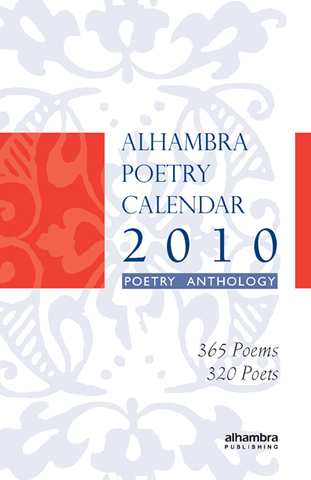
2010 Alhambra Poetry Calendars


The 2010 Alhambra Poetry Calendars are now available. I'm honored to have a poem of mine in the English edition yet again, but I'd also like to recommend that those who read other languages pick up one of the other editions as well; I got the German and French editions for 2009 and have been enjoying them immensely.


Monday, October 12, 2009

Phantom

In this passage from Don Paterson's "Phantom" (from his collection Rain), the "it" at the beginning refers to "matter":

It made an eye to look at its fine home,
but there, within its home, it saw its death;

and so it made a self to look at death,

but then within the self it saw its death;

and so it made a soul to look at self,

but then within the soul it saw its death;

and so it made a god to look at soul,

and god could not see death within the soul,

for god
was death. In making death its god
the eye had lost its home in finding it.

We find this everywhere the eye appears.

Were this design, this would have been the flaw. (57)


For proponents of "intelligent design," the eye is evidence of design in nature; they argue that the eye's "irreducible complexity" is proof that it cannot be the product of a process of natural selection of random mutations. This passage from Paterson, then, provides both a narrative of the evolution of religious belief (eye-home-self-soul-god; a sequence motivated by the eye's awareness of death) and a critique of intelligent design: "Were this design ..." The eye is not evidence of design but counterevidence. (Before I go on about the poem, I should add that the eye is a bad example as evidence of "intelligent design": the evolutionary steps that lead to the eye are well-documented.)

Now the fact that this argument or narrative appears in a poem (and not an essay) is enough to make its claims a little bit unstable; claims made in literary texts are of a different order than those made in scientific or philosophical texts (Literary Theory 101). But this passage is rendered even more unstable than usual by the context it appears in: it is the third of three italicized stanzas that conclude the sixth section of Paterson's seven-part "Phantom." The first stanza of the section introduces the speaker of the italicized material (I am italicizing this because that's what I do with quotations in blog posts):

For one whole year, when I lay down, the eye
looked through my mind uninterruptedly

and I knew a peace like nothing breathing should.

I was the no one that I was in the dark womb.

One night when I was lying in dark meditation

the I-Am-That-I-Am-Not spoke to me

in silence from its black and ashless blaze

in the voice of Michael Donaghy the poet.

It had lost his lightness and his gentleness

and took on that plain cadence he would use

when he read out from the
Iliad or the Táin. (56)

In the poem's overall arc, then, the passage I began with is spoken by "the I-Am-That-I-Am-Not" "in the voice of Michael Donaghy" to the speaker of the whole sequence. Donaghy's voice continues to speak in the poem's next (and final) section, where that voice refers to the poem's overall speaker as "Donno." Thus, the poem's conceit is that the italicized passages are spoken by a version of God (not "I Am That I Am" but "I Am That I Am Not") in the voice of a deceased poet (Donaghy) to the poet who is writing the poem ("Donno," presumably meant to be Paterson himself, in spite of Literary Theory 101).

Beyond that, the passage I began with is dismissed both by the voice of Donaghy and by "Donno." Donaghy's voice begins the final section by saying, "Donno, I can't keep this bullshit up" (58). And after the italics have gone on for another two pages, "Donno" interrupts the speech (again, these italics are mine, to mark the quotation):

He went on with his speech, but soon the eye
had turned on him once more, and I'd no wish

to hear him take that tone with me again. (59)


Thus, the wonderful passage on the eye's metaphorical evolution into a godhead is implicitly called into question (or even repudiated) in at least three ways: first, it is spoken by a godlike figure, the "I-Am-That-I-Am-Not," who, in keeping with the negation in his name, denies himself while also asserting himself at the same time (in the "I Am" and in the very presence of his words). Secondly, the voice of Donaghy dismisses the eye passage as "bullshit." Finally, "Donno" refuses to listen further when Donaghy's voice returns to that tone later in his speech.

As a result, the poem cannot be reduced to a contribution to a critique of intelligent design. Instead, it presents an expository argument in a context that allows it to be fully developed in an extended conceit, while also not allowing the argument to take over the poem. I love that poetic negation of intelligent design, but I also have to finally admit that what makes the poem compelling is not this vivid, rhetorically powerful passage but how it problematizes its own power by framing the passage so intriguingly. As an evolutionist, I want that argument to be made, but as a reader of poetry, I revel in how that argument becomes one facet of the whole poem's exploration (not resolution) of the issues it raises.

Friday, October 09, 2009

10 years of lyrikline

Here's a press release from the wonderful Berlin-based poetry website lyrikline:

26 – 31 October

world wide poetry: 10 years of lyrikline.org

Week of events in Berlin

We are celebrating lyrikline.org, come and celebrate with us! For ten years now, the website for poetry has been seeing to it that international poetry is freely available and accessible everywhere. Reason enough to celebrate with a whole week of events opened by German President Horst Köhler. Sixteen Embassies and cultural institutions are joining the Literaturwerkstatt Berlin in organising a week of poetry readings throughout Berlin to mark this occasion. And if you can’t get to Berlin, never mind. You can listen to the final event of the week on 31 October 2009 at 20 hours CET in a live streaming in the Internet, as well as having the opportunity to take part in a special chat. Berlin-based poet Steffen Popp will be commentating the event live on Twitter.

lyrikline.org has been an ongoing success story since its inception in 1999. There is a huge audience for poetry, even if book publications and sales are in a world-wide decline and publishers are ever more wary of it. There are now 600 poets online on lyrikline.org with 5,500 poems in 50 languages, with translations into 48 languages. Partners in 40 countries collaborate in lyrikline.org, which began as an initiative by the Literaturwerkstatt Berlin.

The week of events to mark “10 years of lyrikline.org” is under the patronage of the EU Commissioner for Multilingualism, Leonard Orban.


The week of events is taking place in cooperation with: the Embassy of the Republic of Argentina, the Embassy of the Republic of Estonia, the Embassy of the Republic of Finland, the Embassy of the Republic of Iceland, the Embassy of the Republic of Croatia, the Embassy of the Republic of Macedonia, the Embassy of the Republic of Slovenia, the Embassy of the Kingdom of the Netherlands, the Flemish Representation, the Greek Culture Foundation, Berlin branch, the Ramon Llull Institute – Berlin, the Italian Cultural Institute, Berlin, The Royal Norwegian Embassy, the Titu Maiorescu Romanian Cultural Institute, Berlin, the Slovakian Institute, Berlin and the Québec Government Office in Berlin.

With kind support from:

The Working Group of Literary Societies, Foreign Office, Senate Chancellery – Cultural Affairs, Prussian Maritime Foundation, the Representation of the European Commission in the FRG, The Heinrich-Böll Foundation, the Federal Government Commissioner for Culture and the Media and the Mandala Hotel


Programme of the week of events to mark 10 years of lyrikline.org


Mon. 26 October

Password: Poetry

Opening

7,30 pm, Palais, Kulturbrauerei, Schönhauser Allee 36, 10435 Berlin, Entrance free, Advance reservation required at mail@literaturwerkstatt.org till 21th October

Featuring Lebogang Mashile (South Africa), Monika Rinck (Germany) Music: Aki Takase (Japan)
In the presence of German President Horst Köhler

Tues. 27 October

Greece: The Blast of Time

6.30 pm Greek Culture Foundation, Wittenbergplatz 3a, 10789 Berlin, Entrance free

Featuring Dionýsis Kapsális (Greece), Moderated by: Anna Lazaridou


Estonia/Finland/Iceland/Norway

North-North-East: a Nordic-Baltic evening

8 pm Nordic Embassies, Felleshus, Rauchstrasse 1, 10787 Berlin, Entrance free, please reserve a seat at info@nordischebotschaften.org

Featuring Simen Hagerup (Norway), Lauri Otonkoski (Finland), Steinunn Sigurðardóttir (Iceland) Elo Viiding (Estonia)


Weds. 28 October

Croatia: Mirrored Words

6 pm Embassy of the Republic of Croatia, Ahornstrasse. 4, 10787 Berlin

Entrance free. Please reserve a seat on 030-2192-5514

Featuring Branko Cegec (Croatia),: Dieter M. Gräf (Germany), Karen Kiwus (Germany), Zvonko Maković (Croatia) and Andriana Škunca (Croatia)

Moderated by: Alida Bremer


Flanders/Netherlands:

Poetry Below Sea-Level

8 pm Embassy of the Kingdom of the Netherlands, Klosterstrasse 50, 10179 Berlin

Entry free, please reserve a seat at: bln-pcz@minbuza.nl

Featuring: Luuk Gruwez (Flanders), Ramsey Nasr (The Netherlands), Victor Schiferli (The Netherlands) and Mark van Tongele (Flanders)

Music: Ma Rain (The Netherlands)


Thurs. 29 October

Slovakia: Electromagnet Love

6 pm Berlin Slovakian Institute, Zimmerstrasse 27, 10969 Berlin. Entrance free

Featuring Martin Solotruk (Slovakia) Music: David Kollar (Slovakia) Moderated by: Angela Repka


Catalonia/Québec

The Poetry of Obstinacy: reading and discussion
8 pm
Literaturwerkstatt Berlin, Knaackstrasse 97, 10435 Berlin, Entrance free
Featuring Nicole Brossard (Québec), Teresa Pascual (València) Translators: Juana Burghardt (Argentina), Tobias Burghardt (Germany), Odile Kennel (Germany)
Moderated by: Frank Heibert

Fri. 30 October
Macedonia: On the borders of poetry
5 pm Embassy of the Republic of Macedonia, Koenigsallee 2, 14193 Berlin
Entrance free
Featuring: Claudia Keelan (USA), Nikola Madzirov (Macedonia), Zvonko Maković (Croatia) and Uljana Wolf (Germany / USA)

Slovenia: The Magic of Slovenian Poetry

6.30 pm Embassy of the Republic of Slovenia, Hausvogteiplatz 3-4, 10117 Berlin

Entrance free

Featuring: Milan Dekleva (Slovenia), Gregor Podlogar (Slovenia)


Argentina / Italy:

Transeurope Hotel & Argentinian Visions

8 pm Instituto Cervantes, Rosenstrasse 18, 10178 Berlin, 2576180

Entrance free

Featuring: Bruno Capezzuoli (Italy), Luigi Cinque (Italy), Silvana Franzetti (Argentina), Daniel Samoilovich (Argentina)

Moderated by Timo Berger & Rike Bolte


Romania: POETRY LIVE – The Long Night of Young Romanian Poetry

10 pm (expected to last until 3 am), Literaturwerkstatt Berlin, Knaackstr. 97, 10435 Berlin

Entrance free

Featuring: Constantin Acosmei (Romania), Svetlana Carstean (Romania), Rita Chirian (Romania), Gabi Eftimie (Romania), Sorin Gherguţ (Romania), Vasile Leac (Romania), Stefan Manasia (Romania), Vlad Moldovan (Romania), Ioana Nicolae (Romania), Olga Stefan (Romania) Moderated by Răzvan Ţupa


Sat. 31 October
world wide poetry

Finale

8 pm Tape Club, Heidestrasse 14, 10557 Berlin (Near main station and Hamburger Bahnhof gallery), Entrance EUR 5/3 with conceesions, tickets on the door
Featuring Nicole Brossard (Québec), Babangoni wawa Chisale (Malawi), Elke Erb (Germany), Claudia Keelan (USA), Nikola Madzirov (Macedonia), Thomas Möhlmann (Netherlands), Joseph Molapong (Namibia), Remi Raji (Nigeria), Daniel Samoilovich (Argentina), Lutz Seiler (Germany)
Moderated by: Knut Elstermann (journalist based in Berlin)

Meeting a Man from the Motor Trade

I've long loved the Beatles song "She's Leaving Home," but I've also long been puzzled by the line "waiting to keep the appointment she'd made, meeting a man from the motor trade." The Wikipedia page on the song has lots of information about how it was written, but it does not saying anything about the significance of "the motor trade." Does "the motor trade" have any significance here? (Perhaps, as an American, I am missing some British slang?)

Here's Brad Mehldau's version of the song, in any case:


Thursday, October 08, 2009

A riddle

Miles and I just wrote this riddle.

WHO ARE WE?

The first will bring you messages
from someone up above.

The second always finds a way
to make you fall in love.

The third's the only one of us
with but a single friend.

The fourth would like to start a war
that will never end.

The fifth killed number six
in order to be king,

while number six, his father,
has more than just one ring.

Number seven is as green
as number three is blue,

while number eight lives in the sea,
far away from you.

Nine's the devil, by the way,
and now we've nothing more to say.

Saturday, October 03, 2009

Scaremongers

I've been enjoying Born in a Barn, by The Scaremongers, which is a British band whose singer is none other than poet Simon Armitage. I picked it up because I'll be teaching a seminar on Armitage next term, and I thought it would be fun to have some of his lyrics/songs to consider, too.

Of the songs on the CD, I particularly like "From the Shorelines of Venus," which as far as I can tell you can only listen to by buying the CD, but if you want to check out some of the tunes, a few can be heard on the band's MySpace page.

Perhaps I'll soon get around to ordering a CD by Rackett, too (Paul Muldoon's band).

Wednesday, September 30, 2009

Upcoming events

More info to follow on all of these, but I thought I'd get them out there.

My band Human Shields will go electric on Saturday, October 24, at the drum school Basel's annual Open House—with my son Miles Delpho (9), a drum school student, on the drums. Time TBA.

Human Shields will then shrink back to its normal, trio size and go back to being acoustic at the Offene Bühne in Basel on November 1. Showtime is 8:00 p.m. (And we have another show scheduled for Sissy's Place in Birsfelden on January 22, 2009.)

Matthew Sweeney and Tim Turnbull will be reading at the Literaturhaus Basel on November 4 at 7:00 p.m as part of ESP, the English Seminar Poetry Series. The reading will be bilingual, with translator Jan Wagner reading the poems in German. I'll be introducing the readers.

I'll be reading my own poetry at the Poetry Hearings in Berlin on November 21. I have the pleasure of sharing the bill again with Matthew Sweeney and Tim Turnbull, as well as with Donna Stonecipher, Alistair Noon, Ivy Alvarez, Tom Chivers, Mary Noonan, Hannah Silva, and Maurice Scully.

Thursday, September 24, 2009

Crème de la crème

In 9th grade, in the late 70s, my sisters Sara and Ruth went to France for a month of French language immersion school with our Great Aunt Betty and Great Uncle Bill. Here's Ruth's funny story about that trip (remembered on the sad occasion of Bill's death this week):
The best France story was the last night when we went to a restaurant and Betty and Bill ordered coffee at the end. Betty mistakenly asked for de la crème, s'il vous plait, and the waiter and Bill (whose French was BAD) asked her several times if that's what she wanted, and she kept assuring them she wanted crème, so they brought her a vat of sour cream, and hovered around watching if she would really put it in her coffee, and Bill kept shaking his head and saying "Mom" (cause they called each other Mom and Dad) and she with nerves of steel scooped a dollop of the sour cream and plunked it in her coffee and we all watched aghast as she drank it down. We rolled on the floor with laughter as we fell out the doors into the street!

Thursday, September 17, 2009

Summertime

I was surprised to see J. M. Coetzee's Summertime shortlisted for the Booker Prize—not because I did not enjoy the book, but because I did not read it as a novel. The book's subtitle is "Scenes from Provincial Life," which is also the subtitle of Coetzee's memoir Boyhood, so I read Summertime as a memoir. (Note that the Wikipedia page on Coetzee lists it under his memoirs.)

Granted, as a memoir, Summertime is even more singular than Boyhood (and than the similar Youth, Coetzee's second memoir). As I have noted before, in Boyhood and Youth, Coetzee takes an unusual approach to autobiographical writing: the books are in the third person and the present tense.

Summertime begins with a section called "Notebooks 1972-1975," and at first it appears to be a memoir like the other two: third person and present tense are used again. A small difference is that these selections from "Notebooks" are dated, whereas Boyhood and Youth are both largely vague about dates (and about how old the protagonist actually is at any given time).

In addition, these notebook entries are followed by italicized comments on them, like this one (the first): "To be expanded on: his father's response to the times as compared to his own; their differences, their (overriding) similarities" (6). To all appearances, then, Summertime is like Boyhood and Youth, but with a few little twists.

What follows, though, is utterly different. The next section is called "Julia," and it is an interview with a woman who had an affair with one John Coetzee in the early 1970s in South Africa. The interviewer (at first anonymous, but later identified by the interviewee, Julia Frankl, as "Mr. Vincent" [43]) begins by referring to "the pages I sent you from John Coetzee's notebooks for the years 1972-1975," and on the next page a question from Frankl to Vincent leads to the clarification that the italicized passages after the entries were by Coetzee, "notes to himself, written in 1999 or 2000, when he was thinking of adapting these particular entries for a book" (20).

Julia then tells Mr. Vincent about her affair with Coetzee. At one point, she says, "And John was not a great talker, as you know" (34). If this implies that this John Coetzee is dead (which J. M. Coetzee is emphatically not), then Mr. Vincent's reply confirms it: "I don't know. I never met him in the flesh" (34). Not "I have never met him," but "I never met him": so this interview is about the late John Coetzee.

At this point, I could have stopped for a moment and thought, "Okay, this is not a memoir!" But this is Coetzee we're talking about, and Boyhood and Youth had already rewritten the rules about memoirs, so I just took this as a much more extreme variation on the memoir: Coetzee writing as if he were dead and a biographer, Mr. Vincent, was working on a book by interviewing people for it.

Five interviews appear in the book, followed by a last section called "Notebooks: undated fragments." In the fourth interview, with Martin, an academic colleague of Coetzee's in the 1970s, Mr. Vincent begins by reading "an account of his [Coetzee's] first meeting with you" (with Martin, that is), which Coetzee had written "in one of his late notebooks." Mr. Vincent goes on to add that he suspects "it was intended to fit into the third memoir, the one that never saw the light of day. As you will hear, he follows the same convention as in Boyhood and Youth, where the subject is called 'he' rather than 'I'" (205). A few pages later, Mr. Vincent then asks a question about what Coetzee might have said "if he had gone on with the memoir, if he had not stopped writing" (210).

Within the world of Summertime, then, John Coetzee worked on a third memoir after Boyhood and Youth, but he did not finish it—not because he died, but because he had stopped writing before he died. In the real world, J. M. Coetzee has continued writing, of course—but he has not published the third memoir. Instead, he has published Summertime.

One can speculate about what this might mean. Coetzee might have started writing a third memoir and decided that it would be boring to just write a third book like the first two. Then the form of Summertime would be an experiment by a writer who does not like to repeat himself. But it's also possible that Coetzee began the third memoir and stopped writing it—not because he stopped writing entirely, like Summertime's John Coetzee, but because he failed to pull it off for one reason or another. Somewhere between failure and experimentation lies the somewhat more down-to-earth alternative that J. M. Coetzee (not John Coetzee) simply decided that this material called for a different approach, an entirely new form, neither memoir nor novel, but a mixture of the two.

But what of these interviews? The strangest possibility of all is that Coetzee conducted the interviews himself! A slightly less strange variation would be that he had somebody else conduct them. A third possibility, odd in an entirely different way, would be that he imagined interviews with these people he had once known. A fourth possibility is that he invented the interviewees, and then I would finally have to admit that the book is an unusual novel, and not a memoir.

But that third alternative is intriguing: if Coetzee conducted imaginary interviews with five people he knew from the 1970s, then one has to grant him a capacity that he ahs not generally been seen as having (either by critics or even by himself—although perhaps his self-criticism in this respect is an ironic mocking of his critics): empathy. Even though the interviews are about John Coetzee, they are as much or even more about the interviewees themselves, and as musings about how others might have seen him, they demonstrate that Coetzee does have a good feel for his own weaknesses and their effects on others.

In the end, then, I find Summertime most interesting when I read it as an experimental memoir, as it were, much more then when I read it as a novel. As a novel, it fits nicely with his last two, Slow Man and Diary of a Bad Year (though I would then say the latter is a much better book), while as a memoir, it is a unique and compelling book.

Wednesday, September 16, 2009

Coetzee on Prose and Poetry

Here's one way the young J. M. Coetzee thought about the difference between prose and poetry (from his memoir Youth):
In poetry, the action can take place everywhere and nowhere: it does not matter whether the lonely wives of the fishermen live in Kalk Bay or Portugal or Maine. Prose, on the other hand, seems naggingly to demand a specific setting. (62-63)
He goes on to say that he cannot write about London (where he is living at the time) because he does not know it well enough yet—and thus implies that he can only write about South Africa, where he grew up.

This could be a commentary on Coetzee's own work, for at the time when Youth was published (2002), he had published eight novels, only one of which does not have "a specific setting": Waiting for the Barbarians is set in an imaginary, unnamed "Empire." Foe and The Master of Petersburg complicate the point, but neither fully contradicts it: Foe might even be the London novel that the younger Coetzee feared he could not write, while imagines a Petersburg that Coetzee the author fully inhabited, in a sense, in his extensive reading of and about Dostoevsky. — The rest of those previous novels are set in South Africa, and the three he has published since are very specific about setting (except perhaps for one or two sections of Elizabeth Costello).

Still, a statement like the above in a memoir is somewhat unstable (even if it is not as unstable as it might be if uttered by a character in a novel). A memoirist might be asserting this position as his own, but he might also be saying that the position is one he once held but now finds mistaken. A more straightforward memoirist than Coetzee would probably make explicit whether he agreed or disagreed with his younger self on this point, but Coetzee never says anything like "what a fool I was" or "I already knew that." He establishes distance from his younger self by writing about himself in the third person and the present tense, but it is not always clear whether that distance is ironic or not. (See my thoughts on this in Boyhood from 2007 here.)

Finally, though, it is worth considering the truth of the claim that prose demands a specific setting while poetry does not. One should be more precise: novels demand a specific setting while lyric poems don't. Put that bluntly, it's surely not true (Kafka, anyone?), but as a rule of thumb it seems accurate to me: lyric poetry can be very unspecific about setting in a way that most novels could never get away with being.

Thursday, September 03, 2009

A recommendation for poets and readers of poetry

I highly recommend Don Brown's fascinating post on "Lyric Occasions":

There are so many ways that language -- as rhetoric -- fails to achieve its intentions, it’s a wonder any poems succeed at all.

Wednesday, September 02, 2009

Two Trees

"Two Trees," the first poem in Don Paterson's Rain, begins with a stanza describing how one Don Miguel grafts an orange tree and a lemon tree together. Then, in a second stanza, "the man who bought the house" splits the two grafted trees apart. A series of negatives follows, climaxing with how the two separated trees did not "strain ... to face / the other's empty, intricate embrace." The poem the explains these negations in the couplet that concludes the second stanza and, with it, the poem itself:

They were trees, and trees don't weep or ache or shout.
And trees are all this poem is about.

If that's the case, then the attraction of this poem lies not in how it extends a potential metaphor for the reader to play around with, but rather in how it teases the reader by apparently offering an extended metaphor before taking it back. This is not the expansion of the usual extended metaphor, which seems to offer such a tremendous range of interpretations, all of them plausible—with the pleasure lying in the poem's surplus of possibilities. Instead, this poem's effect is a matter of diminuition, a playful retreat from the extravagance and excess of extended metaphor (while still partaking of the pleasures of that excess before retreating from them).

TWO TREES

One morning, Don Miguel got out of bed
with one idea rooted in his head:
to graft his orange to his lemon tree.
It took him the whole day to work them free,
lay open their sides, and lash them tight.
For twelve months, from the shame or from the fright
they put forth nothing; but one day there appeared
two lights in the dark leaves. Over the years
the limbs would get themselves so tangled up
each bough looked like it gave a double crop,
and not one kid in the village didn't know
the magic tree in Miguel's patio.

The man who bought the house had had no dream
so who can say what dark malicious whim
led him to take his axe and split the bole
along its fused seam, then dig two holes.
And no, they did not die from solitude;
nor did their branches bear a sterile fruit;
nor did their unhealed flanks weep every spring
for those four yards that lost them everything,
as each strained on its shackled roots to face
the other's empty, intricate embrace.
They were trees, and trees don't weep or ache or shout.
And trees are all this poem is about.

Tuesday, September 01, 2009

Wanting to be normal

Rereading Coetzee's Boyhood, I was struck by the issue of being "normal." The issue is raised in a disturbing way, in a discussion of the beating of children in school: if John, the third-person Coetzee in this memoir, is finally beaten by a teacher, then "he will be able to come out on the other side a normal boy" (7). A few pages later, then, it is no longer just a matter of beatings at school: "He wants his father to beat him and turn him into a normal boy" (13).

What would be beaten out of him so that he would be normal?

Once, during their early months in Worcester, a boy from his class had wandered in through the open front door and found him lying on his back under a chair. 'What are you doing there?' he had asked. 'Thinking,' he had replied unthinkingly: 'I like thinking.' Soon everyone in his class knew about it: the new boy was odd, he wasn't normal. (29)

Thinking, then, is not normal, and the irony is brutal: when he speaks "unthinkingly," his inner world of thinking is exposed. Implicitly, then, "thinking" is what needs to be beaten out of him for him to become "normal."

This is connected to lying:

If he stopped lying he would have to polish his shoes and talk politely and do everything that normal boys do. In that case he would no longer be himself. If he were no longer himself, what point would there be in living? (35)

This reveals the other perspective on normalcy: John wants to be normal, but he also wants to be himself, the thinker and, here, the liar. If thinking and lying make him feel guilty, they still make him who he is: the boy who is different.

His mother is also responsible for his difference: "He wishes she would be normal. If she were normal, he could be normal" (38). Does she create the thinker and liar? Perhaps in part, John thinks, because she does not let his father beat him.

One odd effect of Boyhood is that it is in the present tense, so everything seems to happen at the same time. The boy's development is thus obscured. But his perspectives do change, as do his ability to articulate them:

He is just a boy walking beside his mother: from the outside he probably looks quite normal. But he thinks of himself as scuttling around her like a beetle, scuttling in fussy circles with his nose to the ground and his legs and arms pumping. In fact he can think of nothing about himself that is still. His mind in particular darts about here and there all the time, with an impatient will of its own. (59)

Here, his external perspective on himself grants an apparent normalcy that could not be articulated earlier in the book, and the internal depiction of thinking is much more complex.

And a while later, he rejects normalcy entirely—at least temporarily:

'Can't you just be normal?' asks his mother.
'I hate normal people,' he replies hotly. (78)

His mother, previously seen as partially responsible for his failure to be normal, now wants him to be normal, but now he rejects what, as a younger boy, he so vehemently desired. Still, it is better to be on his mother's side:

He is chilled by the thought of the life he would face if his father ran the household, a life of dull, stupid formulas, of being like everyone else. His mother is the only who stands between him and an existence he could not endure. (79)

Once, his father's failure to beat him was a lack that contributed to his difference; now, the father is a representation of the normalcy he rejects.

John's sense of his difference, then, gradually turns positive, until he can finally feel "convinced that he is different, special" (108). But this cannot be a stable, positive feeling, as this frightening passage makes all too clear:

... if all the stories that have been built up around him, built by himself, built by years of normal behavior, at least in public, were to collapse, and the ugly, black, crying, babyish core of him were to emerge for all to see and laugh at, would there be any way to go on living? Would he not have become as bad as one of those deformed, stunted, mongol children with hoarse voices and slavering lips that might as well be given sleeping pills or strangled? (112)

His outward appearance, as when he was walking with his mother, is "normal," but the restless "thinker" disappears here in a maelstrom of feelings. The move toward a positive sense of "abnormality" can never be permanent and ends in the horrifying image of the strangling of children with Down's Syndrome. (An image that deserves lengthy discussion in the context of Coetzee's work as a whole!)

So a dialectic remains (inevitably?), between normalcy and difference: "Though he blames his parents because they have not brought him up as a normal child, he is proud of their education" (124). Education (thinking?) is something to be proud of even if it does not make one "normal"—and one's "normalcy" remains, always, it seems, the responsibility of one's parents. (Is this a theme in the life of many writers? — Educated parents who have come down in the world? Certainly, mothers who gave up a "creative" side to raise children are a theme in artists' lives.)

"Thinking," as the source of difference, is expressed through education, and most of all, through examinations:

He is good at examinations; if there were no examinations for him to be good at there would be little special about him. Examinations create in him a heady, trembling state of excitement during which he writes quickly and confidently. He does not like the state in itself but it is reassuring to know it is there to be tapped. (131)

Here, his difference from others, what makes him special, is reduced to his good performance in school. The problem with this does not appear in Boyhood, but only in Youth: what do you do when you stop doing well in examinations, or when there are no more examinations to take? ["Never in his life has he been forced to call on his utmost powers. Less than his best has always been good enough"—Youth, 13]

Near the end of the book, a new claim is made about John:

Once upon a time he used to be full of ideas, ideas for places to go, things to talk about, things to do. He was always a step ahead of everyone: he was the leader, the others followed. Now the energy that he used to feel streaming out of him is gone. At the age of thirteen he is becoming surly, scowling, dark. (151)

This is quite surprising, given that the book contains no evidence at all of John, the leader. His energy has only appeared as the energy of thinking about himself and normalcy, and he has largely seemed "surly, scowling, dark." Has Coetzee's older self colored his sense of his younger self? As he says in Youth, "ruthless honesty is not a hard trick to learn" (Youth, 164). Perhaps Coetzee's desire to be "ruthlessly honest" has led him to avoid depicting himself as a leader, for fear of glamorizing himself. In any case, Boyhood is not self-aggrandizing—and Youth, with its scathingly ironic self-portrait of the artist as a young man, is even less so.

Amicable Numbers

Mike Barlow's "Twenty Something Going On Immortal" (from his pamphlet Amicable Numbers, Templar Poetry, 2008) describes one moment in the climbing of a cliff, and concludes:

When I'm gone the same piece of rib
will jut against the sky, and a line of rope
mark out a sequence of inevitable moves.

The eighteen lines before this conclusion, though, make it clear that the "line of rope" was not at all inevitable from the perspective of the climber. Poems are like this, too: a series of choices and decisions that, in the end, must look like "a sequence of inevitable moves."— With the advantage, of course, that a misstep in a poem does not lead to a dangerous fall.

Barlow's "Out of My Body" describes what the speaker sees after "God knows who put what in my drink": From "high above the town," the squares, the river, the cathedral, but not the people: "I can't see how / we touch or hear what we say to one another." The description of being "out of my body" ends with this implicit rejection of the experience of being high in favor of a less self-centered view of the world, and hence makes a claim about what poetry is for: "how we touch" and "what we say to one another."

There's a lovely irony, then, in "Cauliflower Cheese," a descriptio of the making of a meal. It begins: "Don't speak. Don't interrupt. Whatever / you're bursting to say, save it." Here, "what we say to another" is nothing, and the speaker does not touch the addressee, who is sent to drink a glass of wine and walk barefoot on the lawn: "I'll call when it's ready. You can come in then / with all you have to say." But even, no conversation takes place; instead, the meal is eaten:

We'll help each other to seconds,
trying to leave a little for cold, tomorrow.
But we won't. We'll finish the lot.