Sunday, November 23, 2014
Federer, Davis Cup
My first sighting of Roger Federer was live at the Davis Cup in Basel in February 2001. He won two singles matches and the doubles against the US. Such a joy to watch him now, almost 14 years later, winning the only tennis title missing from his laurels.


Monday, November 17, 2014
In language, no.
A claim made in a Facebook comment stream (a discussion of a complaint about the indicative being used where the mandative subjunctive is supposed to be the only correct choice, if you must know):
The number of people, who are doing something incorrectly, is not a determinant of the correctness of the act.
My response: in math, yes. In language, no.
(Is it rude to point out that the above claim contains commas that would best be omitted? Yes, it probably is ...)
Sunday, November 16, 2014
Nietzsche before his mustache went crazy
Here's Nietzsche at 18:
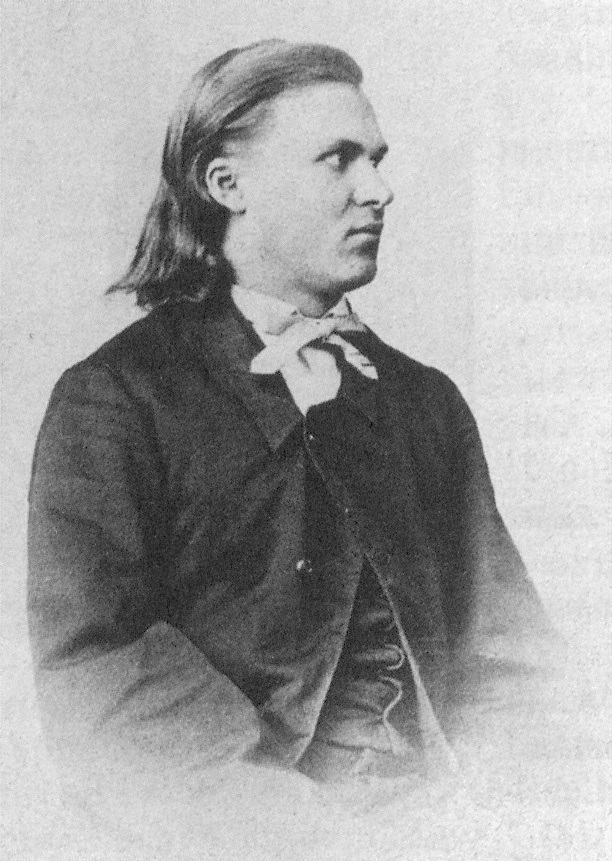
And at 21:

And at 25:
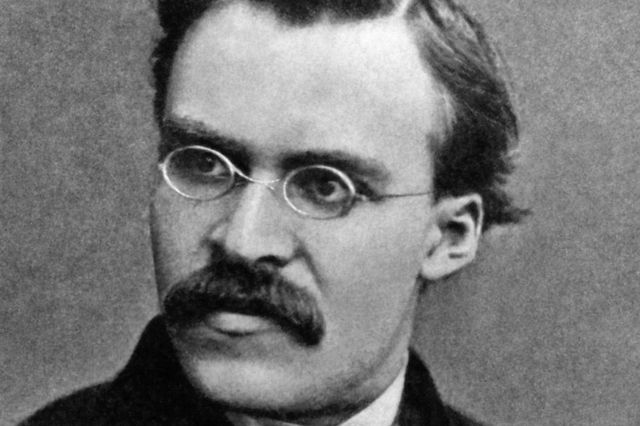
After that, the mustache took over.
And at 21:
And at 25:
After that, the mustache took over.
Wednesday, November 12, 2014
Such as and/or such X as?
In a review of the 2011 film of Jane Eyre, a student wrote the following:
... they were joined by an equally great supporting cast, featuring actors such as Judi Dench and Jamie Bell.
I'm curious about that use of "such as". To me, it implies that Judi Dench and Jamie Bell are not only in the film but also the type of actors who are in the film. That is, from the name "Judi Dench", I should be able to make some pretty good guesses about who the other members of the supporting cast might be. That is, I read it as similar to this example (stolen from the COCA corpus):
It could be damage that happened as the result of an acute injury, such as spinal cord damage.
Here, "spinal cord damage" is an example of "an acute injury," and I can make some pretty guesses as to other members of that category. And I can't really do that with "actors such as Judi Dench and Jamie Bell."
However, I could do it with "featuring great actors, such as JD and JB." So it seems that the problem derives from two things: "actors" by itself seems odd with "such as" (as "an injury" by itself would in the above sentence?), and the absence of a comma before "such as" (though I'm not sure why that absence should be important here).
I actually prefer a different solution: "featuring such actors as JD and JB." To my ear, this implies that the named actors share some characteristic (probably "greatness"?) that is then also shared by the other members of the supporting cast. Even here, though, it would be a bit better to have that characteristic named, wouldn't it? "... featuring such great actors as JD and JB."
Why write all this up? First of all, to ask others what they think about the uses of "such as". And secondly, because I'm worried that I might be just peeving about something that is not as precise in other people's usage as I somehow expect it to be. If I'm just peeving about my own personal taste, then I know that I should just keep quiet about it. Along the lines recently suggested by Geoffrey Pullum: "The idea is that I will concentrate on my own usage rather than other people's."
Monday, November 10, 2014
Poetry in sports
Rob Hughes on Sergio Agüero:
There is poetry in sports when a man moves the way that Agüero can: plucking the ball out of the air with his right foot, feigning to shoot and then, as opponents cluster around him, flicking the ball to his other foot and shooting deftly.If there's poetry here, what poem is it? As an Argentine, perhaps Agüero was reciting Borges:
Now he is invulnerable like the gods.Or perhaps he prefers Ernesto Cardenal:
Or Gabriela Mistral:
Wednesday, November 05, 2014
PBS lists getting boring
Here's the Poetry Book Society list for Spring 2015 (as Neil Astley posted it on Facebook):
Choice
Sean O’Brien – The Beautiful Librarians (Picador)
Recommendations
Sujata Bhatt – Poppies in Translation (Carcanet)
Sean Borodale – Human Work (Jonathan Cape)
Paul Muldoon – Knowing (Faber)
Rebecca Perry – Beauty/Beauty (Bloodaxe)
I am grateful to the PBS for having been my way in to the contemporary UK poetry scene (I knew next to nothing about it when I first signed up for PBS in 1996). And I have frequently defended the value of the PBS in conversation with critics of its picks.
But it's gone on long enough that it is getting pretty discouraging (and simply boring, really) to see these five publishers (Picador, Carcanet, Cape, Faber, Bloodaxe) repeatedly dominating the Choice and Recommendation lists.
Choice
Sean O’Brien – The Beautiful Librarians (Picador)
Recommendations
Sujata Bhatt – Poppies in Translation (Carcanet)
Sean Borodale – Human Work (Jonathan Cape)
Paul Muldoon – Knowing (Faber)
Rebecca Perry – Beauty/Beauty (Bloodaxe)
I am grateful to the PBS for having been my way in to the contemporary UK poetry scene (I knew next to nothing about it when I first signed up for PBS in 1996). And I have frequently defended the value of the PBS in conversation with critics of its picks.
But it's gone on long enough that it is getting pretty discouraging (and simply boring, really) to see these five publishers (Picador, Carcanet, Cape, Faber, Bloodaxe) repeatedly dominating the Choice and Recommendation lists.
If there were an American version of PBS, the five books chosen every quarter would surely not be as dominated by FSG, Norton, Knopf, Houghton Mifflin, and Copper Canyon.
And why does O'Brien get so many Choices? This is his third. I know it's just my taste that I think he's a rather dull poet—but he's no Don Paterson (two Choices), no Edwin Morgan (one Choice), no Les Murray (two choices), no Anne Carson (one Choice).
List of PBS Choices through Spring 2014 is here.
And why does O'Brien get so many Choices? This is his third. I know it's just my taste that I think he's a rather dull poet—but he's no Don Paterson (two Choices), no Edwin Morgan (one Choice), no Les Murray (two choices), no Anne Carson (one Choice).
List of PBS Choices through Spring 2014 is here.
Tuesday, November 04, 2014
Money for something
I usually read Facebook with the "Most Recent" setting, but on my pocket computer, the app opens to "Top Stories". Just now, I found the following two posts right next to each other (the first by a poet friend; the second by a novelist friend):
Are there any reading series in the U.S. not associated with a university or an organization like The Poetry Foundation that actually pay readers on a regular basis? I’m not immediately aware of any. Note: this is not fishing for myself. People often ask about money for readers when they ask about coming to San Diego, and I always wonder why they think there might be some. Not that it hurts to ask, of course.
Taylor Swift speaks for me. Maybe. I think. (As I try to figure out precisely what I'm going to do with this new novel.)
"Music is art, and art is important and rare," Swift wrote in the Journal. "Important, rare things are valuable. Valuable things should be paid for. It's my opinion that music should not be free, and my prediction is that individual artists and their labels will someday decide what an album's price point is. I hope they don't underestimate themselves or undervalue their art."
I found the juxtaposition of the posts (and the vigorous discussion each generated) to be a symptom of how writers, artists, and musicians are thinking a lot about the relationship between money and their creative work.
Monday, November 03, 2014
Piano trio
I'm a great fan of jazz piano trios, such as the Brad Mehldau Trio with Larry Grenadier and Jorge Rossy or Jeff Ballard, and the classic Bill Evans trio with Scott LaFaro and Paul Motian. But until today, I never realized that the first piano trio I ever got into was not a jazz trio but a rock trio: Emerson, Lake, and Palmer. Consider the piano/bass/drums passages of "Take a Pebble," from their first album:
This was definitely the first such music I ever heard, several years before I got into jazz.
[I was listening to ELP this morning because of this post about ELP by Don Brown.]
Saturday, November 01, 2014
A pragmatic consideration of the intentional fallacy
The assignment: a four-to-six paragraph essay on The Fall of the House of Usher. A student asks if she can refer to Poe's life to help her discuss the representation of women in the story. At first, I thought I would just say "intentional fallacy" and give her some background on the issue, but then I started thinking about things in more pragmatic terms. So here's what I wrote to her:
One way to think about this is in terms of how you would present such an argument. In this case, you have about five paragraphs, with about three of them being body paragraphs. Suppose one of your body paragraphs is about the biographical point. Then you have two paragraphs to discuss the story. If the discussion of the story is convincing without the biographical paragraph, then you can toss out the biographical paragraph and have another paragraph about the story. If the discussion of the story is NOT convincing without the biographical paragraph, then you have a weak, two-paragraph discussion of the story ... (There are also less pragmatic, more theoretical reasons to be careful about the author's biography when doing a scholarly study of a work of literature. These theoretical issues are usually summed up in the expression "intentional fallacy.")
Shields's Law
I have just formulated a law of language discussion: talk about a language peeve long enough, and eventually someone will complain about teenagers.
Saturday, October 25, 2014
Cold dark deep and absolutely clear
Preparing Elizabeth Bishop's "At the Fishhouses" for class next week with a digital version of the poem, I was underlining words and making marginal comments about all kinds of things in the poem. So in a sense, I wasn't really reading the poem.
And yet when I got to the beginning of the third stanza, I gasped anyway:
Cold dark deep and
absolutely clear,
element bearable to no mortal,
Perhaps that's a test of just how great a poem is: if it blows you away even when you're not reading it in search of being blown away.
Sunday, October 19, 2014
Gilgamesh Must Die! (Part One): a video by The bianca Story
Here's a video by The bianca Story: "Gilgamesh Must Die! (Part One)". I cowrote the lyrics. Enjoy!
You can get the album "Digger" for free by clicking on the band's name above. If you get it and like it, pass it on to your friends! (If you get and don't like it, pass it on to your enemies!)
Thursday, October 16, 2014
160th birthday
A Happy Birthday to Oscar Wilde, who was born 160 years ago today. Here's Lord Henry in The Picture of Dorian Gray:
Play me a nocturne, Dorian, and, as you play, tell me, in a low voice, how you have kept your youth. You must have some secret. I am only ten years older than you are, and I am wrinkled, and worn, and yellow. You are really wonderful, Dorian. You have never looked more charming than you do to-night. You remind me of the day I saw you first. You were rather cheeky, very shy, and absolutely extraordinary. You have changed, of course, but not in appearance. I wish you would tell me your secret. To get back my youth I would do anything in the world, except take exercise, get up early, or be respectable. Youth! There is nothing like it. It's absurd to talk of the ignorance of youth. The only people to whose opinions I listen now with any respect are people much younger than myself. They seem in front of me. Life has revealed to them her latest wonder. As for the aged, I always contradict the aged. I do it on principle. If you ask them their opinion on something that happened yesterday, they solemnly give you the opinions current in 1820, when people wore high stocks, believed in everything, and knew absolutely nothing.
A Cold Spring
On this autumn morning, I'll be discussing Elizabeth Bishop's "A Cold Spring" with the students in my course on Bishop's poetry. The epigraph to the poem is from Gerard Manley Hopkins's "Spring," but the poem also recalls T. S. Eliot's "The Waste Land," and that recollection allows the "General Prologue" to Geoffrey Chaucer's The Canterbury Tales to shimmer through. I hope all this doesn't distract us too much from looking carefully at Bishop's poem.
Wednesday, October 08, 2014
Majority Approval
To me, the most striking feature of this xkcd comic is this: majority approval of interracial marriage in the United States was only reached in 1995!
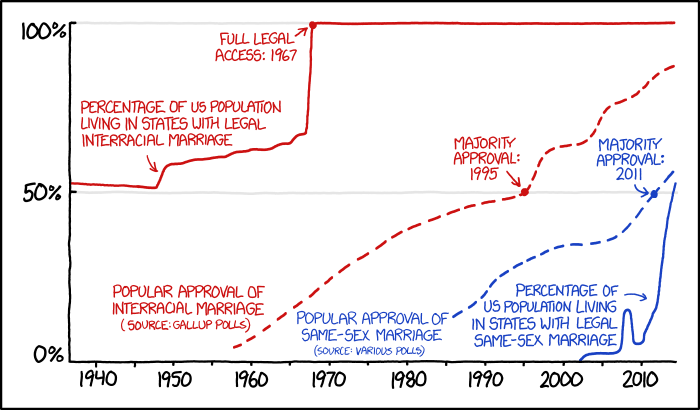
But as the mouseover points out, it's also striking that the relationship between legality and approval is not the same in the two cases. (I read something somewhere that said that SCOTUS may be trying to avoid what happened with Roe v. Wade, where such "full legal access" preceded "popular approval." If so, why not use Loving v. Virginia as your model instead, where legality preceded popularity by almost 30 years?)
Tuesday, October 07, 2014
A Better Rule for "Less" and "Fewer"
Over at the Visual Thesaurus, Jonathan Owen turns his attention to the supposed rule that "fewer is for things you can count while less is for things you can't." After analyzing various exceptions and paying attention to the history of the question and of actual usage, he comes up with a more accurate description of how the two terms are used: "Less is the default, but we also have the option of using fewer when it comes immediately before a plural count noun." His discussion is exemplary: this is how one should think about the rules of language use.
The history of the count/non-count version of the rule is itself exemplary: as Owen points out, "it wasn't until 1770 that Robert Baker suggested that maybe people should use fewer instead of less with count nouns, and the rule has expanded and become more rigid since then." In other words, the "rule" comes not from considering how people actually speak but from someone suggesting that it would be better if people spoke differently.
Sunday, October 05, 2014
Leonard Cohen, "Popular Problems"
In "Slow," the opener of "Popular Problems," 80-year-old Leonard Cohen warns us how not to interpret the album: "It's not because I'm old / It's not what dying does / I always liked it slow." And these mostly slow tunes do belie reading the album as "a work of old age." Here, Cohen looks at love from many angles, climaxing in the speechlessness of a wondering lover: "My Oh My." But the songs also depict a perplexed individual trying to make sense of the contemporary world; with his lover gone to fight a war, he finds himself among the ruins, "standing on this corner / Where there used to be a street".
*
[I'm teaching a course on Writing Reviews. The first assignment was to write a 100-word review. I thought I'd take a stab at it. This is 111 words long. Two-word version of the review: "Get it!"]
Saturday, October 04, 2014
Boyhood withdrawal
I've been telling people that I'm looking forward to mid-December, when the DVD of Richard Linklater's film "Boyhood" is due to be released. And I'd pre-ordered it, but today I got an email saying that it's been delayed until mid-January.
It's hard to have to wait a month longer to see it again, but I guess I'll just have to bear it. Until then, I can get a bit of a fix by listening to songs featured in the movie, especially "Hero," by Family of the Year, and "Hate It Here," by Wilco. And by watching other Linklater movies!
Tuesday, September 16, 2014
Join the Army
I used to have a T-shirt with this slogan on it, though it didn't have a hand grenade. Instead, it had a picture of Uncle Sam.

Which makes it seem like as good a time as any to jam out to "U. S. Blues":
Subscribe to:
Posts (Atom)
