Saturday, November 01, 2014

A pragmatic consideration of the intentional fallacy

The assignment: a four-to-six paragraph essay on The Fall of the House of Usher. A student asks if she can refer to Poe's life to help her discuss the representation of women in the story. At first, I thought I would just say "intentional fallacy" and give her some background on the issue, but then I started thinking about things in more pragmatic terms. So here's what I wrote to her:

One way to think about this is in terms of how you would present such an argument. In this case, you have about five paragraphs, with about three of them being body paragraphs. Suppose one of your body paragraphs is about the biographical point. Then you have two paragraphs to discuss the story. If the discussion of the story is convincing without the biographical paragraph, then you can toss out the biographical paragraph and have another paragraph about the story. If the discussion of the story is NOT convincing without the biographical paragraph, then you have a weak, two-paragraph discussion of the story ... (There are also less pragmatic, more theoretical reasons to be careful about the author's biography when doing a scholarly study of a work of literature. These theoretical issues are usually summed up in the expression "intentional fallacy.")

Shields's Law

I have just formulated a law of language discussion: talk about a language peeve long enough, and eventually someone will complain about teenagers.

Saturday, October 25, 2014

Cold dark deep and absolutely clear

Preparing Elizabeth Bishop's "At the Fishhouses" for class next week with a digital version of the poem, I was underlining words and making marginal comments about all kinds of things in the poem. So in a sense, I wasn't really reading the poem.

And yet when I got to the beginning of the third stanza, I gasped anyway:

Cold  dark deep and absolutely clear,
element bearable to no mortal,

Perhaps that's a test of just how great a poem is: if it blows you away even when you're not reading it in search of being blown away.

Sunday, October 19, 2014

Gilgamesh Must Die! (Part One): a video by The bianca Story

Here's a video by The bianca Story: "Gilgamesh Must Die! (Part One)". I cowrote the lyrics. Enjoy!


You can get the album "Digger" for free by clicking on the band's name above. If you get it and like it, pass it on to your friends! (If you get and don't like it, pass it on to your enemies!)


Thursday, October 16, 2014

160th birthday

A Happy Birthday to Oscar Wilde, who was born 160 years ago today.  Here's Lord Henry in The Picture of Dorian Gray:

Play me a nocturne, Dorian, and, as you play, tell me, in a low voice, how you have kept your youth. You must have some secret. I am only ten years older than you are, and I am wrinkled, and worn, and yellow. You are really wonderful, Dorian. You have never looked more charming than you do to-night. You remind me of the day I saw you first. You were rather cheeky, very shy, and absolutely extraordinary. You have changed, of course, but not in appearance. I wish you would tell me your secret. To get back my youth I would do anything in the world, except take exercise, get up early, or be respectable. Youth! There is nothing like it. It's absurd to talk of the ignorance of youth. The only people to whose opinions I listen now with any respect are people much younger than myself. They seem in front of me. Life has revealed to them her latest wonder. As for the aged, I always contradict the aged. I do it on principle. If you ask them their opinion on something that happened yesterday, they solemnly give you the opinions current in 1820, when people wore high stocks, believed in everything, and knew absolutely nothing.

A Cold Spring

On this autumn morning, I'll be discussing Elizabeth Bishop's "A Cold Spring" with the students in my course on Bishop's poetry. The epigraph to the poem is from Gerard Manley Hopkins's "Spring," but the poem also recalls T. S. Eliot's "The Waste Land," and that recollection allows the "General Prologue" to Geoffrey Chaucer's The Canterbury Tales to shimmer through. I hope all this doesn't distract us too much from looking carefully at Bishop's poem.

Wednesday, October 08, 2014

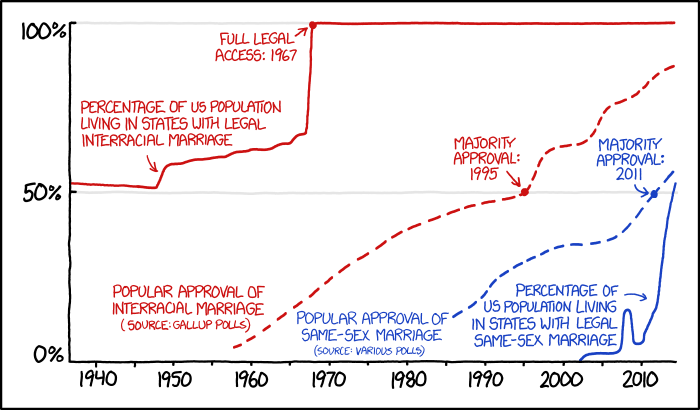
Majority Approval

To me, the most striking feature of this xkcd comic is this: majority approval of interracial marriage in the United States was only reached in 1995!


But as the mouseover points out, it's also striking that the relationship between legality and approval is not the same in the two cases. (I read something somewhere that said that SCOTUS may be trying to avoid what happened with Roe v. Wade, where such "full legal access" preceded "popular approval." If so, why not use Loving v. Virginia as your model instead, where legality preceded popularity by almost 30 years?)

Tuesday, October 07, 2014

A Better Rule for "Less" and "Fewer"

Over at the Visual Thesaurus, Jonathan Owen turns his attention to the supposed rule that "fewer is for things you can count while less is for things you can't." After analyzing various exceptions and paying attention to the history of the question and of actual usage, he comes up with a more accurate description of how the two terms are used: "Less is the default, but we also have the option of using fewer when it comes immediately before a plural count noun." His discussion is exemplary: this is how one should think about the rules of language use.

The history of the count/non-count version of the rule is itself exemplary: as Owen points out, "it wasn't until 1770 that Robert Baker suggested that maybe people should use fewer instead of less with count nouns, and the rule has expanded and become more rigid since then." In other words, the "rule" comes not from considering how people actually speak but from someone suggesting that it would be better if people spoke differently.

Sunday, October 05, 2014

Leonard Cohen, "Popular Problems"

    In "Slow," the opener of "Popular Problems," 80-year-old Leonard Cohen warns us how not to interpret the album: "It's not because I'm old / It's not what dying does / I always liked it slow." And these mostly slow tunes do belie reading the album as "a work of old age." Here, Cohen looks at love from many angles, climaxing in the speechlessness of a wondering lover: "My Oh My." But the songs also depict a perplexed individual trying to make sense of the contemporary world; with his lover gone to fight a war, he finds himself among the ruins, "standing on this corner / Where there used to be a street".

*

[I'm teaching a course on Writing Reviews. The first assignment was to write a 100-word review. I thought I'd take a stab at it. This is 111 words long. Two-word version of the review: "Get it!"]

Saturday, October 04, 2014

Boyhood withdrawal

I've been telling people that I'm looking forward to mid-December, when the DVD of Richard Linklater's film "Boyhood" is due to be released. And I'd pre-ordered it, but today I got an email saying that it's been delayed until mid-January. 

It's hard to have to wait a month longer to see it again, but I guess I'll just have to bear it. Until then, I can get a bit of a fix by listening to songs featured in the movie, especially "Hero," by Family of the Year, and "Hate It Here," by Wilco. And by watching other Linklater movies!

Was bleibt

Was bleibt aber
stiften
die Übersetzer.

Tuesday, September 16, 2014

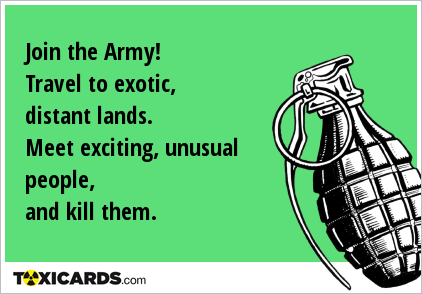
Join the Army

I used to have a T-shirt with this slogan on it, though it didn't have a hand grenade. Instead, it had a picture of Uncle Sam.
Which makes it seem like as good a time as any to jam out to "U. S. Blues":


Tuesday, August 19, 2014

Make it ancient

Listening to "The Band," by The Band, for the first time in a long time today, I was struck yet again by the brilliance of all the songs, but especially by "The Night They Drove Old Dixie Down." It's a song I grew up with, one I don't remember hearing for the first time. But I do know how surprised I was when I discovered that the song is even younger than I am. How could it not be ancient? How could it not have been written in the era it is set in? It shows that one way to fulfill Ezra Pound's call to "make it new" is to "make it ancient", as Pound himself, that lover of the troubadours, was well aware.

Friday, July 11, 2014

"His judgment could not be faltered"

In his INYT article on the Argentine footballer Javier Mascherano, Rob Hughes spends a lot of time talking about a key moment in the Holland-Argentina match the other day: Mascherano's tackle of Arjen Robben in the 90th minute, just before Robben was about to get a good shot on goal (his only one of the day?). He sums it up with a nice bit of understatement, but note also what he says at the beginning of this passage:
His judgment could not be faltered. His defenders had lost sight of Robben, his goalkeeper was frozen to his line, and everything depended on Mascherano’s timing that interception to perfection. A fraction either way, and he risked making contact with the Dutchman, who is known for his, shall we say, unsure footing in the penalty box.
Describing Robben's tendency to fall as dramatically as possible as "nnsure footing" made me laugh, but before I got to that, I had stopped at the first sentence here: "could not be faltered" sounds quite odd. 

First, I thought of this use of "falter" in terms of transitivity. "Falter" is usually an intransitive verb: "he faltered," but not "his opponent faltered him." As an intransitive verb, it cannot be used in the passive voice, as it is in Hughes's phrase: "be faltered." So I wondered if "falter" might be developing a transitive use: "they were unable to falter his judgment."

But then I did a search for the phrase "could not be faltered," and I found examples like this, mostly from travel websites where travel services of various kinds get evaluated: "The service, seats and leg room could not be faltered." This made me realize that I was dealing with an eggcorn, but it turns out to be one that is not listed in the Eggcorn Database. The standard expression that the eggcorn is based on is, of course, "could not be faulted."

I do wonder about the motivation for this one, though. One feature of many eggcorns is that the standard expression involves some oddity of usage, or an archaic word or image—something that a contemporary speaker may not be aware of. For example, "in cohorts with" instead of "in cahoots with": "A natural substitution for a word that only survives in frozen idiomatic usage, since one is typically in cahoots with one’s cohorts." But "faltered" for "faulted" does not seem like "a natural substitution" to me.

Sunday, June 15, 2014

"The use of X to mean Y is not an error but it is poor usage"

Jonathan Owen quotes a passage from The Chicago Manual of Style on the word "nauseous":

The use of nauseous to mean nauseated may be too common to be called error anymore, but strictly speaking it is poor usage.

The first time I came across the idea that "nauseous" means "nauseating" and not "nauseated", I was extremely puzzled, as I was sure that I had never heard "nauseous" used to mean anything but "nauseated." I was born in 1964, so I bet that the "nauseated" meaning had become dominant by the 1970s. (Anyone want to do the corpus work to test that?)

But that's not what interests me here, nor is what interested Owen. As he puts it, "the truly strange assumption is that words have meaning that is somehow independent of their usage." To see this, consider the implications of the sentence if you generalize it:

The use of X to mean Y may be too common to be called error anymore, but strictly speaking it is poor usage.

This is clearly utterly absurd: if this pattern were generally true, then every new meaning Y that develops for any given word X would be "poor usage" even when it had become completely common—and even, perhaps, when an older meaning for X had long since disappeared.

Such an understanding of language completely ignores how language actually works as it develops over time: some old words disappear; some old words develop new meanings; new words are coined; some of those coinages survive; other coinages disappear. And how do we tell what a word means? By looking at how people use the word: when they use X to mean Y, then X means Y, even if it once meant Z. And it is even possible for X to mean Y and Z at the same time.

But not with "nauseous," at least not for me. The people who insist that "nauseous" should only mean "nauseating" totally contradict my linguistic experience—and I doubt that it is just a matter of my idiolect.

Saturday, June 14, 2014

The ordinary

I'm translating some material for the catalogue for a Beijing exhibition of photographs by the German poet Dieter M. Gräf. Here's the end of the foreword:

That is the essence of the arts: they speak their own language, a language that always escapes us. The ordinary: here it is; it doesn't really exist.

The arts—and poetry as one of the arts—always resist "the ordinary." The language of the arts cannot be translated into an "ordinary" language. That is the scandal of art: even when it looks ordinary, it says something extraordinary.

Or perhaps this is the way to put it: art can look ordinary, but art that only looks ordinary without saying anything extraordinary is not very good art.

Wednesday, June 11, 2014

3 for 21

I just got the June 19/July 9 issue of the New York Review of Books. 3 of the 21 contributors are women. 15 authored books are reviewed; none of the authors are women. Seven exhibition catalogues are reviewed; three of them are edited or co-edited by women.

It's an art issue. The cover mentions five artists by name. No women.

I don't know whether these are typical NYRB numbers, but if this issue were a baseball player, and the numbers were his batting average, he'd be sent down to the minor leagues.

Figures for memory

This Wondermark cartoon ponders the figures people use to describe how memory works.


Photography as a figure for memory; cave painting as a figure for memory. One way that photography has long been a figure for how the mind works is the development process: the gradual emergence of the image in the darkroom. An ongoing question of mine (here, for example): what figures will we make out of digital photography?

Thursday, May 08, 2014

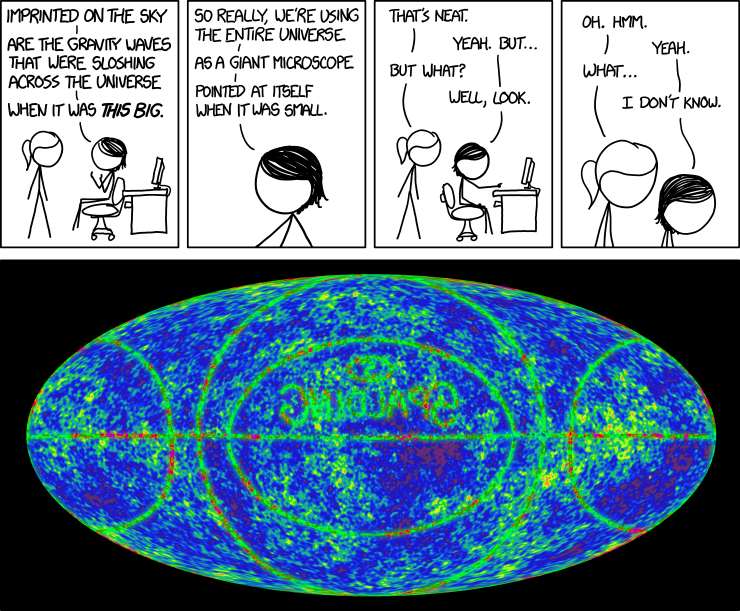
Hidden messages

If the universe contains hidden messages for us, what are those messages?

Perhaps they are messages about aesthetics:

But since we see the world as it currently is as a figure for how everything works, it's more likely that the messages are about branding.


Wednesday, May 07, 2014

Shaming and the Pop Culture Canon

A Facebook status update from a colleague here at the English Department of the University of Basel:
genuine shock and dismay that only 50% of my class has seen Star Wars!!!!
My comment (among the others that had already commented):

For years now (decades even), I have joked with students that it's okay to have never read "Hamlet" but it's not okay to have never seen "The Wizard of Oz." And until just now, I've always meant it as a joke.

But your status here made me realize that there's something more serious going on: in contemporary culture, there's no particular reason to have not "done" any particular traditionally canonical work, be it "Hamlet" or "The Odyssey" or "Pride and Prejudice." If you haven't, oh well, you haven't.

But if no excuse is necessary for not being up on the "high culture" canon ("high culture": for lack of a better term), there is still no excuse for not being up on the "pop culture" canon. Failure to have kept up with that canon is now the acceptable location of cultural shaming.

In short, the proper response to those 50% is not to joke with them about not seeing "Hamlet" or the like—the proper response is to shame them as an earlier generation of professors would have shamed those who exposed their ignorance about the classic canon of literature and art.

(I'll leave it to you to decide whether this is yet another joke. Who can tell, after all, when Shields starts talking like this, just how serious he is actually being?)