One conclusion in my course on short fiction by James Joyce, Franz Kafka, and Virginia Woolf is that the three authors all take up a characteristic position in their stories: Woolf in a chair; Kafka at a window; Joyce in the street. Kafka is thus in the position dubbed "the watcher at the window" by Henry James, which can also be connected to Michel Foucault on Jeremy Bentham's panopticon. Joyce's position is that of Charles Baudelaire's "flaneur". Woolf's chair surely stands in "a room of one's own", but as one student suggested, the chair is also the position of René Descartes, given how her characters spin out philosophies from their chairs. (Andrew Shields, #111words, 14 June)
Sunday, June 14, 2020


Saturday, June 13, 2020
Nostos, saudade, nostalgia
In "The Age of Surveillance Capitalism", Shoshana Zuboff introduces the Greek "nostos" (returning home) in her discussion of the contemporary loss of the home – that is, of privacy. Then she talks about the homesickness of emigrants in terms of the Portuguese "saudade". Although she doesn't refer to this as "untranslatable", it does often come up in lists of such words, even as it promptly gets translated (just not with one word). But she did not need to reach for the Portuguese word to discuss the pain of "nostos"; that word is the root of "nostalgia", which was coined in Basel in 1678 by Johannes Hofer as a Latin term for "homesickness". (Andrew Shields, #111words, 13 June)
Friday, June 12, 2020
"Brazenly and flagrantly violated the separation of powers": the 2020 Republican Party platform
The Donald Trump campaign and the Republican Party have no new platform for the 2020 presidential election campaign; instead, they are re-using the 2016 platform. Oddly, some of the language of that platform refers again and again to "the current Administration", as in this sentence that is quite ironic in 2020: "The current Administration has exceeded its constitutional authority, brazenly and flagrantly violated the separation of powers, sought to divide America into groups and turn citizen against citizen." Beyond the farce this makes of the platform, the Republican Party thus reveals that it has nothing more to offer to Americans than sustaining its own power and maintaining its cult of personality. (Andrew Shields, #111words, 12 June)
The quotation is on page 9 of the 2016 platform, which is available here.
Thursday, June 11, 2020
Spoilers and Virginia Woolf's "The Mark on the Wall"
Virginia Woolf's "The Mark on the Wall" begins when the narrator sees that mark, continues with her reflections on it, and ends when it has been identified as a snail. It is thus broadly like a detective story: there is a mystery, and when it's solved, the story ends. If that were all, then my revealing that the mark is a snail would be a spoiler. But spoilers are only a problem with narratives whose linear focus on plot makes them only worth reading once. The mark of the great mystery story – and a great story in general – is that it's worth reading even if you know the snail did it. (Andrew Shields, #111words, 11 June)
Wednesday, June 10, 2020
"Indian ponies" in James Wright's "A Blessing"
The two horses in James Wright's "A Blessing" are "Indian ponies", which admits the displacement of Native Americans into the poem's evocation of a moment of communion with nature. The history of European expansion is even present in those very horses, a species brought to North America by Europeans, as well as in the demarcation of the land that is inscribed in the space of this "blessing": the poem begins "just off the highway", and after the speaker and his friend see the ponies, they "step over the barbed wire into the pasture." The speaker thus experiences communion with a nature whose history leaves traces in the representation of that experience. (Andrew Shields, #111words, 10 June)
Tuesday, June 09, 2020
"Let us have no political discussion on this day of all days in the year"
At Christmas dinner in James Joyce's "A Portrait of the Artist as a Young Man," an argument begins about priests making political remarks in church. Stephen Dedalus's mother appeals to the holiday as a reason to put politics aside: "[...] let us have no political discussion on this day of all days in the year." Her call for a space and time outside of politics, though, is itself inescapably political. What is left after the bracketing of politics will always only be the politics of the status quo, of common-sense "normalcy", even in a time of political crisis (here, the fall of Irish nationalist leader Charles Parnell after he committed adultery). (Andrew Shields, #111words, 9 June)
Monday, June 08, 2020
Dieser Trump ist blödianisch / Trump is weirdiotic!
Four years ago today, on 8 June 2016, I quoted my then ten-year-old daughter Sara on Facebook: "Sie [Hillary Clinton] muss gewinnen, weil dieser Trump ist blödianisch!" As my wife translated: Clinton had to win because "Trump is weirdiotic!" These days, whenever I come across the idea that Trump's critics suffer from "Trump Derangement Syndrome", which makes it impossible to judge him neutrally, I remember Sara's remark as one of many in 2015 and 2016 about the dangers of a Trump presidency. He was impossible to look at neutrally from the moment he came down that escalator at Trump Tower on 16 June 2015 to spew out his spiel about Mexicans. (Andrew Shields, #111words, 8 June)
Sunday, June 07, 2020
Face masks and protective lenses
Donald Trump won't wear a face mask – at least in public. He has claimed to wear them "backstage" but not in public because he doesn't want the media to make a big deal out of it. It's a game of appearances and a matter of control: he wants to be seen to be the master of any situation he is in. During the 2017 total eclipse, he looked at the sun without protective glasses. Even though he did eventually put a pair on, he made it something he controlled, rather than something imposed upon him. To wear a face mask, then, would be to admit he's lost control of the situation. (Andrew Shields, #111words, 7 June)
Saturday, June 06, 2020
A Black Lives Matter demonstration in Basel, 6 June 2020
At today's Black Lives Matter demonstration in Basel, the organizers insisted that only Blacks should speak. With two exceptions I saw, this condition was accepted. First, a white man asked an organizer for a chance to speak before quietly giving up. Soon after, a white woman spoke to the same organizer and was quite vocal when she gave up. That organizer later urged white demonstrators to accept their silence and added that she'd appreciate not having to say "no" again. I appreciated that the white demonstrators almost all accepted this opportunity to listen to the Black speakers talk about racism in Switzerland and what it means to say Black Lives Matter. (Andrew Shields, #111words, 6 June)
Friday, June 05, 2020
"Himself, his name and where he was"
On a walk the other day, I listened to an audiobook of James Joyce's "A Portrait of the Artist as a Young Man". I read it in spring 1983 during my first year at university; it was one of the works that steered me from physics to literature. But I hadn't read it since, and I wondered how much I'd remember. The walk was long enough to get me to a forgotten passage that quite vividly took me back to my youthful enthusiasm for the novel – when Stephen reads what he'd written in "the flyleaf of the geography": "himself, his name and where he was," all the way to "the Universe". (Andrew Shields, #111words, 5 June)
Stephen Dedalus
Class of Elements
Clongowes Wood College
Sallins
County Kildare
Ireland
Europe
The World
The Universe
Thursday, June 04, 2020
Texts in lines are poems
Here's how I distinguish prose and poetry: prose is organized in paragraphs, poetry in lines, so texts in lines are poems. (This doesn't explain "prose poetry".) With meter, something's counted: usually syllables or stresses. When you've counted up what's being counted, you start a new line. When lines aren't determined by counting, it's less clear where they should end. They can follow syntax and end with sentences, clauses, or phrases. If that's all they do, the poem can seem flat, but if they always break syntactical units, that can seem arbitrary. Still, meter also drags if it's too static, and stumbles if it's too variable. The rest is reading, and practice. (Andrew Shields, #111words, 4 June)
(A friend asked me to explain why a particular text was a poem; this is an adapted version of my answer to him.)
Wednesday, June 03, 2020
"You have to dominate"
In President Trump's conference call with governors on Monday, he advised them to "dominate" demonstrators: "If you don’t dominate, you’re wasting your time." Such "domination" involves effective and efficient action to achieve a desired result. But it's also about appearance: those who fail to dominate look like "jerks" and "fools" who are themselves "run over" – dominated – by the protestors. To avoid being a jerk or a fool himself, Trump aims to make those he dominates into jerks and fools. For him, the dominant person controls the situation and himself; the dominant person is wise; the one who is dominated is foolish; and all that matters is the efficient and effective result. (Andrew Shields, #111words, 3 June)
"You have to dominate, if you don’t dominate you’re wasting your time. They’re going to run over you, you’re going to look like a bunch of jerks. You have to dominate. [...] You’re making a mistake because you're making yourselves look like fools."
Tuesday, June 02, 2020
The Brave Space
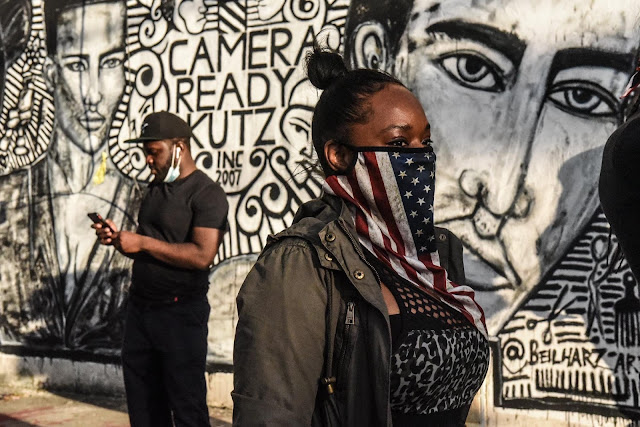
Camera Ready Kutz is a Brooklyn barbershop "geared towards, but not exclusive to, the LGBTQIA community". Outside is a black-and-white mural in the background of Stephanie Keith's photograph from yesterday's demonstration; the foreground is a woman in a mask made out of an American flag. The red-white-and-blue stands out in this black-white-and-brown scene: the black-and-white mural; her brown skin with the sun on her forehead; the brown skin of the man in black behind her, his white mask under his chin. This is the "brave space" of the barbershop, of the demonstration, of this American woman, brown in a land that makes her black, but claiming the red-white-and-blue as her own. (Andrew Shields, #111words, 2 June)
Monday, June 01, 2020
And 'Yesterday, or Centuries Before'
The two heroic couplets in the first stanza of Emily Dickinson's "After great pain, a formal feeling comes" begin with substitutions of spondees for iambs in the second foot (plus a trochaic substitution in the first foot of the poem's first line), while the second lines of each couplet pick up on the regular iambic pentameter of the end of the first lines. But even that regularity has its ambiguities. Line four, especially, with its two three-syllable words with first-syllable stress, can be read to great effect with only three strong stresses: "And YESterday, or CENturies beFORE." This rhythm echoes the line's point about the elasticity of time "after great pain". (Andrew Shields, #111words, 1 June)
Third post on the poem here (this is the fourth).
Sunday, May 31, 2020
"Touching but meaningless" or "meaningless but touching" – in search of a phrase from W. G. Sebald
After coincidences, I quote W. G. Sebald – "touching but meaningless" – or was it "meaningless but touching"? And where did Sebald say that? This morning, a search for the German, "bedeutungslos aber berührend", led me to a blog post by Pierre Joris – with the "Austerlitz" quotation in a comment I myself had written! Anthea Bell translated this as "entirely insignificant in itself but nonetheless [...] curiously moving", so I could now start saying "insignificant but moving". But while both "insignificant" and "meaningless" work for me, I prefer how "touching" makes the experience of coincidence a matter of sensation, of the sense of touch. These distinctions are themselves perhaps "insignificant" but still "touching". (Andrew Shields, #111words, 31 May)
Im Verlauf meiner weiteren Beschäftigung mit den Skizzenbüchern und dem Leben Turners bin ich dann auf die an sich völlig bedeutungslose, mich aber nichtsdestoweniger eigenartig berührende Tatsache gestoßen, dass er, Turner, im Jahr 1798, auf einer Landfahrt durch Wales, auch an der Mündung des Mawddach gewesen ist und dass er zu jener Zeit genauso alt war wie ich bei dem Begräbnis von Cutiau. (W. G. Sebald, "Austerlitz")
During my subsequent studies of Turner's life and his sketchbooks I discovered the fact, entirely insignificant in itself but nonetheless one I found curiously moving, that in 1798 he, Turner, had himself visited the estuary of the Mawddach on a journey through Wales, and that at the time he was exactly the same age as I was at the funeral in Cutiau. (translation by Anthea Bell)
Saturday, May 30, 2020
Dehumanization without dehumanizing language: "I'm going to tell them there's an African-American man threatening my life"
"I'm going to tell them there's an African-American man threatening my life", said Amy Cooper to Christian Cooper in Central Park on Monday, 25 May. If "African-American" is a neutral term, then in doing the racist thing – calling the police when "an African-American man" challenged her – she repeatedly used language that isn't considered racist at all. She was able to appeal to structural racism without offensive language. One of Terrance Hayes's "American Sonnets for My Past and Future Assassin" imagines how "[e]ven the most kindhearted white woman" could "chant inwardly" along to the n-word in hiphop. She might then angrily use it – but Amy Cooper didn't. Dehumanization doesn't require dehumanizing language. (Andrew Shields, #111words, 30 May)
Friday, May 29, 2020
Forms in Dickinson's "After great pain"
With its iambic pentameter and AABB rhymes, the first stanza of Emily Dickinson's "After great pain, a formal feeling comes" reads like heroic couplets. Its discursiveness could even fit into an imaginary Alexander Pope poem, "Essay on Pain". The second stanza then shifts to five iambic lines of 4, 2, 3, 2, and 4 feet, with internal rather than end rhymes. But if the stanza had followed them as AABB, it would have had iambic lines of 4, 3, 4, and 4 feet, with the unexpected four feet in the last line disrupting the common meter. The poem's "formal feeling", then, is a feeling for forms being explored for "great pain". (Andrew Shields, #111words, 29 May)
Thursday, May 28, 2020
Wrapping up the "111 Words" course
Today is the last day that the students in my course "111 Words a Day: A Writing Project" have to write their daily text. Their writing has developed incredibly quickly in the course of the past 14 weeks. After I had gone over some of their early texts to highlight ways to make their writing more precise, concise, clear, and convincing, the daily practice led them to a wonderful combination of those goals and their increasingly individual styles. If they can take what they've learned from this project and apply their newly developed skills and styles to their papers for the university, then the course will have been a complete success. (Andrew Shields, #111words, 28 May)
Wednesday, May 27, 2020
"The stiff Heart questions" in Dickinson's "After great pain"
The third line of Emily Dickinson's "After great pain, a formal feeling comes" does not settle into the steady iambic pentameter the second line seems to have established but returns to a variation on the stress pattern of the first line: "The stiff Heart questions" does not reproduce the initial troche of line one, but the second foot is again a spondee. The heart's questioning is thus linked to the "great pain" of the first line: it may come after that pain, as the "formal feeling" does in general, but that feeling has to return to the form it first gave to the pain in order to formulate its "stiff questions". (Andrew Shields, #111words, 27 May)
Tuesday, May 26, 2020
After "After great pain"
"After great pain, a formal feeling comes": after the comma in the first line of Emily Dickinson's poem are three iambic feet. But before that, "after" has first-syllable stress, so the first foot is a trochee. One can experiment with the stress of "great pain" (as I just did while writing this), but only one reading makes sense: a spondee, with both syllables equally stressed. As the next line continues with the iambic pattern of the end of the first line, the poem's own "formal feeling" – its "mechanical feet", to paraphrase the fifth line – is only established after the phrase "after great pain". That is, the form acts out the content. (Andrew Shields, #111words, 26 May)
Monday, May 25, 2020
Getting out of one's chair in Virginia Woolf short stories – or not
In Virginia Woolf's "The Mark on the Wall", the narrator never gets up from her chair to identify that mark. In "The Lady in the Looking-Glass: A Reflection", "one" also never gets up to see outside without the help of the mirror. But in "A Haunted House", "one" puts down one's book and gets up to see what's haunting the house. If this search is at first as fruitless as the narrator of "The Mark on the Wall" expects such projects to be, a first-person speaker later wakes up and understands what the ghosts were communicating to her. An answer is found – but not because one gets up from one's chair. (Andrew Shields, #111words, 25 May)
Sunday, May 24, 2020
Reading John Ashbery for two-and-a-half years
On 14 October 2017, I read John Ashbery's poem "Two Scenes", which opens his 1956 debut "Some Trees", and posted a quotation from it on Twitter and Facebook: "From every corner comes a distinctive offering." From then until today, with only a few missed days, I have been reading and posting quotations from the two volumes of Ashbery in the Library of America editions, and today I read and quoted from "The Lyricist", the last previously uncollected poem at the end of "Collected Poems 1991-2000": "So I was bewildered, OK?" It's been wonderful to follow the development of Ashbery's "distinctive offerings" and be pleasantly "bewildered" by their humor "from every corner". (Andrew Shields, #111words, 24 May)
Saturday, May 23, 2020
"Le Livre des Questions," by Edmond Jabès
I began reading Edmond Jabès' "Le Livre des Questions" in October, 2018, in a one-volume edition of its three books, a few lines or pages a day, occasionally with a few days without picking it up. I'd read the first book in Rosmarie Waldrop's translation back in the 1980s and was delighted to return to Jabès' unique style. I finished it a few days ago, but I also recently discovered that there is another one-volume edition of four more books that also belong to this series! I'll return to it someday, but for now, for my French reading, I've decided to turn to a giant anthology of French poetry from 1960-2010. (Andrew Shields, #111words, 23 May)
Friday, May 22, 2020
The authoritarian mind in Virginia Woolf's "Solid Objects"
In Virginia Woolf's 1920 short story "Solid Objects", the movement of John's mind from his moment of immediacy with a "lump" of beach glass to the return of mediation in the form of kitsch as he imagines possible origins for the "gem" resembles the workings of movements emerging when the story was published. First, history and politics are rejected in favor of a direct experience of the world beyond all partisan interests; then, the desire for an origin story arises to fill the gap left behind by that rejection; finally, history and politics return in their simplest forms with heroes stripped of tragedy and authoritarian leaders of the whole "imagined community". (Andrew Shields, #111words, 22 May)
[A continuation of my previous post on "Solid Objects", which was a continuation of my first such post, so that makes three in all.]
Thursday, May 21, 2020
Kafka, translator of Joyce
In 1931, the Frankfurter Zeitung published a story attributed to James Joyce, but it was actually by Michael Joyce. The newspaper blamed the translator; the translator blamed her secretary; even Michael wrote James an apology. The translator's name was Irene Kafka. In part because of my course this term (Joyce, Kafka, Woolf), I tried to find out some things about her: she lived in Vienna; she translated French and English literature, including Julien Green and Agatha Christie; she might have been a cousin of Franz Kafka. And as these stories end all too often in Central Europe in the early part of the twentieth century, she died in Ravensbrück in 1942. (Andrew Shields, #111words, 21 May)
Wednesday, May 20, 2020
From immediacy to kitsch in "Solid Objects"
As John in Virginia Woolf's "Solid Objects" digs into the sand, he discovers a "lump of glass" he finds fascinating. When he wonders about its origin, he imagines it is "really a gem" that could have been "worn by a dark princess" or an emerald from "a sunk Elizabethan treasure-chest." So with his focus on unmediated experience, the only origin story he can imagine is a generic romance or adventure. At the same time, the political world that John just "damned" returns through the royalty of the Princess and through the era named after its Queen. Instead of a "background of thought and experience", he's left with aesthetic and political kitsch. (Andrew Shields, #111words, 20 May)
[A continuation from the previous post on "Solid Objects“.]
Tuesday, May 19, 2020
"An inscrutable depth" and a "clear transparent surface" in Virginia Woolf's "Solid Objects"
In Virginia Woolf's "Solid Objects", the young politician John's first words are a dismissal of his profession: "Politics be damned!" When he then "burrows" his hand into the sand of the beach he's on, the expression in his eyes changes: "[...] the background of thought and experience which gives an inscrutable depth to the eyes of grown people disappeared, leaving only the clear transparent surface, expressing nothing but wonder, which the eyes of young children display." As John "damns" the "inscrutable" world of adulthood, of politics and history, he experiences a childlike "wonder" unmediated by any "background". But this apolitical, "surface" immediacy only leads to the return of "depth" as kitsch. (Andrew Shields, #111words, 19 May)
Monday, May 18, 2020
"It is the wish of the majority to arm themselves with the weapons of the minority"
"It is the wish of the majority to arm themselves with the weapons of the minority," writes Natascha Strobl, a political scientist who specializes in right-wing extremism. In one example that immediately crossed my mind when I read Strobl's aphorism, white Americans respond to accusations of racism by claiming that people of color are the actual racists. Further, Strobl's observation clarifies why anti-lockdown protestors keep stylizing themselves as oppressed people and comparing themselves to those murdered by the Nazis during the Holocaust. The majority sees the "minority" as using the concept of oppression as a "weapon" to defend themselves, so they pick up that weaponto challenge whatever threatens their majority status. (Andrew Shields, #111words, 18 May)
Es ist der Wunsch der Mehrheit sich mit den Waffen der Minderheit zu bewaffnen. (Natascha Strobl)
Sunday, May 17, 2020
"Corona is spread invisibly through the air"
The flyer in my mailbox says that coronavirus is "the biggest lie in the world". All the demonstrators around the world seem to agree, and they might well share the flyer's xenophobia: "Corona was introduced by foreigners and asylum seekers!" But this particular variant has a local spin unlikely in Lansing or London: "Basel pharma companies are behind it!" Apparently, Roche and Novartis introduced the virus to make money with a vaccine. So many of the flyer's statements are absurd that it even makes something true sound like paranoia: "Corona is spread invisibly through the air." – Yes, and the viruses of xenophobia and fascism are spread visibly by flyers into mailboxes. (Andrew Shields, #111words, 17 May)
Saturday, May 16, 2020
"If only in one line of unwritten poetry" (Virginia Woolf, "The Waves")
On his way home from boarding school for the summer, Louis in Virginia Woolf's "The Waves" imagines resisting the transience of his individual life with poetry. Even just one unwritten line would position the passing moment in the grand sweep of history all the way back to Egypt. With poetry, he can imagine the Egyptian women who "carried red pitchers to the Nile"; if he could transform his train journey into a poem, then his experience "in a third-class railway carriage full of boys going home for the holidays" would also be part of that shared, imaginable history – one in which, apparently, the women work and the men go on journeys. (Andrew Shields, #111words, 16 May)
I should be transient as the shadow on the meadow, soon fading, soon darkening and dying there where it meets the wood, were it not that I coerce my brain to form in my forehead; I force myself to state, if only in one line of unwritten poetry, this moment; to mark this inch in the long, long history that began in Egypt, in the time of the Pharaohs, when women carried red pitchers to the Nile. I seem already to have lived many thousand years. But if I now shut my eyes, if I fail to realize the meeting-place of past and present, that I sit in a third-class railway carriage full of boys going home for the holidays, human history is defrauded of a moment's vision. (Virginia Woolf, "The Waves")
Friday, May 15, 2020
"Did someone think we didn't have souls?"
In Kazuo Ishiguro's "Never Let Me Go," the Hailsham teachers send the best art by the pupils to a mysterious "Gallery". Only as adults do Kathy H. and her friend Tommy D. find out why: "We took away your art [...] to prove you had souls at all." Kathy is puzzled: "Did someone think we didn't have souls?" – The Hailsham students are clones raised to be organ donors, and the "normal people" deny their humanity. And works of art created by the dehumanized will never be accepted as proof they have souls. Or in coronavirus terms, who is being dehumanized to justify the sacrifice of their lives for the community's survival? (Andrew Shields, #111words, 15 May)
Thursday, May 14, 2020
If I were as tall as they?
The first two lines of Emily Dickinson's "Will there really be a 'morning'" (148) establish trochaic tetrameter as the poem's meter (with the final unstressed syllable of the second line omitted to form a "tailless" or "catalectic" line). The next two lines can easily be read the same way in a fairly neutral tone. Yet in both lines, the opening trochee could also be inverted to put a quite convincing stress on "I" that implies that the speaker wonders if she, too, could do what others do. This alternative emphasis adds a personal urgency to the question that reflects back on the first two and makes them seem less neutral, too. (Andrew Shields, #111words, 14 May)
Will there really be a "morning"?
Is there such a thing as "Day"?
Could I see it from the mountains
If I were as tall as they?
Wednesday, May 13, 2020
Medicines or Natural Remedies?
A pharmacy in Basel had a sign in their window: "Medikamente oder Naturheilmittel?" – "Medicines or Natural Remedies": This choice is also a sales pitch to appeal both to those who prefer "medicine" and those who prefer "complementary and alternative medicine", which would include such "natural means of healing" (to translate each word in that German compound). The provision of "alternatives" makes the pharmacy look open-minded, of course. But if this alternative obscures how any "natural remedy" can always be reclassified as "medicine" as soon its efficacy and safety have actually been demonstrated, it also betrays the fact that marketing, not medicine, is the essence of the "natural remedy" or "alternative medicine". (Andrew Shields, #111words, 13 May)

Subscribe to:
Posts (Atom)
